
A standard soccer game lasts 90 minutes, divided into two 45-minute halves, with a 15-minute halftime break.
Ever wondered how long soccer games last? It’s a common question for both new fans and those vaguely familiar with the sport. The duration of a match affects everything from player strategy to fan experience.
Understanding the basic timing helps appreciate the flow and intensity of the game. You will find that the official time includes additional time added to each half for stoppages.
It is always important to check any special rules or guidelines of the league you’re watching as it may vary slightly. We hope this clears up the question of how long soccer games last.

How Long Does a Soccer Game Last?
Okay, so you’re curious about how long a soccer game actually lasts? That’s a great question! It might seem like they go on forever when you’re watching a really exciting match, but there’s actually a pretty standard length. Let’s break down all the details so you know exactly what to expect when you tune in or head to the field. It’s not just a simple answer; there are a few things that can affect the total time. We’ll look at everything from the official time to those sometimes tricky additions!
The Official 90 Minutes: The Heart of the Game
The most important thing to know about how long a soccer game lasts is that the official playing time is 90 minutes. This is broken into two halves, each lasting 45 minutes. So, you’ve got 45 minutes of action, a short break, then another 45 minutes of play. This is the standard you’ll find in most professional matches, international tournaments, and even many youth leagues. It’s the basic framework of how long a soccer game should last.
The Halftime Break: A Quick Rest
Between those two 45-minute periods, there’s a pause called halftime. This gives the players a chance to catch their breath, grab some water, and talk strategy with their coaches. Halftime is usually about 15 minutes long. It’s a pretty short break, but it’s enough time for the teams to regroup before heading back onto the field. This halftime period is really important for the players’ stamina and the flow of the game.
Understanding Added Time: Injury Time and Stoppages
Now, here’s where things can get a bit more interesting. The official 90 minutes isn’t always the final word on the clock. Referees can add extra time at the end of each half. This extra time is sometimes called “stoppage time” or “injury time.” These moments really can affect how long a soccer game lasts.
Why is Added Time Necessary?
Several things cause added time. These can include:
- Injuries: If a player gets hurt and needs medical attention on the field, the clock stops. The referee adds this time back at the end.
- Substitutions: When a player comes off the field and another goes on, that time also gets added on.
- Wasting Time: Sometimes, a team might intentionally slow the game down, especially if they’re winning. Referees can add time for this.
- Other Delays: Any other significant stops in play (like equipment issues) can cause added time.
How is Added Time Determined?
The referee keeps track of all these pauses during the half. At the end of the 45 minutes, the ref signals how much extra time will be played. The time can be a little different each half and each game. It is not always a fixed length of added time that is added every single game.
It’s important to know that added time isn’t a perfect calculation. The referee’s judgment plays a big role in how long soccer game last. It is an estimate based on all the stoppages during the play time.
Variations in Game Length: Not Always 90 Minutes
While the standard is 90 minutes, there are some differences you’ll see depending on the type of game. We need to consider the length of soccer games across different age groups and competition formats.
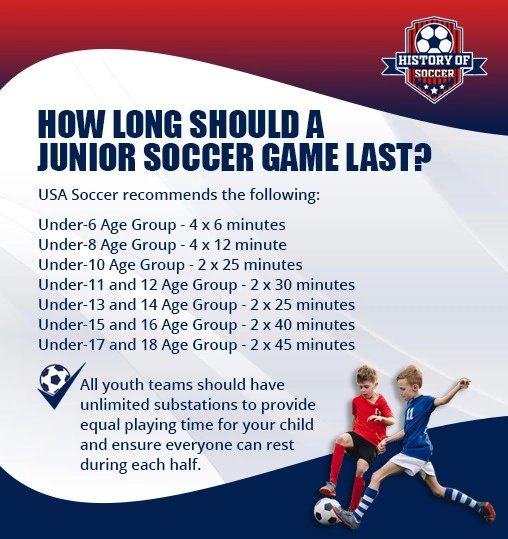
Youth Soccer: Shorter Game Durations
For younger players, the games are usually shorter. This helps make sure kids don’t get too tired and that the game is appropriate for their age and fitness levels.
- Under 6-8 Years Old: Games are often around 40-50 minutes, split into shorter halves (like 20 or 25 minutes each).
- Under 10-12 Years Old: You’ll see games around 60-70 minutes long, with halves lasting about 30-35 minutes.
- Under 14-16 Years Old: Games can be 80 minutes, sometimes closer to the full 90, with 40-minute halves.
Indoor Soccer: A Different Tempo
Indoor soccer, often called futsal, is played on a smaller court with smaller teams. Games here are usually shorter too, lasting around 40 minutes, which are often divided into 20-minute halves. The style of play is generally faster paced. The changes in court size and player count have a big impact on the time of the game.
Special Competitions: Extra Time and Penalties
In certain important tournaments and matches, especially in the knockout stages, a game that is tied after 90 minutes might go to extra time. This extra time usually involves two 15-minute halves. If the score is still tied, they might proceed to a penalty shootout to determine the winner. These extra periods mean the game can go way beyond the usual 90 minutes.
How Long Does a Soccer Game Last: A Quick Table
Let’s summarize with a table that can give you a quick overview of how long soccer game last:
| Type of Game | Regular Time | Halftime | Typical Total Time (Including Added Time) | Notes |
|---|---|---|---|---|
| Professional/Adult | 90 minutes (2 x 45 min halves) | 15 minutes | Approx. 1 hour 45 mins to 2 hours | May include added time. Can extend to extra time + penalties in knock-out matches. |
| Youth (Under 6-8) | 40-50 minutes (2 shorter halves) | 5-10 minutes | Approx. 50-60 minutes | Shorter game length to suit young players. |
| Youth (Under 10-12) | 60-70 minutes (2 x 30-35 min halves) | 10 minutes | Approx. 70-85 minutes | Longer than younger games, preparing for full length games |
| Youth (Under 14-16) | 80 minutes (2 x 40 min halves) | 10-15 minutes | Approx. 90-100 minutes | Closing in on adult full length games |
| Indoor/Futsal | 40 minutes (2 x 20 min halves) | 5-10 minutes | Approx. 45-55 minutes | Faster pace, smaller playing area. |
| Extra Time (knockout matches) | 30 minutes ( 2 x 15 minute halves) | No Halftime Between halves | Total time depends on how much added time is added and if penalties are needed. | Added to regular time when a match is tied after 90 minutes |
The Flow of Time: Beyond the Numbers
It’s important to remember that the game’s clock keeps going, but what happens within that time can change the experience for each fan and player.
The Impact of Momentum
Sometimes, a game will feel like it’s going by really fast. This can be when there are many scoring opportunities, goals are scored, and constant movement. When the game is gripping, you might find yourself wondering where the time went. On the other hand, when a team is playing defensively and there’s not a lot of action, the clock can seem slow. These changes in pace are natural parts of any soccer game.
What About Half Time?
Halftime is a really important part of the match. It gives players a chance to rest, review what’s been going well or what needs fixing, and then to go out for the second half fresh. Fans might also use this time to discuss the game, grab a snack, or maybe visit the restroom.
The Added Time Experience
The added time at the end of each half can be a nerve-wracking moment. It can be very tense for fans of both sides, as the extra minutes can allow a team that’s losing to score or a team that’s winning to hold out. This period is really important because it means that the game is not over until the final whistle.
Final Thoughts on Game Length
Knowing how long a soccer game lasts is not just about numbers. The time includes breaks, potential extra periods, and constant action, all of which add to the overall excitement. Whether you’re a player, coach, or a fan, this understanding can improve your experience. You can be ready for all the twists and turns that a soccer game can provide. So, now you know! The next time you watch a soccer match, you’ll know what to expect, and you’ll know exactly how long you’ll be on the edge of your seat. You know that it’s not just about the 90 minutes; it’s about every moment of the game. This understanding gives us a clearer picture of the whole playing experience.
So, whether you’re cheering from the stands or playing on the field, you can appreciate the rhythm and timing that make soccer such a captivating sport.
Extended Highlights: Liverpool 2-2 Manchester United
Final Thoughts
A standard soccer match lasts 90 minutes, divided into two 45-minute halves. There is a 15-minute halftime break between those halves. This is the core duration of play.
Additional time, known as stoppage time, is added at the end of each half. Referees add this time to compensate for injuries, substitutions, and other delays. This additional time varies greatly depending on the circumstances.
Therefore, when people ask how long a soccer game lasts, they should remember the core 90 minutes, plus any added stoppage time. The actual game’s length can fluctuate, but that 90 minutes is what establishes the standard duration.

