
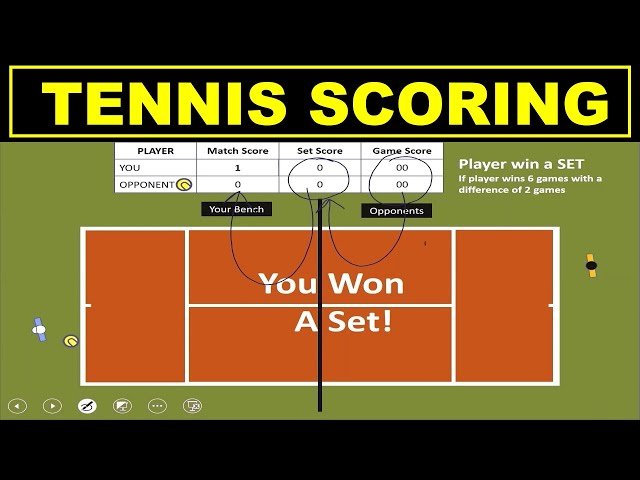
A tennis match requires a player to win at least six games in a set, and typically two or three sets to win the match.
Ever wondered how many games in a match of tennis are actually played? It can seem a bit confusing with all the sets and tie-breaks. Figuring out the total can depend on the format.
The simple answer is that a player needs to win multiple sets, often two out of three or three out of five. Each set, in turn, needs six games to be won.

How Many Games in a Match of Tennis?
Okay, so you’re curious about tennis and how many games are in a match, right? It’s a great question! Unlike some sports where the time is the key factor, in tennis, we count games and sets. It can seem a bit confusing at first, but once you get the hang of it, it’s actually pretty straightforward. Think of it like climbing a ladder – you have to win a certain number of games to win a set, and you need to win a certain number of sets to win the whole match. Let’s explore all of this in detail, so you understand how many games make up a tennis match and why it’s structured the way it is.
Understanding the Basics: Points, Games, and Sets
Before we dive into the total number of games, let’s quickly review how a tennis match is structured. It’s all about points turning into games, and games turning into sets. Imagine it like building blocks, with the smallest block being a single point.
From Points to Games
Tennis uses a unique scoring system for points within a game. Here’s how it goes:
- Love: This means zero points. So, if the score is “love-15,” it means one player has zero points and the other player has one point.
- 15: The first point a player scores.
- 30: The second point a player scores.
- 40: The third point a player scores.
- Game: A player wins a game by scoring the fourth point after scoring 40, but they have to win by at least two points. If the score reaches 40-40 (also called “deuce”), then someone must win two consecutive points to win the game.
The goal is to win enough points to win the game. Winning a game is the first step in winning a set.
Games to Sets
Okay, so you understand points make games, now let’s see how games make sets. In tennis, a set is a collection of games. Typically, the first player to win six games wins the set, but there’s a catch.
- Standard Set: To win a standard set, a player needs to win at least six games and have a lead of at least two games. This means you can win with scores of 6-0, 6-1, 6-2, 6-3, or 6-4.
- Tie-Break: If the score in a set reaches 6-6, most of the time, we have a tie-break. The tie-break is a special mini-game that determines the winner of the set. In a tie-break, the first player to reach seven points (winning by two points) wins the set.
So, when we talk about how many games in a match, we’re really talking about how many sets a player needs to win, and each set consists of many individual games.
Different Match Formats Affect Game Count
Now that we know the building blocks of tennis scoring, we need to talk about match formats. The number of sets a player needs to win changes the total games played in a match dramatically. The two most common formats are best-of-three sets and best-of-five sets.
Best-of-Three Sets
This is the most common format you’ll see, especially in most women’s professional tournaments and many amateur matches. In a best-of-three set match:
- A player needs to win two sets to win the match.
- The minimum number of games is 12, if the scores are 6-0, 6-0, meaning the winner did not lose a single game.
- A long match can go up to 39 games, if the set scores are something like 7-6, 6-7, 7-6.
Therefore, the number of games in best of three set matches can greatly vary. Usually, the number of games in these matches range from around 18 to 30 games.
Best-of-Five Sets
This format is mainly used in the men’s Grand Slam tournaments (like Wimbledon, the US Open, the French Open, and the Australian Open) and the Davis Cup. In a best-of-five set match:
- A player needs to win three sets to win the match.
- The minimum number of games in a best-of-five match is 18, with scores of 6-0, 6-0, 6-0.
- The maximum number of games can be very high, especially if all five sets are close. One could see over 60 games.
Best-of-five matches often last longer and have more games than best-of-three matches, and they can be particularly exciting to watch because of the extra drama of more sets.
The Role of Tie-Breaks
Tie-breaks are like the emergency exit of a set. They’re used to prevent sets from dragging on forever when the game score reaches 6-6. Without tie-breaks, imagine matches with sets going to 8-6, or even 10-8. It would be really exhausting for the players and not very fun for the spectators. Tie-breaks add a decisive mini-game that quickly determines the set winner.
How Tie-Breaks Affect Game Count
Tie-breaks add another possible game to each set. They introduce a unique structure to the set as it reaches its ending. Here’s how they work and how they impact the total number of games:
- Points in a tie-break: The points are counted like this: 1, 2, 3… instead of 15, 30, 40 in a typical game.
- Winning the tie-break: The first player to win seven points, with a margin of at least two points, wins the tie-break and the set.
- Adding to Game Count: If a tie-break happens, it adds at least one game to the number of games in a set. Instead of ending at 6-4, the score might become 7-6, with the 7-6 being determined through a tiebreak. This adds another game to the count.
Tie-breaks help to keep the length of a match somewhat predictable, while also adding an element of excitement, because anything can happen in a tiebreak, no matter what the score is.
Average Number of Games in a Match
While the actual number of games in a match can vary quite a bit, it’s helpful to have a general idea of what to expect. Let’s look at some averages:
Best-of-Three Sets Average
In a best-of-three set match, a typical number of games falls within the range of 20 to 30. This can, of course, vary depending on how many close games there are, and if any of the sets reach a tiebreak.
- Quick Match: If one player dominates, a match can end very quickly, possibly with only 18-20 games in total.
- Close Match: A very close match with several tie-breaks could reach 30 or more games.
Best-of-Five Sets Average
In a best-of-five set match, you can anticipate a higher total number of games, usually between 35 and 50 games. These matches can get pretty long, which is why many fans enjoy watching these matches, because of the drama that often takes place.
- Dominance: If one player controls most of the game, a match may end with 35-40 games, with scores like 6-3, 6-4, 6-2.
- Epic Battle: When the players are evenly matched, matches can easily go beyond 50 games, and a very, very long match can have well over 60 games, particularly if the sets go to tie-breaks repeatedly.
These averages can help you anticipate how long a match might last and to appreciate the physical effort the players put in, especially in best-of-five matches.
Factors Influencing the Number of Games
Several different things can affect how many games there will be in a tennis match. These factors can help explain why some matches feel short and others feel like they go on forever.
Player Skill Level
If two players have very different skill levels, the match is likely to have fewer games. A more skilled player can win games and sets more easily and quickly. On the other hand, when players are equally skilled, you can expect longer matches with more games, as they battle it out for every point.
Playing Style
- Aggressive Players: Players who are very aggressive and try to win points quickly can sometimes make the matches have fewer games, by either winning quickly or losing quickly.
- Defensive Players: Players who are more defensive can often have longer rallies and more close games, which means they can make the number of games go up, and matches can take longer.
Surface Type
The surface type of the tennis court also plays a part in the game length and the number of games:
- Grass: Grass courts tend to have faster points, which means faster games and sometimes fewer games overall, because the balls will not slow down and bounce high and therefore points are decided quicker.
- Hard Courts: Hard courts are usually medium speed, allowing more balanced rallies and game lengths and overall number of games will be somewhat medium
- Clay Courts: Clay courts are the slowest, with more time for players to run around, which can lead to longer rallies and therefore more games overall.
Mental Toughness
Players who remain calm and focused under pressure are more likely to win crucial points and games. Mental strength often prevents a close match from becoming a rout. If a player gives up, or loses their focus, matches will be shorter with less games.
Weather
Even the weather can influence how a match plays out. If it’s very hot or there is a lot of wind, players may become tired sooner, which can also affect the game scores and total games.
Table Summary: Typical Game Counts
To help you remember, here is a little table to summarise what we have discussed:
| Match Format | Typical Minimum Games | Typical Maximum Games | Average Games |
|---|---|---|---|
| Best-of-Three Sets | 12 | 39 | 20 – 30 |
| Best-of-Five Sets | 18 | 70+ | 35 – 50 |
Remember, these are just estimates. Every match is different, and the actual number of games can vary quite a bit based on what is happening on the court!
So, to answer the question of “how many games in a match of tennis,” it varies considerably. While the minimum is 12 games, many matches can go much longer. The total games are determined by sets and within those sets, how many games it takes to win those sets. Factors such as player skill, style of play, surface, weather, and mental toughness influence the total number of games in any given match. That’s why, for fans and players alike, every tennis match is like its own story, and the number of games is a part of that story. Each game, set, and match is unique and unpredictable. It’s part of what makes tennis such a captivating sport.
The Rules of Tennis – EXPLAINED!
Final Thoughts
The number of games in a match of tennis varies. A set requires six games to win, but a player must win by two games, except tiebreakers. In a match, how many games in a match of tennis needed differs by formats. Best of three set matches require a minimum of twelve and potentially many more games.
Best of five set matches have a considerably higher minimum. Players must win more games to achieve victory. This makes the matches longer.

