
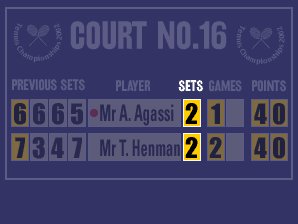
To win a set in tennis, a player typically needs to win at least six games with a margin of at least two games, or win a tie-break.
Ever wondered exactly how many games to win a set in tennis? It’s a common question for both new fans and seasoned viewers. The rules are specific but not overly complicated.
You see, generally, a player must reach six games first. However, just getting to six isn’t enough to win the set.
A player needs that two game advantage. If the score reaches 6-5, the set continues and the next game becomes the crucial point. Should the score reach 6-6, a tie-break then determines the set winner.

How Many Games to Win a Set in Tennis
Okay, so you’re watching tennis, maybe even playing, and you hear people talking about sets and games. It can get a little confusing if you don’t know the basic rules. Let’s break down exactly how many games you need to win a set in tennis. It’s not always the same number, and there are a few special situations to keep in mind. This section will explain all of that clearly, so you’ll be a tennis pro in no time when it comes to understanding how sets are won!
The Standard Set: Six Games and a Two-Game Lead
The most common way to win a set is by winning at least six games. However, simply winning six games isn’t always enough. You need to win by at least a margin of two games. This means if the score is 6-4, the player with six games wins the set. Easy enough, right? Let’s look at another example.
Imagine the score is 5-5. Neither player has reached six games, nor do they have the necessary two game advantage. In this case, you need to win two more games to win a set. If the player wins the next game, the score goes to 6-5, they are still one game short of winning the set. The other player will try to tie the set by winning next game, making it 6-6, then this goes on until there’s a two-game advantage.
Winning Scenario:
The score can be 6-0, 6-1, 6-2, 6-3 or 6-4 to win the set. In all these scenarios one player or team has reached 6 games, with a lead of 2 or more games.
Not Winning Scenario:
A score of 6-5 is not enough to win the set.
The Tie-Break: When Sets Get Tight
So, what happens if both players are really good and keep winning games back and forth? When the score reaches 6-6, we enter a tie-break. A tie-break is a special mini-game used to decide who wins the set. Instead of normal scoring, points are simply counted from 0, 1, 2, etc.
Here’s a detailed look at how a tie-break works:
First to Seven Points: The first player (or team) to reach seven points wins the tie-break, but there is a twist!
Two-Point Lead: Just like with games, you must win by at least two points to win a tie-break. If the score is 7-6, the tie-break continues.
Tie-Break Continues: If the score gets to 6-6, you still need to win two points in a row to win the tie-break. The score could reach 8-6, 9-7, 10-8, or higher.
Set Winner: The player or team who wins the tie-break wins the set. The score of the set in this scenario will be 7-6.
Why is the Tie-Break Important?
Tie-breaks were added to tennis to make matches shorter and more exciting. Imagine if you had to keep playing until someone finally got a two-game lead, it might take all day! The tie-break ensures there’s a winner after those tightly contested sets.
Advantage Sets: A Different Approach (Less Common)
While tie-breaks are the common decider now, there’s another way sets can be played called ‘advantage sets.’. In these sets, there’s no tie-break at 6-6. Instead, you simply keep playing games until one side achieves a two game advantage. Advantage sets can extend sets for a longer period of time. In some tournaments, a decision is taken to switch over to advantage set from the standard method to make the game longer and more thrilling.
No Tie-Break at 6-6: This is the main feature of an advantage set. The set continues until there is a two game advantage.
Example: If the score reaches 6-6, you would keep playing until one player wins 8-6, 9-7, 10-8, and so on.
Where You Might See Advantage Sets
You are less likely to see advantage sets in normal tennis events, because professional tennis tournaments normally use tie-breaks for the final set. However, some non-professional matches or leagues might still use the advantage set rule. For example, in some club matches or recreational play, an advantage set may be played.
The Final Set Variations: Tie-Break vs. Advantage
When it comes to the final set of a match (the third set in a best-of-three match or the fifth set in a best-of-five match), there’s another difference to be aware of. Most professional tournaments use tie-breaks for all sets, including the final set. However, some tournaments and competitions have a different set of rules for the final set.
Tie-Break in Final Set (Most Common): Most tournaments, including Grand Slams, will use a tie-break in the final set if the score reaches 6-6.
Example: If the final set score becomes 6-6, a standard tie-break is played to decide the winner.
Advantage Set in Final Set (Less Common): Some matches might use an advantage set for the final set. In this case, there is no tie-break and it simply continues until there is a two game advantage.
Grand Slam Variations
Grand Slams used to have different rules for the final set tie-break. Wimbledon used to have an advantage final set, while the other three Grand Slams had a tie-break. However, in recent times all the four Grand Slams have agreed to implement a common final set tie break format. So, even if a final set goes to 6-6, it doesn’t have to go to 12-10 or 24-22, like it was a few years ago.
Now, the Grand Slams use a super tie-break format for the final set. This means that when the score reaches 6-6 in the final set, a tie-break is played, but the tie-break is played to ten points instead of seven. In this format, the winner still needs a 2-point lead to win the tie-break and therefore the match. For example, if the score reaches 10-9, then the tie-break is not yet finished, and the player needs to reach 11, and win by a 2 point margin.
Summary: How Many Games?
Let’s make a quick recap table that will be very handy for you:
| Scenario | How many games to win a set | Tie-break at 6-6? |
|---|---|---|
| Standard Set | 6, with a two-game lead | Yes |
| Advantage Set | 6, with a two-game lead, but no tie-break. | No |
| Tie-break Set | First to 7 points (2-point lead) | No |
| Final set in Grand Slams(New Format) | First to 10 points(2-point lead) at 6-6. | Yes |
Understanding “Games” Within a Set
It’s also good to briefly touch on how games themselves are scored. This helps you understand why winning six games is such an important achievement to win a set. Let’s go into more details:
Points in a game: A game is made of points. These are scored 15, 30, 40.
Love means zero: Zero is called ‘love’ in tennis. So if the score is 30-love, it means one person has 30 points and the other person has zero points.
Deuce: If the score reaches 40-40 (or ‘40-all’) then it is known as deuce.
Advantage: When the score is deuce, the next point decides who has the ‘advantage’. If the player with advantage scores again, that player wins the game, if the other player scores, it is deuce again.
Winning the Game: To win a game, you need to get a two-point lead from deuce, or you just have to reach 4 points before the other player, if the game does not go to deuce.
Why Games Matter
Each game you win in a set builds towards your goal of winning the set. Winning a game is just as important as winning a point, as each game you win, will help you achieve the target of winning the required 6 games, to win the set.
Strategies for Winning Sets
Understanding how many games to win a set is essential. But knowing some tips and strategies for winning can help you to play better. Here are some ideas that will make you play better:
Consistency is Key: Try to make fewer mistakes. Putting the ball in play consistently is better than playing aggressive with high risk shots.
Serve Advantage: Try to win as many points when you are serving. It is easier to win points if you serve well, with more powerful shots.
Break Their Serve: If you can win points when your opponent is serving, it will give you an advantage. A break in tennis is like scoring a goal in soccer.
Stay Calm: Tennis can be a game of ups and downs. It’s important to stay calm even if you lose a game or two.
Pay Attention: Watch your opponent carefully. Look for weaknesses in their play. If they struggle with shots to the left, try to play the ball more to the left side.
Practice: There’s no replacement for practice! The more you play, the better you’ll understand game winning strategies.
The Mental Game
Tennis is not just a physical game; it’s also a mental challenge. How you approach a set mentally is very important.
Stay Positive: Believe in yourself and your abilities. Negative thoughts can cause you to miss your shot, and therefore lose the game.
Focus on the Present: Don’t dwell on mistakes you have made or think too much about the match situation. Concentrate on the next point you will play.
Set Small Goals: Instead of just thinking about winning the set, focus on winning the next game, then the next point.
Take Breaks: If you feel stressed, take a moment to breathe and refocus before playing again. It is better to calm down, and then play to win the game.
Practice Makes Perfect
The best way to learn how many games to win a set is to get out there and play! Practice those serves and returns. Pay attention to the score, and you’ll be on your way to becoming a better tennis player. Remember that tennis is not just a physical game, it is also a mental challenge, so it is very important to prepare both physically and mentally.
Ultimately, understanding the game and point system in tennis is the foundation of becoming a more skilled tennis player. Now that you have this information on how many games to win a set, you are one step closer to becoming a tennis master.
Tennis for dummies video | Tennis Scoring Explained
Final Thoughts
To win a set in tennis, you must win at least six games. Importantly, you also need a two-game lead over your opponent. A score of 6-4, for example, means you won the set.
However, if the score reaches 6-5, you must win the next game to achieve 7-5 and win the set. The tie-break comes into play if the score is 6-6. The question of ‘how many games to win a set in tennis’ has a simple answer, usually six with two game difference.
So understanding these rules is crucial. Knowing this fundamental aspect of scoring makes watching tennis more enjoyable.

