
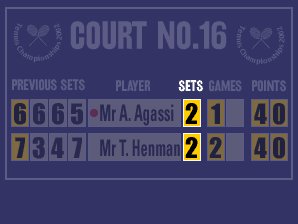
In tennis, the number of games in a match varies; a set requires a player to win at least six games, and a match typically involves winning two or three sets, thus affecting how many tennis games in a match occur overall.
Ever found yourself wondering about the structure of a tennis match, specifically how many tennis games in a match might actually be played? It can seem complicated at first.
The scoring system, with its sets and games, determines the flow of play. The number of games changes depending on how each set unfolds and how many sets you need to win the match.

How Many Tennis Games in a Match?
Have you ever watched a tennis match and wondered how many games they play? It can seem a little confusing with all the sets and tie-breaks, right? Well, let’s break it down and make it super simple to understand! The number of games in a tennis match isn’t fixed; it changes depending on a few important things. We’ll look at those things in detail to help you get a firm grasp on what’s happening on the court.
Understanding Sets and Games
First, we need to understand what a game and a set are in tennis. Think of it like building with blocks: games are the small blocks, and sets are like the bigger structures you build with those blocks.
What is a Game?
A game in tennis is a period of play where a player serves until one player scores at least four points and has at least two more points than the other player. The points in a game are counted in a unique way: 15, 30, 40, and then “game.” For example, if the score is 40-30, and the server scores the next point, they win the game. If the score reaches 40-40 (also called “deuce”), a player needs to win two points in a row to win the game. This “win by two” rule makes the game a little bit tricky and exciting.
What is a Set?
Now that we understand what a game is, let’s talk about a set. A set is made up of multiple games. The first player to win a certain number of games (usually six) wins the set, but there is another catch. A player needs to win by at least two games, for example, 6-4, or 7-5. However, if the score reaches 6-6, a “tie-break” is typically played.
The Tie-Break: When Games Get Really Close
When a set is tied at 6-6, a tie-break is used to decide who wins the set. A tie-break is a special game where players score points using regular numbers (1, 2, 3, etc), and not 15, 30, and 40. The first player to reach seven points with at least a two-point advantage wins the tie-break and therefore wins the set. For example, a score of 7-5 wins the tie-break, but if the score gets to 6-6, someone needs to win by two points (like 8-6 or 10-8, etc.).
Different Match Formats and Their Effect on Game Count
The biggest factor in how many games are played in a tennis match is the type of match being played. Tennis matches are typically decided by sets, and not just games, and there are two main formats that decide how many sets make up a match, and therefore how many games. These are:
Best of Three Sets
In a best-of-three sets format, the first player to win two sets wins the match. This format is frequently seen in women’s tennis, at junior tournaments, and many other smaller tennis events. Because the match ends after someone wins two sets, the exact number of games can vary quite a bit. A match could be over quickly if one player wins two sets easily, or it could go much longer if the players are closely matched and all three sets are played. Let’s look at some examples of game counts in a best-of-three set match:
- A quick match might be 6-2, 6-3 which would only be 17 games in the entire match.
- A close match could go 7-6, 5-7, 6-4. This match would have 35 games played in it.
- An extreme match could include a lot of close tie-breakers, perhaps 7-6, 6-7, 7-6 which would total 39 games.
Best of Five Sets
The best-of-five sets format is most common in men’s Grand Slam events and is how men’s professional tennis is mostly played. In this format, a player needs to win three sets to win the match. This means that best-of-five set matches are typically longer, and more games are played than in the best-of-three format. Let’s look at examples of game counts in a best-of-five set match:
- A very straightforward best-of-five match could be 6-3, 6-4, 6-2, and would have only 27 total games.
- A closer match could go 6-4, 3-6, 7-5, 4-6, 6-3, which has 47 total games
- An extremely close match could go the distance like, 7-6, 6-7, 7-6, 6-7, 7-6, which would have 65 total games.
Possible Range of Total Games in a Match
As you can see from the examples, the number of games in a tennis match can vary widely. Let’s examine the possible ranges of game counts for both formats.
Minimum Games
The absolute minimum number of games in a match happens when one player wins two sets quickly, without the need for tie-breaks. For a best-of-three set match, a quick win might be 6-0, 6-0 resulting in only 12 games. For a best-of-five set match it could be 6-0, 6-0, 6-0, which is only 18 games. In both instances, this is the fastest a match can end, with a total domination by one player.
Maximum Games
The maximum number of games occurs when matches go to the maximum sets, and almost every set goes to a tie-break. These are relatively rare but do happen! In a best-of-three set match, if all sets go to 7-6, the maximum total games that are possible is 39 games. In a best-of-five set match, if all sets go to 7-6, the maximum possible total is 65 games. These matches are exhausting for both players and are very thrilling for spectators.
Factors Affecting the Number of Games
Several other factors can influence the total number of games in a match, which includes player skill and playing surface:
Player Skills and Styles
The skill levels and playing styles of the players greatly influence the number of games. If one player is much better than the other, the match will typically end quickly with fewer games. However, if the players have similar skill levels, the match could be very close with many close games and tie-breaks, resulting in a higher game count. A match between two very offensive players may have short fast games, while a match between two defensive players may have long drawn out games. A matchup between these two vastly different styles, could have an unpredictable and very interesting game count.
Playing Surface
The playing surface of the tennis court also plays a role in the length of games and matches. Grass courts, like those at Wimbledon, are known for faster play, because the ball tends to skid off the court more quickly than other surfaces. This often leads to shorter rallies and quicker games, with the service game being particularly valuable on grass. Clay courts, such as those at the French Open, slow the ball down and make for longer rallies, and more breaks of serve. Therefore, you’ll see more games played on a clay court match than you might expect on a grass court match with two players of the same skill.
Other Match Rules
Some tournament events feature specific rules that can influence game count. Some tournaments may use a variation of the tie-break where the players play until they reach 10 points, and in other very rare instances, the final set is not a tie-break, but rather a traditional ‘win by two games’ scenario, meaning there is no limit to how many games that final set can have! These are very unusual situations though and don’t occur in most professional tournaments.
Average Number of Games
While it’s difficult to state an exact average, considering all the possible variables involved, we can look at what is commonly seen in matches:
- Best-of-three set matches: On average, most best-of-three set matches will range from about 20 to 35 games.
- Best-of-five set matches: Best-of-five set matches tend to have more variance, but a common range would be about 30 to 50 games.
Remember that these are just averages, and any match could easily go below or above these ranges.
Why Understanding Games is Important
Knowing how many games to expect is useful for understanding the progress of a tennis match. By understanding sets and games, you can understand the flow of the game and more easily follow the strategies of each player. Watching tennis can be much more enjoyable when you have an idea about how the game is structured, and you will have an easier time understanding when a game is close, or when a player is beginning to dominate.
So, next time you watch tennis, you’ll know what to expect in terms of games, sets, and tie-breaks! It might seem complicated at first, but with a little practice, understanding the game will become easy.
Tennis for dummies video | Tennis Scoring Explained
Final Thoughts
The number of games in a tennis match depends on how many sets a player must win. A standard match requires winning either two of three sets, or three of five sets. Each set continues until one player wins at least six games by a margin of two.
The minimum number of games is twelve in a two-set win, while a long match must require many more. Understanding ‘how many tennis games in a match’ is crucial for following along and appreciate the flow of the game. A tie-break may determine a set winner too.

