
To do rule 16 in the password game, you must include a chess notation of a checkmate. For example, “Qh7#” would satisfy the rule.
The Password Game is full of tricky rules, isn’t it? Many players stumble when they reach rule 16. It can seem quite complicated but actually, it is not difficult. We get asked so often about how to do rule 16 in the password game.
The game requires you to know basic chess notation. Specifically the notation must result in a checkmate. Once you grasp this single requirement, you’ll sail through this level with ease. Let’s get back to the fun.

How to do Rule 16 in the Password Game
Okay, so you’ve made it to Rule 16 in the Password Game – congrats! It’s a tricky one, but don’t worry, we’re going to break it down step-by-step. Rule 16 throws a curveball by asking for a specific chess move in algebraic notation. If you’re thinking, “Chess? I haven’t played that in years!” or “What even is algebraic notation?”, you’re not alone. Many players get stumped here, but with a little explanation, you’ll breeze through this rule. Let’s get started!
Understanding the Basics of Chess Notation
Before we can tackle Rule 16, we need to understand the language of chess. Think of it like learning a new code. Chess notation, also known as algebraic notation, is how we write down the moves in a chess game. It’s pretty simple once you get the hang of it.
The Chessboard Grid
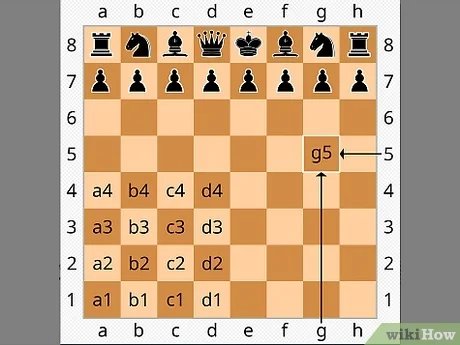
The chessboard is like a grid. It has rows (called “ranks”) and columns (called “files”).
- The ranks are numbered from 1 to 8, starting from the bottom of the board for the white player.
- The files are lettered from ‘a’ to ‘h’, starting from the left side of the board for the white player.
- Each square on the board is identified by its file letter followed by its rank number. So the bottom left square is ‘a1’, and the top right square is ‘h8’.
See it like this:

Image source: Wikimedia Commons
Identifying Chess Pieces
Each chess piece has a letter associated with it, except for pawns which are represented by the square they move to:
- King: K
- Queen: Q
- Rook: R
- Bishop: B
- Knight: N (because ‘K’ is already used for the king)
- Pawn: No letter; we only use the square it moves to.
Writing a Chess Move
To write a chess move, you need to write the piece’s letter (except for pawns) followed by the square it’s moving to.
- For example, moving a King to square ‘e4’ is written as ‘Ke4’.
- Moving a Knight to square ‘f3’ is written as ‘Nf3’.
- Moving a pawn to square ‘d4’ is written as ‘d4’.
- If a piece captures an opponent’s piece, we add an ‘x’ in between the piece and the square it captured the piece from. For example, a Queen capturing a piece on e5 would be written as ‘Qxe5’.
Decoding Rule 16’s Specific Chess Move
Rule 16 doesn’t just want any chess move; it usually asks for a specific one. The rule will give you the starting move of a particular chess opening. You will need to provide the next move of the chess opening. This means you need to be familiar with common chess opening moves. The Password Game is not trying to get you to play a whole game of chess, it just expects you to know your basic chess openings.
Common Chess Openings
Here are a few common openings you might see in Rule 16. Let’s go through some examples.
-
The Ruy Lopez: This is a super popular opening. The first few moves are:
- 1. e4 (Pawn moves to e4)
- 2. e5 (Pawn moves to e5)
- 3. Nf3 (Knight moves to f3)
- 4. Nc6 (Knight moves to c6)
- 5. Bb5 (Bishop moves to b5)
If you are given this opening in rule 16, you will need to type ‘Bb5’ in the input box.
-
The Italian Game: Another very popular opening. The first few moves are:
- 1. e4 (Pawn moves to e4)
- 2. e5 (Pawn moves to e5)
- 3. Nf3 (Knight moves to f3)
- 4. Nc6 (Knight moves to c6)
- 5. Bc4 (Bishop moves to c4)
If you are given this opening in rule 16, you will need to type ‘Bc4’ in the input box.
-
The Queen’s Gambit: This opening starts with the following moves:
- 1. d4 (Pawn moves to d4)
- 2. d5 (Pawn moves to d5)
- 3. c4 (Pawn moves to c4)
If you are given this opening in rule 16, you will need to type ‘c4’ in the input box.
-
The King’s Gambit: A risky and fun opening. The first few moves are:
- 1. e4 (Pawn moves to e4)
- 2. e5 (Pawn moves to e5)
- 3. f4 (Pawn moves to f4)
If you are given this opening in rule 16, you will need to type ‘f4’ in the input box.
How To Approach a Rule 16 Prompt
Here’s how to figure out the move required by Rule 16:
- Identify the Opening: Look at the moves given to you in the password game and identify the opening.
- Research the Opening: If you don’t know what the next move is, research the chess opening. You can easily find the next move online. Just search for the opening name followed by “chess opening moves” or similar on google.
- Type the Move: Once you know the next move, type it in algebraic notation into the password game. Make sure the capitalization of the letters is correct.
For example, if the game gives you: ‘1. e4 2. e5 3. Nf3 4. Nc6’ you would need to determine which opening this is. If you search these moves online, you will find that this is the start of the Italian Game. You can then type ‘Bc4’ into the password field.
Tips and Tricks for Rule 16
Rule 16 is tricky because it tests your knowledge of a specific subject, chess. Here are some tips and tricks to help you:
Don’t Panic
It’s a chess move, not rocket science! Break it down into smaller pieces, and it’s not as daunting as it seems.
Use Online Resources
There are so many great resources out there to help you with chess. If you don’t know the move, simply search on Google or another search engine and you will find the answer. Chess opening explorers or databases can be very useful.
Learn Key Openings
Familiarize yourself with the basic chess openings mentioned earlier. These are some of the most common ones, and knowing them makes Rule 16 much easier.
Practice Chess Notation
Practice writing some chess moves to get comfortable with the notation. It will become second nature, and you will be able to spot the moves much more easily.
Be Precise
Make sure to use correct capitalization and notation. ‘Nf3’ is different from ‘nf3’ and a different answer might be expected by the game.
Why is Rule 16 in the Password Game?
This is a good question! Rule 16 adds an element of unpredictability and complexity to the game. It’s designed to make you think outside the box and learn something new. It’s a fantastic way to introduce you to a basic chess knowledge, and to test whether you can use an external resource to find the information.
Final Thoughts on Rule 16
Rule 16 can feel tough at first, but once you get the hang of it, it becomes much simpler. Understanding chess notation and basic chess opening moves is key to conquering this rule. With a little practice and the help of some online resources, you can easily clear this hurdle in the password game. Don’t give up, you’ve got this!
How to beat the chess game / Rule 16 with zero chess knowledge (the Password Game)
Final Thoughts
Rule 16 in the password game requires entering a valid chess move in algebraic notation. You must know chess notation to get past this stage. Identify the piece and its start, and then the destination square. For example, ‘Nf3’ moves the knight to f3.
Practice common chess moves. Use online resources to learn algebraic notation if needed. Understanding basic chess will make this password game rule achievable, so you must get better before you proceed further. Knowing exactly how to do rule 16 in the password game will make this stage easier.

