
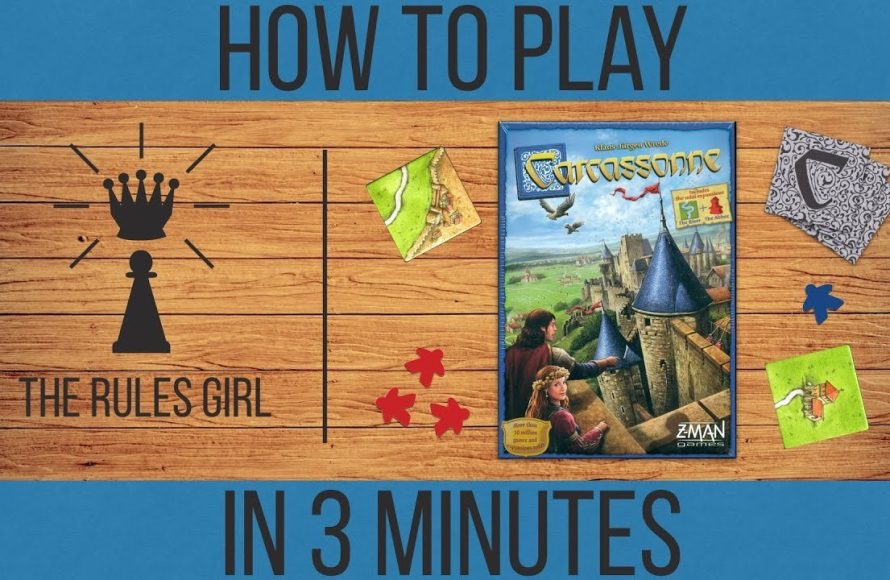
To play Carcassonne, players take turns drawing and placing tiles to build a landscape of cities, roads, and fields, deploying followers to score points based on completed features.
Ever wanted to build your own medieval landscape, one tile at a time? Then you’re in the right place! This guide will show you exactly how to play Carcassonne game, step by step.
You will learn the basic rules of placing tiles and deploying your followers, and how they help you score points by claiming features like roads, cities, and monasteries. It’s a fun and strategic game.

How to Play Carcassonne Game
Alright, let’s dive into the exciting world of Carcassonne! It’s a super fun tile-laying game where you build a landscape together, but also try to score the most points. It might sound tricky, but once you get the hang of it, it’s really easy and addictive. Think of it like putting puzzle pieces together, but with a bit more strategy and a lot more fun!
Understanding the Game Components
Before we start building our medieval landscape, let’s meet the stars of the show. Carcassonne comes with a bunch of important pieces, and knowing what they are is the first step to victory. Here’s a quick rundown:
- Terrain Tiles: These are square cardboard pieces with different features printed on them – roads, cities, fields, and monasteries. They’re the building blocks of your game.
- Meeples: These are small wooden figures, also called followers. You’ll use them to claim features on the map and earn points. Each player gets a set of meeples in their own color.
- Scoreboard: A track to keep score as you play. Usually, this is a circle around the board where you move your meeple to mark the points you scored.
The Terrain Tiles: What Do They Show?
The terrain tiles are where all the action happens. Let’s examine what you might find on each tile:
- Roads: These look like paths and often run along the edge of the tile or across it. They can be straight, curved, or end in a T-shape.
- Cities: Cities are walled areas, often with turrets or battlements. They might be small or large and have various shapes.
- Fields: These are green areas usually outside of roads and cities. Sometimes fields surround the roads and cities. They can be large and open or smaller and interrupted.
- Monasteries: These are like small buildings, usually with a cloister. They have their special rules for scoring.
- Combinations: You will often see a combination of these on one tile, such as a road leading into a city, or a monastery next to a field.
Setting Up the Game
Setting up Carcassonne is pretty simple, which means you can start playing quickly! Here’s how to get started:
- Place the Starting Tile: Find the special tile with a darker back. This is the first tile and it goes in the center of the table.
- Shuffle the Remaining Tiles: Shuffle all the other tiles facedown to make a draw pile. This pile will be used for drawing new tiles during the game.
- Give Each Player Their Meeples: Every player selects a color and takes their set of meeples. Make sure you put one meeple on the “0” space of the scoreboard to keep track of your points.
- You are ready to play: You are now ready to start playing the game!
Gameplay: Step-by-Step Guide
Now, for the exciting part – actually playing! Each turn follows a simple process. Here’s a detailed look at what to do:
1. Drawing a Tile
The first thing you do on your turn is to pick a tile from the face-down draw pile. It’s a mystery what you’ll get, so you have to adapt your strategy as you go!
2. Placing the Tile
Next, you have to add the drawn tile to the growing map. Here are the rules you must follow when placing tiles:
- Matching Features: The new tile must be placed next to at least one existing tile, and the features must match up. Roads connect to roads, cities connect to cities, and fields connect to fields.
- No Gaps: There cannot be any gaps or spaces left between the edges of the tiles.
- No Overlapping: You can’t overlap the tiles to create new features.
Remember: you must follow these rules to place a new tile! If you cannot place a tile legally, you must discard it, and you don’t get to play a meeple this turn.
3. Placing a Meeple (Optional)
After you placed your tile, you can place one of your meeples on the tile that you just put on the board. If you don’t want to, you don’t need to play a meeple. You might not want to place a meeple if you think you might be able to place that meeple on a bigger feature later in the game. You must follow these rules when you decide to place a meeple:
- Claim a Feature: You can only place a meeple on an unclaimed feature of the tile you just placed. You can’t place a meeple on a feature that already has a meeple of any color.
- Meeple Choices: You can place a meeple as a:
- Knight: On a city section.
- Monk: On a monastery section.
- Roadman: On a road section.
- Farmer: On a field. This is important and has some specific rules that we will discuss later in more detail.
4. Scoring Features
Some features can be scored as soon as they are completed. When a road, city, or monastery is finished, it gets scored! A finished feature can be:
- A road that has a start point and an endpoint, such as going back into the city or into an intersection.
- A city that has a closed edge, meaning the city is surrounded by walls on all edges.
- A monastery that is completely surrounded by tiles on all eight sides.
Once a feature is finished, follow these steps:
- Count Points: Each feature scores points differently, which we will discuss in the next section.
- Return Meeple: After scoring is complete, the meeple gets returned to the owner.
- Adjust Score: All players that scored points on a completed feature, moves their scoring meeple on the scoreboard.
5. End of Turn
Once you have finished your scoring, if there is any, your turn is over. It is now the next player’s turn to draw a tile. When the game ends, each feature that is not finished scores different points, and all players count their end game points.
Scoring: How to Earn Points
Knowing how to score is crucial to win the game. Each feature earns you points in a different way. Here’s a breakdown:
Scoring Roads
Roads can be scored in two instances, if they are completed or at the end of the game. Completed roads are roads that are connected on both ends. For example, a road that connects to itself or into a city are finished roads. Scoring a finished road:
- Every road tile is 1 point.
If the road is not finished at the end of the game, then it is scored the same as a finished road, 1 point per road tile.
Scoring Cities
Cities can also be scored in two different instances, if they are completed or at the end of the game. Completed cities are cities that are closed off by walls on all edges. Scoring a finished city:
- Every city tile in the completed city is worth 2 points.
- If a city has a shield, you score 2 extra points per shield.
If the city is not completed at the end of the game, then it is scored by a player in the following manner:
- Every city tile in the not complete city is worth 1 point.
- If a city has a shield, you score 1 extra point per shield.
Scoring Monasteries
Monasteries score points when they are finished and at the end of the game. A finished monastery is one that is completely surrounded by tiles, meaning there are 8 tiles around the monastery tile. Scoring a finished monastery:
- You get 9 points for a finished monastery.
If the monastery is not finished at the end of the game, then it is scored by the player for 1 point for the monastery tile and 1 point for every surrounding tile.
Scoring Fields: The Unique Farmers
Fields work a bit differently than other features. They are not scored until the end of the game. Also, instead of placing the meeple in the fields, you place it in the grass part of the tile, and the meeple becomes a farmer. Here is how a farmer works.
- A farmer remains in the field until the end of the game.
- Fields score points based on cities that border that field.
- Each completed city that borders your field, scores 3 points for that field.
- Multiple completed cities can score a lot of points for that farmer in the field.
- If there is more than one farmer in the same field, then the player who has the most farmers gets the score. If it is a tie, then both players get the full score.
A Note on Claiming Features
If two or more features connect in a way that has a meeple of each player, then both players will share the points for the feature! This can happen with cities and roads and can also happen when a farmer in one field connects to another field with another player’s farmer.
Strategy Tips for Winning
Carcassonne isn’t just about random placement. Here are some strategic tips to help you outscore your opponents:
- Focus on Cities: Cities generally score more points than roads, so aiming to complete cities is a great strategy.
- Complete Your Roads: Don’t ignore the roads, though! Try to complete them quickly, especially if they are short.
- Watch Your Opponents: See what features they are trying to build, and try to complete your own or put a meeple in their feature and claim the points!
- Think Ahead: When placing a tile, imagine how it might affect the board a few turns down the road. Try to set yourself up for future scoring.
- Don’t Be Greedy: Sometimes it’s better to let go of a feature that might be hard to complete, rather than waste a meeple on it.
- Use Farmers Sparingly: Fields can provide a lot of points, but can also be easily taken by an opponent. Be careful when placing farmers in a field.
- Consider the Long Game: Think about which scoring strategy will get the most points by the end of the game.
Variations and Expansions
Once you get comfortable with the base game, you can add expansions and variations to spice things up. There are many add-ons for Carcassonne, each bringing its own set of tiles and rules. Here are a few popular ones:
- Inns & Cathedrals: Adds bigger cities and bonus scoring for roads and cities. Also adds larger meeples worth double the points.
- Traders & Builders: Introduces trade goods and builders that can help you take extra turns.
- The Princess & The Dragon: Adds a dragon and a princess who make things more chaotic.
- Count, King & Cult: Gives you some extra challenges and new ways to score.
These expansions add complexity and variety to the game, offering a lot of replay value! Try one and you will have a whole new game to explore!
So there you have it – a detailed look at how to play Carcassonne. With a bit of practice, you’ll be building incredible landscapes and outscoring your friends in no time. Remember to have fun and enjoy the experience. Happy gaming!
How to Play Carcassonne
Final Thoughts
To summarize, you play by placing tiles to build landscapes. Players place meeples on features to claim points. Scoring occurs when features complete or at the game’s end. Understanding how to play carcassonne game involves tactical tile placement and meeple deployment.
The game’s core is about expanding the board and claiming features. Each turn allows you one tile and one meeple placement. Effective strategy requires planning for future turns. This makes how to play carcassonne game strategic and fun.

