
Playing Shanghai rummy involves completing a series of rounds with specific melds (sets and runs) each round, and the first player to complete all rounds wins.
Ever wondered about a card game that combines strategy with a bit of luck? Shanghai rummy is just that game! It’s a fun and engaging game for a group of friends or family. You might be asking, “how to play shanghai rummy card game?”
This game will challenge your planning as you work through different phases. Each phase requires you to make different types of card combinations. The first person to complete all phases will be the winner.

How to Play Shanghai Rummy Card Game
So, you’re ready to dive into the fun world of Shanghai Rummy! It’s a super cool card game that’s a bit like regular rummy, but with a twist. It’s all about collecting sets and runs, and each hand gets a little bit different, making it a game that’s never boring. Let’s get started on how to play this exciting game.
What You’ll Need to Play Shanghai Rummy
Before you can jump into the game, you’ll need a few things:
- A Standard Deck of Cards: You’ll need at least one deck, but more people usually mean more decks. Two decks work well for 2-4 players, and you might want three decks for 5 or more players. Make sure there are jokers in the deck, as they play an important part of the game.
- Players: You need at least two players to start a game, but Shanghai Rummy is a blast with a bigger group, too. Usually, you’ll see it played with 2 to 8 players.
- Paper and Pen or a Score Sheet: You’ll want something to keep score, which you’ll add up at the end of each round.
Understanding the Core Gameplay
Shanghai Rummy is made up of multiple rounds. The goal is to be the first to get rid of all your cards by creating melds. What’s a meld? It’s either a set or a run.
- Sets: These are groups of three or more cards of the same rank (like three 7s or four Kings). The suit doesn’t matter for sets.
- Runs: Runs are three or more cards in sequential order of the same suit (like 4, 5, 6 of hearts).
The Role of Wild Cards
Jokers and sometimes twos act as wild cards. They can be used in place of any card to help you create a set or a run, which makes them valuable. But be careful, wild cards count as points at the end of the round if they’re still in your hand!
Setting Up the Game
Let’s get ready to play!
- The Deal: Decide who deals first. The number of cards each player receives changes every round. We’ll cover that in a bit.
- The Stockpile: The remaining cards are placed face down to make the stockpile. This is where players will draw cards during the game.
- The Discard Pile: The top card of the stock pile is turned face up and placed next to the stockpile to begin the discard pile.
Card Values
In order to know how to calculate the points, here is how each card is valued.
- Ace: 1 point (sometimes 11, depending on the variation)
- Number cards (2-9): Face value
- 10, Jack, Queen, and King: 10 points each
- Joker: 20 points
- Wild Cards (Twos when applicable): 20 points
The Rounds and Their Goals
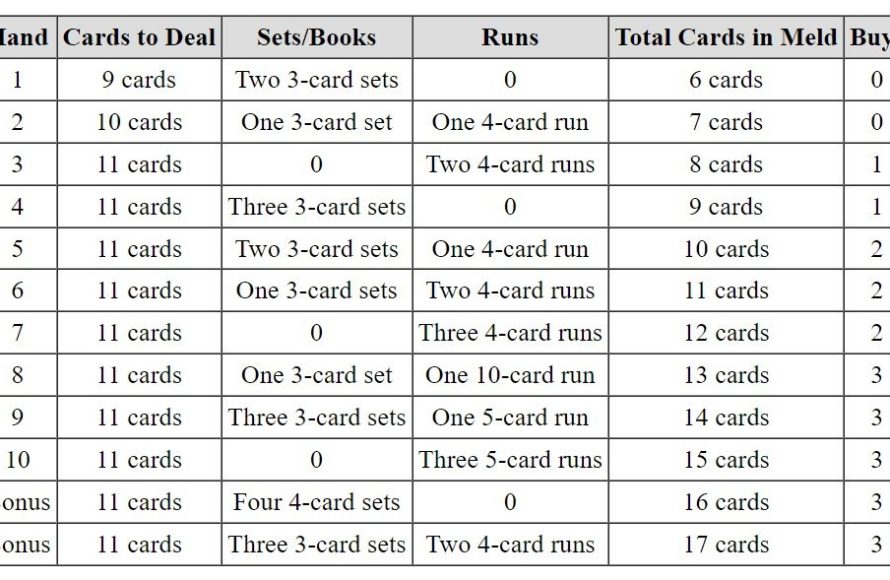
The unique thing about Shanghai Rummy is that each round has a different goal. You need to form a certain combination of sets and runs to “go out.” Here’s a rundown of the standard round requirements. Variations exist, so it’s good to agree on the rules before starting.
| Round | Goal |
|---|---|
| 1 | Two sets of three |
| 2 | One set of three and one run of four |
| 3 | Two runs of four |
| 4 | Three sets of three |
| 5 | Two sets of three and one run of four |
| 6 | One set of three and two runs of four |
| 7 | Three runs of four |
Dealing the Cards
The number of cards each player gets varies with each round. Here’s how it typically works:
- Rounds 1 to 3: Each player gets 10 cards.
- Rounds 4 to 7: Each player gets 11 cards.
Note: Some rule variations may alter this slightly, so it’s always good to confirm at the start of your game.
How a Turn Works
During your turn, you’ll do three things.
- Draw a Card: Start by drawing one card from either the top of the stockpile or the top of the discard pile.
- Meld (Optional): If you have the cards to form the required meld for the round, you can lay them face-up on the table in front of you. You may also add to the existing melds of your opponents in certain rules variation.
- Discard a Card: Choose one card from your hand to discard and place it face-up on top of the discard pile. You must discard a card to end your turn.
Going Out
Going out means getting rid of all your cards. After you complete the meld requirement of the round, you can lay down your remaining cards on another player’s meld or simply discard them. If you can add to other people’s melds, you will try to get rid of as many cards as possible. The first player to go out in a round wins the round.
More Details on Melding
Laying Down Your Initial Meld
For your initial meld, you must complete the entire round’s goal at the same time. You can’t lay down one set of three at a time, instead you need to complete entire round goal. For example in round one you need to lay down two sets of three in one turn.
Adding to Existing Melds
After your initial meld, you can add cards to any of the existing melds on the table, be it yours or your opponents’ sets or runs, whenever it is your turn. This process is called laying off. For instance, if there’s a run of 4-5-6 of hearts, and you have the 7 of hearts, you can lay it off.
- You can lay off in your turn or immediately after your meld on the initial turn
- You cannot lay off if you have not melded yourself.
Example of a Turn
Let’s say it’s your turn in round two. You have two 7’s, one 8, one 9, one 10 of hearts, and other cards. You draw the 7 of hearts from the discard pile. Now you have three 7s, and a run of 8, 9, 10 of hearts. Since the requirement for round two is a set of three and run of four, you lay down your three 7’s, and lay down your 8, 9, and 10 of hearts. You could then add your left over cards to other people’s melds, or discard one card from your hand and end your turn.
Scoring Shanghai Rummy
At the end of each round, players count up the points left in their hands. Remember, you want to have as few points as possible. When a player goes out, all players add up the value of their remaining cards in their hand, and the points are tallied.
Keeping Track of the Scores
You will need paper and pen to record the score for each round. At the end of the game, usually after seven rounds, each player adds up their total score. The player with the lowest score wins the game!
Tips and Strategies for Shanghai Rummy
Here are a few tips that can help you improve your Shanghai Rummy game:
- Pay Attention to the Discard Pile: If you see a card you need, grab it. However, if you are giving the next player a card they need, think about if that play would be beneficial to you, or just beneficial to them.
- Hold Onto Wild Cards Strategically: Wild cards are powerful, but they’re worth a lot of points at the end of a round. Don’t keep them too long, unless you know you will be going out soon.
- Plan Ahead: Think about what melds you’ll need in the next round and try to collect those cards early.
- Be Flexible: Sometimes you’ll have to change your plan based on the cards you draw, so don’t get too stuck on one strategy.
- Watch Your Opponents: Keep an eye on what your opponents are collecting, which can give you an idea of what they need.
Adapt to Variations
Shanghai Rummy has several common variations, so it’s important to understand the specific rules being used in each game.
- Some variations have more rounds.
- Some variations change the number of cards used and the card requirements for each round.
- Some rule sets might change what cards count as wild cards.
Always discuss and agree on rules before starting a game.
Advanced Strategies for Shanghai Rummy
Once you’ve got the basics down, it’s time to think about how to really up your Shanghai Rummy game. Let’s explore a few advanced strategies that could give you an edge.
Card Counting (Sort Of)
While you can’t count cards like in Blackjack because of the number of cards and the discard pile, it is helpful to pay close attention to the cards being discarded. If you see many of a certain card, then it is likely you will not be able to get a set of that card.
Keeping an Open Mind
It’s good to have a plan, but being open to change is key. Don’t get attached to only getting one type of set or run. Adjust your strategy based on what you draw and what other players are doing.
Blocking Opponents
Sometimes, it’s not about what you need but about preventing what your opponents need. If you see them collecting a lot of a certain card, keep them from getting that last one they need. This is a bit tricky, but it can be helpful once you get a feel for the game.
Managing Your Hand
A good rule of thumb is to keep your hand balanced. Try not to focus too much on any particular meld. Having a few options gives you more flexibility. Try to get rid of high value cards as soon as possible. Getting rid of cards early is key.
Observing Other Players’ Habits
Watch how your opponents play. Do they tend to keep or discard high cards? Do they only go for certain melds? Their patterns can give you clues about what they’re working toward. Use these observations to help you change your strategy to beat them.
Shanghai Rummy can be easy to learn, but difficult to perfect. It takes time and practice to be a better player, and these strategies can help improve your overall game.
And that’s how you play Shanghai Rummy! It’s a game that’s a mix of strategy, luck, and a little bit of quick thinking. It’s super fun for families and friends and perfect to learn for game nights. So grab some cards, gather some friends, and get ready to play. Remember, the most important thing is to have fun!
How to Play Shanghai Rummy | Game Rules | Card Games
Final Thoughts
Shanghai rummy involves multiple rounds, each with a specific meld requirement. Players draw cards, form sets or runs, and discard. The goal is to go out first by using all cards. This game requires strategic planning to manage your hand effectively.
The game proceeds through seven hands, with increasingly complex melds. Remember to keep track of discards to understand opponents’ strategies. Learning how to play shanghai rummy card game means understanding these rules.

