
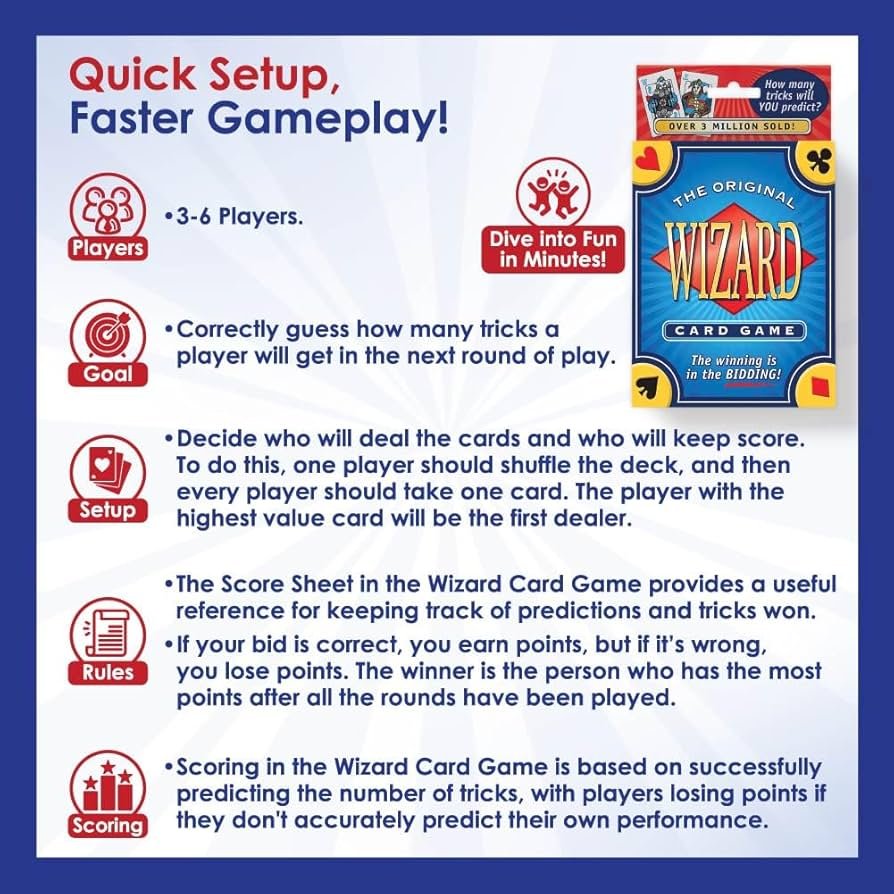
To play the card game Wizard, players bid on the number of tricks they expect to win each round, then try to achieve their bids through strategic card play, influenced by a trump suit and special wizard and jester cards.
Have you ever wanted to learn a fun, trick-taking game that mixes strategy and a touch of chance? Many people find it fascinating to understand how to play the card game Wizard. It’s a game that seems simple at first, but reveals layers of depth as you play.
The core of the game revolves around bidding and predicting the number of tricks you think you can take in each hand. You play cards strategically to either win a trick or avoid it, depending on your bid. The wizard and jester cards add elements that shake up the game.

How to Play the Card Game Wizard
Okay, let’s dive into the wonderful world of Wizard! This card game is a fun mix of strategy and luck, perfect for game nights with family and friends. It’s not too hard to learn, but it has enough depth to keep you coming back for more. We’re going to walk through everything you need to know, from the basics of the deck to the tricky parts of bidding. Let’s get started!
Understanding the Wizard Deck
First things first, let’s talk about the deck itself. Wizard uses a standard 52-card deck, just like you would use for poker or other common card games. But, it also adds a few special cards that make it unique and interesting.
The Standard Suits
You’ll find the familiar four suits:
- Hearts (♥)
- Diamonds (♦)
- Clubs (♣)
- Spades (♠)
Each suit has cards numbered from 2 to 10, plus a Jack, Queen, King, and Ace.
The Special Cards: Wizards and Jesters
Here’s where things get exciting! In Wizard, we have two types of special cards that aren’t in your regular deck.
The Wizard
The Wizard card is the most powerful card in the game. When you play a Wizard, you automatically win the trick (we’ll talk about tricks in a bit!), no matter what other cards were played. You can also use a Wizard at the start of the trick to determine which suit becomes the trump suit.
The Jester
The Jester is the opposite of the Wizard. It’s the weakest card in the game. When you play a Jester, you’re guaranteed not to win the trick. In fact, you must play it in specific situation. We’ll discuss more about that later.
Setting Up a Game of Wizard
Alright, now that we know the deck, let’s get ready to play! Here’s how to set up a Wizard game.
Gather Your Players
Wizard is great for 3 to 6 players. You can even play with two, but it isn’t as fun! More players equals more fun in our opinion.
Shuffling and Dealing
One player becomes the dealer. They shuffle the deck really well. The number of cards dealt to each player varies depending on the round of the game, which we will describe further in the next sections. It’s best practice to take turns dealing the cards. The player to the left of the dealer is the next dealer in the following round. We usually use a rotating order around the circle.
Determining the Trump Suit
In each round, there is a trump suit. It is the strongest suit for that round and is determined by the top card of the remaining deck, this card should be placed face up after the initial cards are dealt. All cards of that suit will outrank any other suit, meaning they will win any trick containing a card of a different suit. If this card is a Wizard, the dealer should choose which suit is the trump suit, in each round. If the card is a jester, there is no trump suit. We will explain more later about the details of the game rounds.
Playing a Round of Wizard
Now for the exciting part – actually playing the game! Here’s how a round of Wizard works.
The Bidding Phase
Before the round actually starts, players must make bids, indicating how many tricks they think they will win. Let’s say, in the first round you have 1 card, you can bid to win zero trick or 1 trick. If you have 3 cards in another round, you can bid to win 0, 1, 2, or 3 tricks. Bids are made in order starting with the player to the left of the dealer. Once all the bids are made, this will conclude the bidding phase.
Playing Tricks
A trick is a group of cards played in each round. The player to the left of the dealer starts, playing one card face up.
Then, each player takes a turn to play one card face up to the middle of the table. As the player puts down a card, it is added to the “trick”. Players must follow suit if possible. Meaning, if the first player plays a heart, then you must play a heart if you have one in your hand. If you don’t have any of that suit, you may play any card of another suit. If a player plays a wizard, they win the trick. If a player plays a Jester, they automatically lose the trick.
Once each player has played one card, the trick is over. The player who won the trick will gather all cards from the trick and store them in front of them in a face down stack. In the next trick, this winning player goes first.
Determining the Trick Winner
Here’s how to figure out who wins each trick:
- Wizard Wins: If a Wizard is played, that player wins the trick.
- Trump Suit Wins: If no Wizard is played and a trump suit card is included in the trick, the highest trump suit card wins the trick.
- Highest Followed Suit Wins: If no trump suit card and no wizards are played, the player who played the highest value card of the leading suit wins the trick. For example, if the leading suit is diamonds and the other players play other suits or lower value diamonds, the highest diamond will win the trick.
Continuing the Round
You repeat the steps above by playing a new card in each player’s turn, until each player has played all the cards in their hand. Then the round is over, and the scoring phase occurs.
Understanding the Game Rounds
Wizard isn’t just one round, it’s a series of rounds. The number of cards dealt changes for each round, which adds a fun strategic element to the game. Let’s go over how the rounds work.
First Round: One Card
In the first round, each player only receives one card. As mentioned above, you bid before the round begins, indicating whether you will win zero trick or 1 trick with that card. After the bid is settled, each player plays their card and the trick is finished. Then you proceed to the scoring phase.
Second Round: Two Cards
In the second round, the dealer deals two cards to each player. Bidding is performed before the round starts by each player. You are trying to bid correctly with zero, one or two tricks that you will win. When the bid phase is over, each player plays their card in tricks and tries to win or lose according to their bids. Once each player plays all their cards, this round is over and we proceed to the scoring phase.
Continuing the Rounds
This continues, where each round you add a card to each player’s hand. The third round gives 3 cards to each player. The fourth round gives 4 cards. This pattern continues, until one player reaches the end of the game, based on the number of players.
For 3 player game, the maximum number of cards dealt in each round is 17
For 4 player game, the maximum number of cards dealt in each round is 13
For 5 player game, the maximum number of cards dealt in each round is 10
For 6 player game, the maximum number of cards dealt in each round is 8
Final Round: Decreasing Cards
Once the maximum card hand is reached, the cards dealt in each round start to decrease. For example, if the game is being played with 4 players, once a player’s card count reaches 13, the next round will reduce the cards dealt down to 12, and so on until the final round where only one card is dealt to each player.
Scoring in Wizard
Keeping score is important, as it helps to determine who will be the wizard master! Let’s break down the scoring system.
Points for Correct Bids
If you win the exact number of tricks that you bid, you get 20 points and then 10 points per trick. For example, If you bid that you will win 2 tricks, and you actually win 2 tricks, you get 20+20 points which means a total of 40 points for that round.
Points for Incorrect Bids
If you fail to win the correct number of tricks according to your bid, you will lose 10 points for every trick difference. For example, If you bid that you will win 2 tricks, and you actually win zero tricks, you lose 20 points for that round. If you bid to win 2 tricks, and you win 1 trick, you lose 10 points. If you bid to win 2 tricks, and you win 3 tricks, you lose 10 points. Remember that in the beginning rounds, you may only have 1 or 2 cards so bidding wisely can save you points.
Keeping Track of the Score
It’s important to keep track of everyone’s score after each round. You can do this with a piece of paper, using a white board, or with a mobile app made specifically for playing Wizard. Add each person’s score from the previous round to their current score. Keep this up throughout the game, until the final round.
Strategies and Tips for Wizard
Now that you know the rules, let’s talk strategy. Here are some tips to make you a better Wizard player.
Pay Attention to the Trump Suit
Knowing the trump suit is essential! Remember, it will win any other suit. So, if the trump suit is hearts, a heart will beat a diamond. When you have the ability to determine the trump suit by using a Wizard card, choose the suit that is most useful for your current hand.
Bidding Wisely
Bidding accurately is the key to winning. It’s better to be a little cautious than overly confident, especially at the beginning. If you aren’t sure about your hand, it is okay to bid low (or even zero) if that’s the best choice. Remember, it’s better to lose a few points for underbidding than to lose points for a wild, overconfident bid.
Keep Track of Played Cards
Keep an eye on the cards that have been played. This can help you guess what cards other players have. You can do this by using a pen and paper. If you know they haven’t played a high trump suit card, then your trump suit card might be able to win the trick. Keeping track of other player’s low cards or high cards may help you to make a bid for the next trick.
Don’t Be Afraid to Use Your Wizard
The Wizard card is very powerful, and knowing when to play it is important. If you are able to use it to determine the trump suit, choosing the suit that is best for your current hand can increase the probability of winning tricks in that round.
Timing with the Jester
Using a Jester effectively can be tricky! It’s better to play it in the later rounds when the stakes are high. When played, the Jester will ensure that you don’t win a trick, so that you are able to meet your bid accurately.
Adjusting Your Strategy
Each round is different, because the number of cards changes. Adjust your strategies based on the cards you have and the current state of the game. If it is a round with few cards, your bid needs to be careful. And the same for the later rounds, if you have a hand full of powerful cards, you may increase your bid to try to earn more points.
Variations on the Rules
While the standard rules are pretty consistent, some people like to add variations to their game of Wizard for extra fun.
House Rules
Some players might decide on house rules. For example, allowing multiple bids of the same value. If everyone agrees, then that’s how the game should be played! This can make the game more personalized and enjoyable.
Another common house rule is to allow players to play the Jester card during the first trick of the round, whereas the standard rule is that this is not allowed.
Using Different Decks
Sometimes people add more than one deck when playing with more than 5-6 players. Using multiple decks may make the game longer and more chaotic, but it can increase fun, depending on the group of people that are playing.
Special Scoring
Some people use different scoring systems for winning and losing. You can adjust the points to change the difficulty of the game. For example, some people may use an increase for perfect bids or add additional points for winning every trick in one round.
Playing Wizard is a fantastic way to spend time with friends and family. It’s easy to learn but also offers strategic depth that keeps things interesting. From understanding the different cards to mastering the bidding process, now you have the foundation to become a great wizard player. Go ahead and shuffle the deck, gather your friends, and start the magical world of Wizard. Happy playing!
How To Play The Original Wizard Card Game
Final Thoughts
In summary, predict the number of tricks you will win each round. The trump suit changes every round, so pay attention. A zero bid means you must avoid winning any tricks. Following suit is a must, but you can play any card if you don’t have the matching suit.
The game continues until all rounds are finished. Scoring involves the accuracy of your bids. Correct predictions earn a plus points. Incorrect ones lead to minus points. Knowing how to play the card game wizard well increases your chance of winning.

