
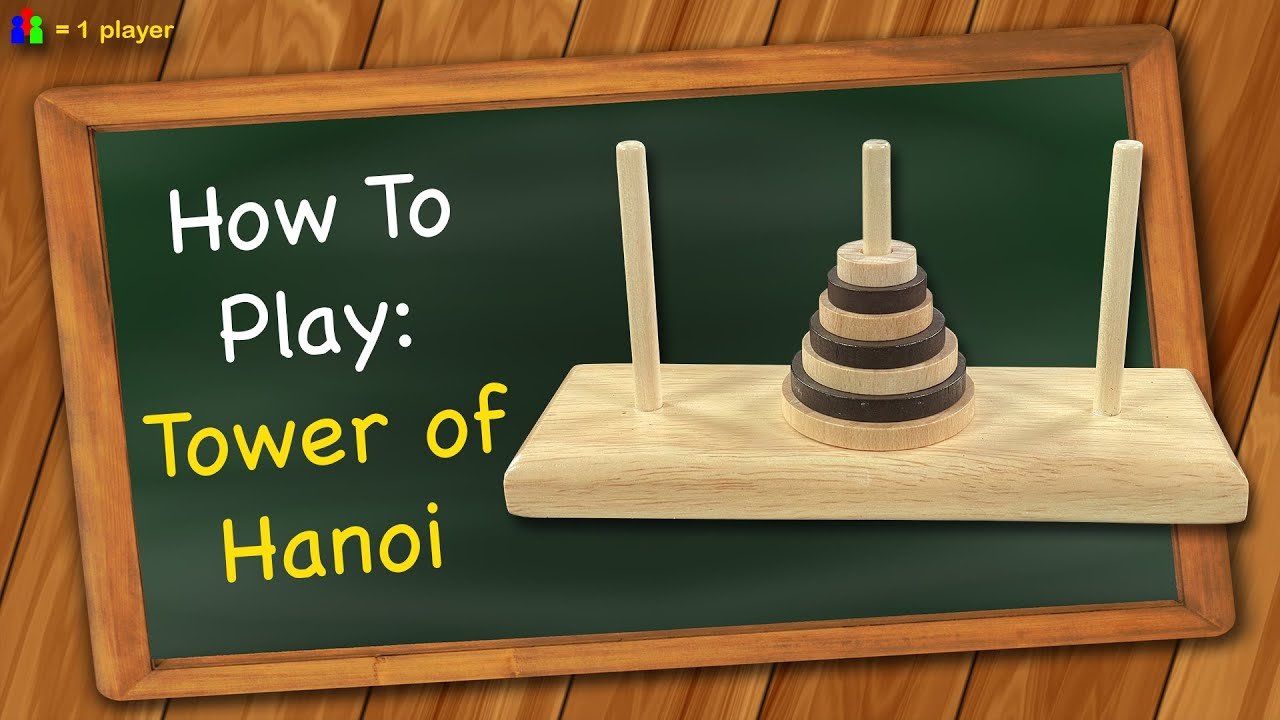
Playing Tower of Hanoi involves moving a stack of disks from one peg to another, one disk at a time, never placing a larger disk on a smaller one.
Have you ever seen those intriguing puzzles with stacked disks and wondered how to play Tower of Hanoi game? It might seem complex at first glance, but the core mechanics are quite simple. The objective is moving the entire stack of different sized disks to another peg while adhering to the rule that you never place a larger disk on a smaller disk. This fun and classic puzzle actually has some very cool mathematical ideas behind its seemingly simple gameplay.

How to Play Tower of Hanoi Game
Alright, let’s dive into the wonderful world of the Tower of Hanoi! It’s a classic puzzle that might look tricky at first, but with a little understanding, you’ll be solving it like a pro in no time. The Tower of Hanoi game is all about moving disks from one peg to another while following a few simple rules. Sounds fun, right? Let’s break it down step-by-step so you can learn how to play.
Understanding the Tower of Hanoi Setup
Before you start moving disks around, you need to understand how the game is set up. The Tower of Hanoi puzzle comes with three pegs and a set of disks of different sizes. Here’s what each part does:
- The Pegs: You’ll see three vertical pegs or rods. These are where the disks will sit. They’re usually placed in a row. Let’s call them Peg A, Peg B, and Peg C just for easier reference.
- The Disks: These are the circular pieces of different sizes. They are stacked in size order, with the biggest disk at the bottom and the smallest on top. Initially, all disks are stacked on the first peg (Peg A).
The goal of the game is to move all of the disks from the first peg (Peg A) to the last peg (Peg C), using the middle peg (Peg B) for temporary placement.
The Rules of the Game
Now for the important part – the rules. These rules are the key to solving the puzzle. They might seem simple, but they are very important:
- Move One Disk at a Time: You can only move one disk in each step. No picking up more than one at once!
- Larger Disk on Top: You can’t place a larger disk on top of a smaller one. A bigger disk must always be below a smaller disk.
- Only Move Top Disk: Only the top disk on a peg can be moved. You can’t grab a disk from the middle of a stack.
Keep these rules in mind as you play, and you’ll be on your way to solving the Tower of Hanoi!
Starting the Game
With the puzzle set up, you’re ready to begin. You’ll start with all disks stacked in size order on the starting peg (Peg A). It’s important to visualize what you need to do: move the entire tower of disks to Peg C while following the rules. Here’s how to proceed:
Step 1: Planning Your First Move
Take a good look at the initial set up. You have the largest disk at the bottom. The only disk you can move at this point is the smallest one on top.
Step 2: Making Your Move
Move the smallest disk to peg C. Remember the goal here, you have to transfer all the disks to peg C by keeping the rules in mind.
Step 3: Second Move
Now you will see two disks on peg A. You will now move the second smallest disk from peg A to peg B. Notice that the smallest disk is on peg C.
Step 4: Third Move
The next logical step is to move the smallest disk from peg C to peg B, you will have two disks on peg B now, and the largest disk remains on peg A.
Step 5: Fourth Move
Move the largest disk from peg A to peg C. The smallest disks are still on peg B.
Step 6: Fifth Move
Move the smallest disk from peg B to peg A, so that the second smallest disk can move from peg B.
Step 7: Sixth Move
Move the second smallest disk from peg B to peg C. You will now see both of the smallest disk on peg A and both of the second smallest disk on peg C.
Step 8: Seventh Move
Move the smallest disk from peg A to peg C. You have now completed the transfer of all the disks to peg C.
Solving Strategies and Tips
Alright, those basic rules will get you started, but let’s talk about some strategies to help you solve the Tower of Hanoi puzzle quicker and more efficiently.
The Recursive Approach
The Tower of Hanoi puzzle can be solved using recursion, that means a repetitive or repeated process. It’s like using the same plan over and over, but on smaller and smaller versions of the puzzle. Here’s the basic idea of how that works.
- Moving the Top Disks: Think of it like this: to move the largest disk to the last peg (Peg C), you first need to move all the smaller disks on top of it to the middle peg (Peg B).
- Moving the Largest Disk: Once the smaller disks are moved to the middle peg, you can move the biggest disk to the last peg.
- Moving the Other Disks: Now, you will have to move all those small disks from middle peg (Peg B) to last peg (Peg C) to sit on top of the largest disk.
This idea can be applied recursively. It breaks the problem down to three smaller problems. It is not very straightforward at first, but you’ll be good once you practice this a little more.
Thinking Ahead
It’s easy to get caught up in moving disks one at a time, but try to think a few moves ahead. If you move a disk here, where will it need to go next? This kind of planning can help you avoid getting stuck. It is like thinking like a chess player and thinking about the next moves.
The Odd and Even Disk Trick
Here’s a neat trick that can help. If you are playing with an even number of disks, the first move should always be the smallest disk on the destination peg, if you have odd number of disks, the first move should be the smallest disk on the helper peg.
Practice Makes Perfect
Like any puzzle, the more you play, the better you will get. Don’t get frustrated if you don’t solve it perfectly at first. Keep practicing and you’ll start to see patterns and improve your solving time.
Tower of Hanoi with Different Numbers of Disks
The number of disks you use can change the difficulty of the puzzle dramatically. Let’s see how the complexity changes as we increase the number of disks:
Simple Tower of Hanoi (3 Disks)
The version of Tower of Hanoi with three disks is a great place to start. It’s simple enough that you can complete it quickly, but complex enough that it will teach you how the game works. It’s the perfect game to help you understand all the rules of the game.
Moderate Tower of Hanoi (4 Disks)
Adding just one more disk increases the difficulty significantly. The number of moves required to solve this puzzle is more than the 3 disk puzzle. At this point, you’ll have to start thinking ahead a few steps to solve the puzzle successfully. You will have to start applying some strategies now.
More Complex Tower of Hanoi (5+ Disks)
Once you start working with 5 or more disks, the puzzle becomes much more complex. The number of moves required to solve the puzzle increases substantially. At this point, it can take several minutes to move disks from peg to another. This higher number of disks challenge you and help you improve on your game skills.
How many moves does it take?
If you are wondering, how many moves does it take to solve a tower of Hanoi with x number of disks, here is how you can calculate it. Number of moves = 2n– 1 where n is the number of disks.
| Number of Disks | Minimum Number of Moves |
|---|---|
| 1 | 1 |
| 2 | 3 |
| 3 | 7 |
| 4 | 15 |
| 5 | 31 |
| 6 | 63 |
| 7 | 127 |
As you can see, as the number of disks increases, the number of moves required increases quite quickly. With more disks, the puzzle may take some serious time and dedication to solve.
Why Play Tower of Hanoi?
So, why should you spend time trying to solve this disk-moving puzzle? There are several great reasons!
Brain Exercise
It’s an excellent way to give your brain a workout. It helps you improve your problem-solving abilities and logical thinking.
Patience Builder
The puzzle can test your patience, especially with a higher number of disks. It teaches you to stay calm and keep thinking through the problem without frustration.
Fun for All Ages
The Tower of Hanoi is enjoyable for people of all ages. Children can start with fewer disks and gradually work their way up as their skills improve. It’s good for older people to keep their minds active.
Understanding Recursion
This puzzle is often used to illustrate how recursion works, which is a concept in computer science. It gives you a great example of breaking down a large problem into smaller, easier to manage problems. It teaches you to divide and conquer.
Visual Learning
It can help people with visual-spatial learning. The game is visual, and it allows people to improve on their visual learning skills. So, if you think that you are a visual learner, the game is certainly for you.
Variations on the Tower of Hanoi
While the classic Tower of Hanoi is fun, there are many variations that can add a new layer of challenge. Here are some of the most popular ones.
Number of Pegs
The traditional Tower of Hanoi uses 3 pegs. However, some variations use 4 or more pegs which change the way the puzzle is solved and add more complexity to it. The increased number of pegs can significantly reduce the number of moves to be made to solve the puzzle.
Different Shapes and Colors
Instead of just round disks, you may find Tower of Hanoi puzzles with square or triangle disks. Some variations use different colors of disks, but these changes don’t change the basic rules of the game. They mostly just change how it looks.
Larger Puzzles
If you think the standard versions are easy, you can find Tower of Hanoi puzzles with more than 8 or 10 disks. These will definitely challenge your problem-solving skills and give you much more satisfaction after solving it.
Reverse Tower of Hanoi
In this variation, the disks are stacked in reverse order, with the smallest disk on the bottom. Your goal is to stack the disks in the normal order (biggest disk on the bottom) on another peg. This variation requires you to apply slightly different strategies.
Common Mistakes and How to Avoid Them
Even with the rules in mind, it is easy to make mistakes when you are playing. It’s perfectly normal, especially when you’re first starting out. Let’s discuss some of the common mistakes and how you can prevent them.
Moving Multiple Disks at Once
One of the most common errors is trying to move more than one disk at a time. It might be tempting to move a few disks at once to speed things up, but you must resist that urge. Make sure you follow the basic rule of only moving one disk at a time.
Placing a Larger Disk on a Smaller Disk
Sometimes, people forget that they can’t place a bigger disk on top of a smaller disk. It’s a mistake, and it can mess up your whole sequence. If this happens, just take a moment to evaluate what went wrong and correct it.
Not Thinking Ahead
Many people move disks without thinking about the next steps. That will often lead to unnecessary moves. Take a moment to plan your steps before moving. This will help you in the long run.
Getting Frustrated
It’s okay to feel frustrated if you’re struggling with the puzzle. But don’t give up! If you feel overwhelmed, take a short break and then come back to the puzzle with a clear mind. It helps if you look at the board after the break with a fresh view, because you might have missed something on your first go.
Forgetting the Goal
It’s easy to get lost in the process of moving individual disks. Remember, the ultimate goal is to move the entire stack of disks to the third peg while keeping the same size order. It helps when you try to keep the end goal in mind, it gives you a clear idea about what you need to accomplish.
Practical Applications of the Tower of Hanoi
While the Tower of Hanoi is a classic game, it is also used in some practical applications as well. It is used to illustrate how some complex computer algorithms work.
Computer Science
The puzzle is often used in computer science courses to show how recursive functions work. Recursion is a way of doing something over and over, using the same steps each time. Programmers use recursive algorithms all the time, and it is very important to understand how they work. The Tower of Hanoi puzzle serves as a great example to illustrate the recursion concept.
Psychology and Research
Researchers use this puzzle to study problem-solving skills, learning, and memory in people. They can understand how a person approaches a specific problem. They can also understand if a person has any learning disability and identify the type of learning disability.
Testing AI
Some researchers use this game to test the performance of artificial intelligence algorithms. If an AI can solve this problem effectively, it might be ready for more complex applications.
Problem Solving in Real Life
The strategies used to solve the Tower of Hanoi, such as breaking a problem into smaller parts, thinking ahead, and being patient, can be applied to problems in real life. For example, if you are working on a project, you can use the same strategy.
The Tower of Hanoi is a very interesting puzzle game. The puzzle will improve your mind, problem solving skill, and helps you to stay calm. It is a good game for all ages and you can start playing this game today.
How to play Tower of Hanoi
Final Thoughts
To play the Tower of Hanoi game, move disks one at a time from one peg to another. You can only move the top disk on a peg. A larger disk must never sit on a smaller disk.
The objective is to move all the disks from the starting peg to the destination peg, using the spare peg as needed. Following these rules carefully helps you solve the puzzle.
That’s how to play tower of hanoi game; strategic moves and careful planning is important for the solution. Try it out, and enjoy!

