
Scoring in bridge involves totaling points from tricks won above the book, plus any awarded points for honors or vulnerability, while also tracking points for making contracts.
Bridge can seem complex, especially when you first encounter the intricate scoring system. Many people find the process of learning how to score bridge card game a bit daunting at first. The actual scoring itself is built around a combination of trick points and bonus points.
Figuring out the totals requires understanding the contract, vulnerability status, and any honors held. Keeping track of this while playing can feel like a lot, but with practice, it will become second nature. This will enhance your game and overall enjoyment.

How to Score Bridge Card Game
So, you’ve learned the basics of playing bridge, and now you’re ready to keep score like a pro? Great! Scoring in bridge might look a bit confusing at first, but don’t worry; it’s not as hard as it seems. This guide will walk you through all the steps, from figuring out how many tricks you made to adding up your points. Let’s get started and learn how to score bridge effectively! Understanding scoring will not only help you keep track of the game but will also improve your gameplay, as knowing the value of bids and contracts becomes a key strategy.
Understanding the Basics: Tricks, Contracts, and Vulnerability
Before we dive into the nitty-gritty of scoring, we need to understand a few key terms. Think of them as the building blocks of bridge scoring. These fundamental elements help us understand how each hand is evaluated and impacts the overall game.
Tricks
In bridge, a “trick” is a set of four cards, one played by each player in a round. The player who plays the highest card in the suit that was led, or the highest trump card if one is played, wins the trick. For scoring purposes, it’s vital to know how many tricks a team takes during the play.
- Each hand has 13 tricks possible in total.
- The goal is to win more tricks than the other team.
- Winning more tricks than the contract requires gives you extra points, and failing to meet a contract results in penalties.
Contracts
The “contract” is the number of tricks a declaring team needs to win to get points. It’s determined by the bidding process. It’s composed of two parts: the number of tricks and the trump suit (or no trump). The number stated in the contract shows how many tricks the declaring team needs over 6. So a contract of 2 hearts means the team is trying to win 8 tricks (6+2). A contract can also be “passed” which means the hand is played with no contract and no scores are generated. This happens usually when no one has a hand that is worth bidding on.
- Contracts are bids declared during the auction.
- They indicate the number of tricks and the suit or no trump the declaring team aims for.
- Bids are often based on the strength and length of each suit in a player’s hand.
Vulnerability
Vulnerability is a concept that adds extra layers to scoring. In duplicate bridge, vulnerability changes with each deal to provide a balanced and more dynamic gameplay. Some tournaments like to rotate vulnerability to prevent bias. There are two vulnerability states: vulnerable and not vulnerable. Being vulnerable increases the penalties for failing to make a contract and also increases the rewards for making a contract. Think of it as a risk-reward factor. Vulnerable teams get significantly more points for making their contracts and pay higher penalties if they do not make their contract.
- Vulnerability rotates among the tables
- When a team is vulnerable, they have higher risks and rewards.
- Being vulnerable has substantial implications for scoring
The Basics of Point Values: Making the Contract
Now that we understand tricks, contracts, and vulnerability, let’s look at how points are earned when a team successfully completes a contract. The core of scoring is based on the number of tricks won above six and the suit or notrump value. Understanding the points per trick and how these points are applied is important for strategic bridge playing.
Trick Values
Each suit in bridge has an assigned point value per trick, and these values play a vital role in determining the final scores. Here are the base values:
- Clubs (♣) and Diamonds (♦): 20 points per trick. These are the minor suits.
- Hearts (♥) and Spades (♠): 30 points per trick. These are the major suits.
- No Trump (NT): The first trick is worth 40 points and each additional trick is worth 30 points.
Making the Contract: Example
Let’s say your team bid and made a contract of 3 Hearts, winning 9 tricks. Since the contract requires you to take 3 tricks over 6, meaning 9 tricks total, you’ve made your contract. Each heart trick is worth 30 points so you would earn 90 points, and you’d get a bonus for making the contract which we will look at later. If, for some reason, you had won only 8 tricks you would have failed to make the contract, and would receive no points for making the bid. The opposing team would receive penalties.
Overtricks
What if you make more tricks than required by your contract? These additional tricks are called “overtricks.” They are scored differently based on the vulnerability status and the suit or notrump value.
If you bid 3 hearts but take 10 tricks, your team receives the 30 points for the additional heart, assuming you aren’t vulnerable.
- Overtricks are tricks won in excess of the contract
- Their value depend on the suit or notrump, the vulnerability, and if the team is vulnerable.
Scoring Penalties: Failing the Contract
Just as making a contract brings rewards, failing to make a contract leads to penalties. These penalties are given to the other team. The severity of these penalties is based on the difference between the number of tricks bid and the tricks that were won and vulnerability status. When a team is unable to make its contract, it’s a missed opportunity, and the other team profits.
Penalties
If a team fails to make the contract, the opposing team earns penalties. Here’s how they break down:
- Not Vulnerable: 50 points for each trick short of the contract.
- Vulnerable: 100 points for each trick short of the contract.
For example, if you contract for 3 Spades (9 total tricks), but take only 8 tricks, you missed by one trick. If you are not vulnerable the opposing team receives 50 points. If you are vulnerable then they receive 100 points. These can pile up quick, so be careful with your bids!
Bonus Points: Slam Bonuses and Game Bonuses
The game of Bridge wouldn’t be complete without its fair share of bonuses that elevate the scoring. These bonuses provide more strategic depth to the game and encourage players to go for more demanding contracts.
Game Bonuses
When a contract reaches a specific threshold of points, it is called a “game.” Earning a game bonus results in an extra set of points.
To reach a game, the contract needs to have at least 100 points. For example:
- 3 No Trump
- 4 Hearts or 4 Spades
- 5 Clubs or 5 Diamonds
The amount of the game bonus is determined by vulnerability.
- Not Vulnerable: 300 points
- Vulnerable: 500 points
Slam Bonuses
Slam bonuses are awarded for achieving high-level contracts, adding significant points to the game. These big bids should not be taken lightly, as the bonuses are very generous.
- Small Slam (6 level contract): 750 points if vulnerable, 500 if not vulnerable
- Grand Slam (7 level contract): 1500 points if vulnerable, 1000 if not vulnerable
Making a Slam: Example
Let’s say you bid 6 Hearts and make it. This is a small slam. If you are not vulnerable you would receive 500 points for the slam and the 120 points for making 6 hearts ( 6 tricks at 30 points for each heart). So 620 total.
Putting it All Together: Keeping Score
Alright, we’ve covered all the main scoring rules. Now, let’s put it all together. In practice, keeping score usually involves a scoresheet. Here are the core areas you need to pay attention to:
The Scoresheet
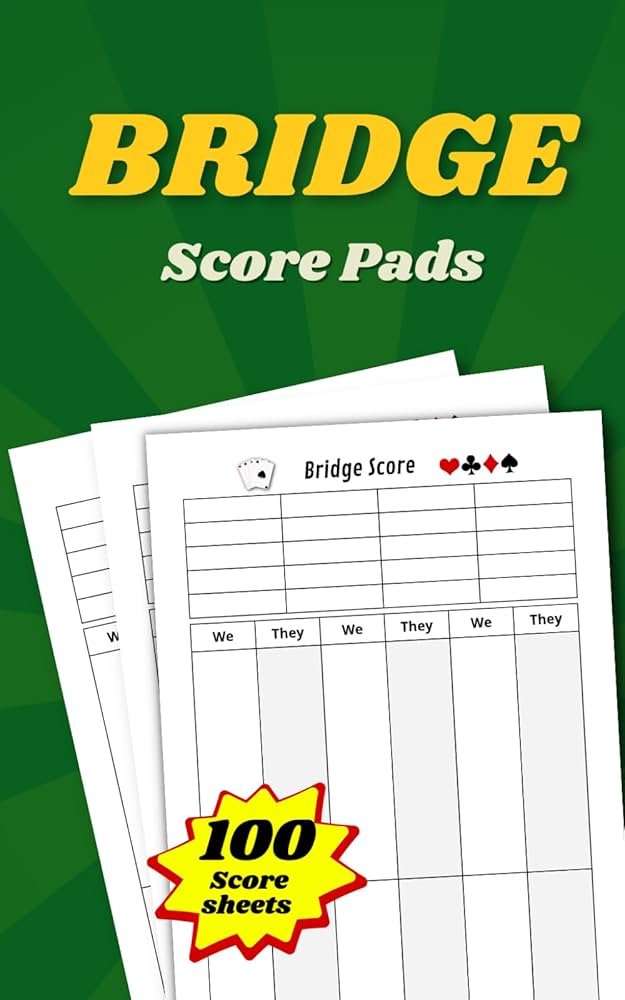
The scoresheet is a simple piece of paper divided into two columns for each side. Often, you will see two horizontal lines that form a grid where scores are entered. The column for the team that declares the contract is often on the left and the column for the other team is on the right.
- Keep a separate column for each team.
- Record all the points for each hand played as you go.
- Make sure you include both the bonus points and penalty points.
Recording Each Hand
After each hand you should record:
- The contract.
- The number of tricks the declaring side took.
- The base point value (based on suit).
- Bonus or penalty points.
- The total score for each team.
Example Game Scoring
Lets do an example of a full game to show how all of this plays out. For this game, we will use the following vulnerability sequence.
- Hand 1: Neither side vulnerable
- Hand 2: North/South vulnerable
- Hand 3: East/West vulnerable
- Hand 4: Neither side vulnerable
Here is how the hands played out in our example:
Hand 1:
- North/South bid 2 Hearts and make exactly 8 tricks.
- East/West score 0 points.
- North/South Score: 60 points for the tricks + 50 point for making game for a total of 110 points.
Hand 2:
- East/West bid 3 Notrump and take 10 tricks.
- North/South score 0 points.
- East/West score 100 points for tricks ( 40 for first trick and 30 for each additional trick) + 300 for game bonus because they are vulnerable for a total of 400 points.
Hand 3:
- North/South bid 4 Spades and take 9 tricks.
- East/West score 50 points for taking one trick and not making the game.
- North/South score 0 points.
Hand 4:
- East/West bid 5 Clubs and take 11 tricks
- North/South score 0 points.
- East/West score 100 points for tricks (5 tricks at 20 points) + 300 for game bonus because they made the game for a total of 400 points.
Total Score:
North/South: 110 points
East/West: 850 points
In this example, East/West would win the game.
Adjusting for Rubber Bridge
Rubber bridge involves different scoring rules. To win, a partnership must win two games, usually out of three. A game is won when the first side reaches a score of 100 or more points. Points from each game and overtricks are carried over and added to each team’s running total. A bonus of 700 points is awarded to the team that wins the rubber. Some players choose to use the Chicago method where each rubber is treated as a separate game.
- In rubber bridge, you aim to win two games.
- Scores carry over from hand to hand, so keep track of your running total for each game.
- When one team wins a game, the scores are reset.
Tips for Easy Scoring
Here are a few tricks to make scoring easier:
- Use a scoresheet or an app.
- Always double-check your calculations.
- Make a habit of scoring as you go.
- If your are playing with a group of friends, assign one person to keep track of scoring and rotate this duty each game.
Bridge scoring might feel daunting at first, but with a little practice, it will become second nature. Understanding the scoring is essential for strategizing your game effectively and will elevate you to a more competitive and advanced player. Now you have the knowledge to keep score in bridge effectively and accurately!
How Bridge Scoring Works
Final Thoughts
To correctly score bridge, you add up points from tricks won, fulfilling your contract, and any overtricks. The specific values depend on the suit, level of the contract, and if vulnerable or not. You must understand the scoring table for precise calculation.
Remember honors provide additional points, but only when held in the declaring hand. It’s important to keep a running total for each partnership, using a dedicated score sheet. This helps to ensure proper how to score bridge card game outcomes.
You must learn these details to play correctly. Understanding the fundamentals of how to score bridge card game will greatly improve your results. Consistent practice with these rules aids accuracy.

