
Yes, rock paper scissors is fundamentally a game of chance, as each player’s choice is made without knowledge of the other’s, leading to random outcomes.
Ever found yourself in a tense showdown, hands poised, ready to throw? The age-old question arises: is rock paper scissors a game of chance? It feels like skill might be involved, maybe a little mind reading?
But when we really think about it, each player makes their selection independently. This creates a situation where the results are mostly unpredictable.
Therefore, the outcome comes down to random selection each time, which makes the game of rock paper scissors rely on chance.

Is Rock Paper Scissors a Game of Chance?
That’s a question many of us have pondered while trying to settle a disagreement or just pass the time. On the surface, rock paper scissors (or “Roshambo,” as some call it) seems like a completely random game. You pick one of three options, and your opponent does the same. It’s like flipping a coin, right? Well, maybe not quite. Let’s dive into the details and see if there’s more to it than meets the eye.
The Basics: How Rock Paper Scissors Works
First, let’s recap the rules. It’s pretty straightforward:
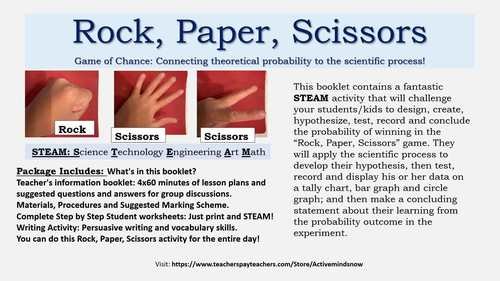
- Rock crushes Scissors
- Scissors cuts Paper
- Paper covers Rock
If both players choose the same thing, it’s a tie, and you play again. This simple set of rules has made rock paper scissors a favorite for quick decisions around the world. But the question remains: is this simple game truly random?
Understanding Chance and Skill
To figure out if rock paper scissors is pure chance, it’s important to understand the difference between chance and skill. A game of chance relies heavily on luck; the outcome is unpredictable, and player ability doesn’t really matter. Think of rolling dice – you might have a favorite die, but no matter how you roll it, the numbers that come up are mostly up to random factors.
A game of skill, on the other hand, rewards practice and understanding of the game mechanics. Chess, for example, is almost entirely skill-based. Players must think ahead, analyze their opponent’s moves, and strategize for victory. The better the player, the higher their chance of winning.
The Initial Assumption: Pure Randomness
At first glance, rock paper scissors appears to be pure chance. Each choice – rock, paper, or scissors – is equally likely, right? It’s like picking a color out of a hat – no option is inherently better or more prone to occur. If everyone played completely randomly, over a large number of games, the result should even out with each option winning around one third of the time. This is the basis for saying it is a game of chance.
Digging Deeper: The Human Element
But here’s where things get interesting: humans are not very good at being random. We tend to fall into patterns, even when we’re trying not to. That’s where the “skill” element sneaks into this simple game. Our choices aren’t truly random if our choices are influenced by our thoughts and past results. This is where strategies begin to form.
Psychological Patterns in Rock Paper Scissors
There are some pretty common patterns that people often fall into in rock paper scissors. These patterns can be exploited. For instance:
- The “Beginner’s Rock”: Many beginners choose rock in their first round because it feels like the default, basic choice. Knowing this, an experienced player might start with paper.
- The “Repeat After a Loss”: Players often repeat their last move if they lost the previous round. If you lost with paper, you might throw paper again. If you’re aware of this, you might go with scissors.
- The “Shift After a Win”: After a win, many players tend to switch to the choice that beats their previous winning selection. If a rock beat paper, you may assume a player will choose scissors next.
These are just a few examples of the patterns and common tendencies people have when playing. A keen observer can begin to predict what their opponent will do. These tendencies are subtle, and they’re not foolproof, but they can shift the odds ever so slightly.
The Importance of Observation
The key to playing rock paper scissors with any element of “skill” is observation. You’re not just trying to be random, you’re watching your opponent. Are they repeating moves? Do they get nervous and choose one option frequently? Do they show a tell or slight hesitation? Every little clue your opponent gives can help you predict their next move, thus making the game less about chance and more about using human tendencies to your advantage.
Strategies and Counter-Strategies
There’s actually a surprisingly large amount of strategy that goes into this simple game. People have written about it and even developed complex ways to try to predict or trick their opponents. Here are a few basic rock paper scissors strategies and how to counter them.
Basic Strategy 1: The “Double Bluff”
A common trick is to act like you are about to choose a common pick, such as rock, then choose paper instead. This plays on a players idea that their opponent will predict they will use rock and therefore choose paper, which your paper then beats. You are tricking them by acting as you are going to do what they expect, but then deviating at the last second.
Counter: If you think your opponent is trying to double bluff, go with scissors. By thinking ahead, you can exploit this strategy.
Basic Strategy 2: The “Psychological” Approach
Some players attempt to intimidate or “read” their opponent to anticipate their choices. This involves eye contact, physical cues and sometimes even just a fast throw to throw the other player off. The hope is to make the opponent feel pressured, making them revert to simpler more obvious choices, like throwing rock.
Counter: Stay calm and focus on patterns. Do not overthink or get in your own head. Throwing in a random choice can also through off your opponent.
Advanced Strategies
As you become a more advanced player, the level of strategy increases. This moves beyond simple tricks and tends to involve a deeper understanding of probabilities and psychology.
Using Frequency Analysis
A more advanced strategy involves keeping track of the choices your opponent makes and predicting their next move based on the frequency of what they do. For example, if they throw rock four times in a row, they’re likely to pick something else next time. So, you pick paper. This involves careful counting of choices and is a form of data analysis.
Counter: Vary your choices and avoid recognizable patterns. The more random your choices seem, the harder it will be to predict.
Conditioning
Conditioning involves subtly encouraging your opponent to repeat a certain choice. This can be done by purposefully losing one round to prime them for repeating their choice on the next throw. If you repeatedly throw paper against rock, your opponent may start throwing rock every time, believing they have a guaranteed win. You can then start throwing scissors to win those rounds.
Counter: Focus on not becoming conditioned. Avoid repeating the same choices or letting a single win make you feel like you are now going to always win with that choice.
Is It Really A Game Of Skill?
While we’ve talked about strategies and psychological factors that can influence the outcome of a rock, paper, scissors game, it’s still not a game where skill dictates the results like chess or even a video game. Most of the game still relies on the fact that both players need to choose at the same time, meaning they cannot have any reliable information on what the opponent will throw.
At its core, it’s still a game where you need to make a random selection. Unless you can literally read your opponent’s mind, there is still a huge element of chance involved in the outcome of a single round. The skill element simply influences your probabilities of winning over a long set of rounds.
Think of it this way: if two complete strangers played a single round of rock paper scissors, there’s no reason to think one person will be more likely to win than another. But if two experienced players face off for a long series of games, the one better at understanding patterns and thinking ahead may indeed have an edge. The higher the number of rounds, the less chance plays a part and more skill comes into it.
The Spectrum of Chance and Skill
Instead of viewing games as either purely chance or purely skill, it’s helpful to think of them on a spectrum. At one end of the spectrum we have games that are mostly chance, such as slot machines and games of chance, and on the other end we have games that are largely based on skill, such as chess and musical instruments. Most games fall somewhere in the middle, including rock paper scissors.
Here’s how rock paper scissors fits into the spectrum:
| Game Type | Description | Role of Chance | Role of Skill | Example |
|---|---|---|---|---|
| Pure Chance | Outcome depends completely on luck | Very High | Very Low | Lotteries, Slot Machines |
| High Chance, Some Skill | Outcome largely influenced by luck, but some skill can tip the odds slightly | High | Low to Moderate | Rock Paper Scissors, Texas Hold’em, Backgammon |
| Moderate Chance, Moderate Skill | Outcome has some chance, but strategy and skill are important | Moderate | Moderate | Poker, Video Games, Trading Card Games |
| Low Chance, High Skill | Outcome depends almost entirely on skill and strategy | Low | High | Chess, Musical Instruments |
As you can see, Rock paper scissors leans towards the “high chance, some skill” category. It’s not purely random, but luck still plays a big part. By understanding the psychological elements and patterns, a player can increase their chances of winning slightly, but not completely overcome the randomness. The skill lies in spotting and taking advantage of these minor tendencies.
Why Does It Matter?
Even though Rock Paper Scissors is simple, understanding its underlying nature is useful in a broader sense. It helps us understand how much different factors contribute to game outcomes. This understanding is applicable when deciding whether to play more strategic games, or understanding the randomness of the games of chance.
Rock paper scissors is also a fantastic way to teach kids about probability, prediction, and the psychology of human behavior. It’s a fun and engaging way to introduce concepts like probability and logical thinking to kids, and a fun simple game for all.
While the core of rock paper scissors relies on the randomness of the throw, human behavior and tendencies play a part in the game. A player can use observation and pattern recognition to improve their chance of winning, but they will never completely remove the randomness inherent in the nature of the game. It’s a fun game that can be a great way to resolve disputes, but remember, there’s always an element of chance!
Rock Paper Scissors against your Child
Final Thoughts
Ultimately, analysis suggests that while strategy exists, rock paper scissors is primarily a game of chance. The random nature of choices makes it difficult to predict outcomes consistently.
A player might attempt to recognize patterns, but opponents can alter their approach. This inherent unpredictability confirms ‘is rock paper scissors a game of chance’ at its core.

