
Jurassic Architect launches on Tuesday, November 24, 2026, on Windows only, and Steam lists no price yet. It is a cozy dinosaur zoo game from MadOctopus: you build a park on the far side of a Portal, keep more than 50 species of dinosaurs happy, and grow the park level by level.
There is no free demo listed on Steam, so your first park is your first lesson. This guide gives you that first park, step by step, with the launch facts, the first 30 minutes, and the habits that stop a T. rex from testing your fences.
Release Date
Tuesday, November 24, 2026
Price
No price published on Steam yet
Platforms
Windows only, on Steam
First Goal
One happy enclosure, then research
Release date, price and platforms
Jurassic Architect launches on Tuesday, November 24, 2026. The developer and publisher is MadOctopus, and Steam lists the game under Casual, Indie, Simulation and Strategy. It is a single-player game with Steam Achievements, Steam Cloud saves and a save-anytime option.
| Fact | What Steam says |
|---|---|
| Release date | Tuesday, November 24, 2026 |
| Price | Not published yet, so no price is printed here |
| Platforms | Windows only |
| Free demo | None listed on Steam |
| Developer and publisher | MadOctopus |
| Genres | Casual, Indie, Simulation, Strategy |
The missing price is the one thing to check again before you buy. Steam showed no price on launch day, so this guide prints no price at all rather than guessing one. Check the Steam store page at purchase time, and we will update this guide when a price appears.
The game is Windows only, so Mac and Linux players cannot play it, and there is no console version listed. There is also no free demo listed on Steam, so you cannot try it before you buy it. That is why this guide stays practical: it tells you what to do in your first session, so the money you spend turns into a good park instead of a messy one.
What kind of game is this
Beyond the Portal sits a valley where dinosaurs never died out, and yours is the only zoo in it. People from our world buy a ticket, walk through the Portal, and come to see real dinosaurs. You build the place they come to see, in a soft, toy-like 3D valley under a smoking volcano.
The game is a cozy park builder, not a race against a timer. You shape enclosures, discover more than 50 species, hire keepers, rangers and vets, and keep your dinosaurs happy before they start testing their fences. There is a campaign across the valley with stars to earn, plus free play and a sandbox mode if you would rather build without goals.
Ivy, the park guide, shows you each new thing once and then lets you play. Streamers get one extra feature: streamer mode lets your chat name the dinosaurs and vote on what tomorrow’s event will be. You do not need it to enjoy the game, but it turns viewers into part of the zoo if you ever stream your park.
Your first park: the first 30 minutes
Your first session sets the shape of your whole park, so go slow and build small. A small park with one happy enclosure beats a big park with three unhappy ones. Follow these six steps in order, and you will have visitors, fed dinosaurs and your first research points before the first day ends.
- Let Ivy guide you. Ivy shows you each new thing once, so follow her prompts instead of skipping past them. The first prompts teach you the tools you will use for the rest of the game.
- Build one enclosure first, not three. Pick a gentle species, drag a fence into a simple shape, and leave plenty of room inside. A cramped dinosaur is an unhappy dinosaur, and an unhappy dinosaur tests its fence.
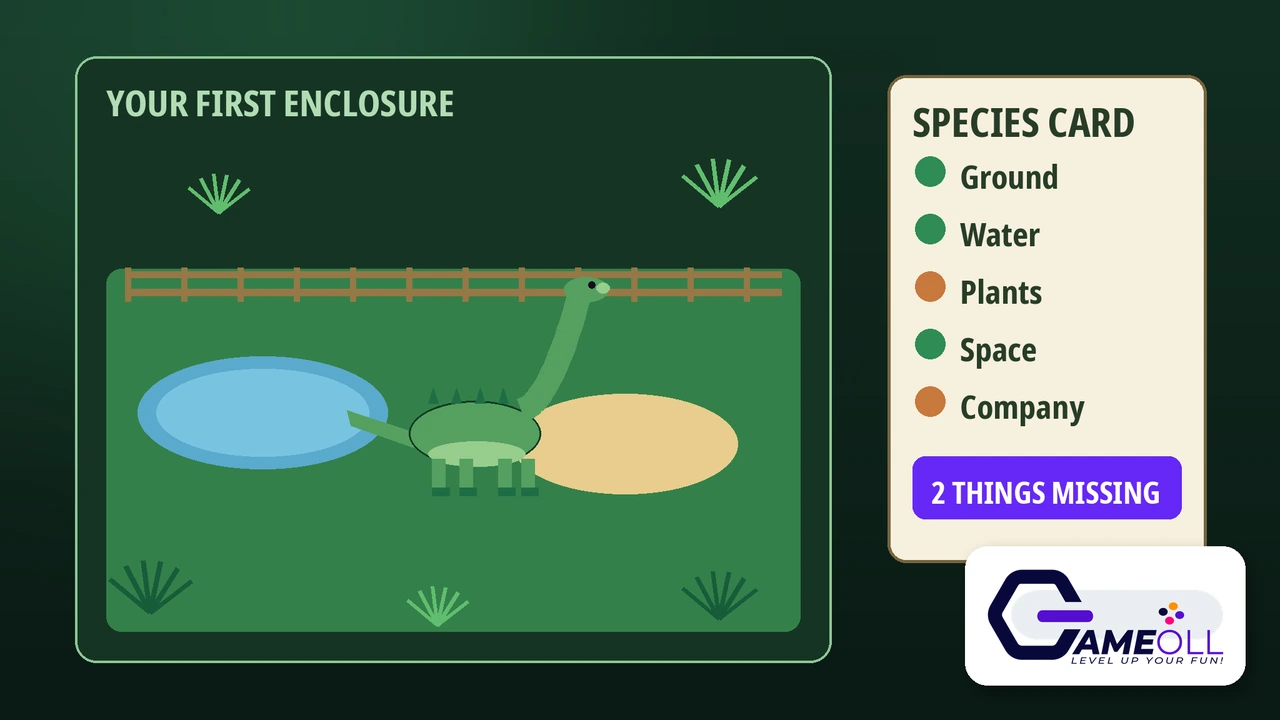
- Paint the ground before you add the animal. Give the enclosure a pond, a patch of sand or grass, and a few ferns or palms. Each species wants its own mix, and the species card tells you what is still missing.
- Add a path and one food stand. Visitors need a way to reach the enclosure, and they get hungry while they watch. A path plus a food stand turns a pen into a park.
- Watch your dinosaurs and earn Knowledge. Just watching them teaches you things, and that Knowledge is the currency for the research board. Do not rush past this step, because research is how your park grows.
- Hire one keeper early. Keepers walk up to the enclosures and toss hay or meat into the feeders, so your dinosaurs stay fed while you plan the next enclosure.
Enclosures that keep dinosaurs happy
Happiness is the whole game in one word. A happy dinosaur eats, rests, plays and, if it has a mate, lays eggs. A hungry or bored dinosaur tests its fence, and sometimes it gets out.
When a dinosaur escapes, the visitors run, and your rangers go after it with a tranquilizer dart. Keep the herds fed and busy and it rarely comes to that. A bored dinosaur is a testing dinosaur, so one toy in each enclosure is one of the cheapest happiness buys in the game.
Every species has its own needs: food, water, the right ground, enough space, plants to hide in, toys, and the company of its herd. The species card is your best friend here. It tells you exactly what is missing in an enclosure, so check it every time you build or change something.
If the card says the dinosaur needs water, paint a pond. If it says it needs company, add a second animal of the same species. Anything you build can be picked up later and moved, so a mistake is never permanent.
| What to build | What it does | Beginner tip |
|---|---|---|
| Fences | Keep dinosaurs in and visitors safe | Match the fence to the animal, never the other way round |
| Ponds and sand | Give species the ground and water they want | Paint them before the animal moves in |
| Ferns, palms and trees | Give cover, shade and the right plants | Read the species card first, then plant |
| Toys | Keep curious animals busy and happy | Add one toy per enclosure early |
| Paths and viewing towers | Let visitors see the animals well | Build the path before the crowds arrive |
Fences deserve special care, because not every fence holds every dinosaur. The game offers hedges, wood, steel, log palisades, stone walls, electric fences, armoured glass and carved Portal stone. A Parasaurolophus is fine behind a hedge, but a T. rex needs the strongest kind.
An electric fence holds only while it has power, so a storm that cuts the power can leave a T. rex behind a dead fence. If you are unsure, build stronger than you think you need. The extra cost is cheaper than an escape.
Toys are easy to forget and quick to fix. Mud wallows, sand baths, giant balls, swinging logs, waterfall showers and hanging meat all keep animals busy and happy. If escapes still worry you, the game has a calm option: escapes can be switched off in the options menu, so you can learn first and turn them back on when you feel ready.
Research first: spend Knowledge on the right things
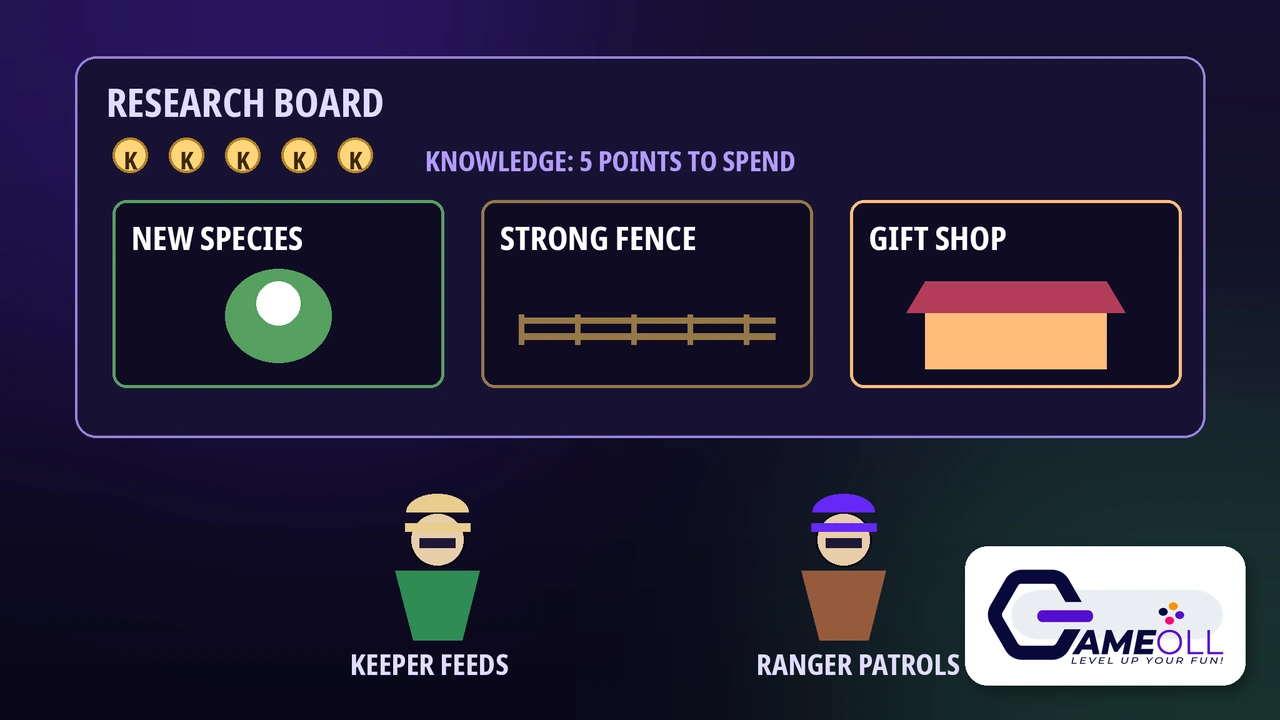
Knowledge is the quiet engine of the game. Your dinosaurs teach you as you watch them, and the longer you keep a species, the more you learn about it. You spend that Knowledge on the research board, where your scientists get to work unlocking new species, shops, plants, fences and lasting upgrades.
Spend your first Knowledge in this order. First, unlock a new species or two, because new animals bring new visitors and new Knowledge. Second, unlock fences and plants that fix what your species cards keep asking for.
Third, unlock shops and visitor buildings, because happy visitors spend money and the park grows level by level. Lasting upgrades can wait until your enclosures are already working well.
Two more systems reward patient players. The Paleopedia fills with real paleontology as you discover each species, so the game teaches you true facts about the animals you keep. Every animal also carries its own genes and colours, so you can breed stronger herds and rare colour morphs, and trade animals with other parks on the animal market.
A few legendary animals even glow at night. Expeditions are the other way your collection grows: send teams through the Portal into the Triassic, the Jurassic or the Cretaceous, and they bring back Knowledge, eggs and stories. Happy pairs in your own park lay eggs too, and the babies trot after their parents.
Visitors, staff and park level
Visitors come through the Portal in groups, eat ice cream, take photos, and go home with a story if the park treated them well. Keep them happy and the park grows level by level, from a few pens to a whole valley. That growth is your real progress bar.
Visitors need more than dinosaurs. Paths and skywalks, viewing decks and observation towers help them see the animals. Food stands, a café, a gift shop full of plush dinosaurs, guided tours, a safari ride through the herds and helicopter flights over them all give visitors reasons to stay longer and spend more.
Build one visitor building at a time, and put it where the crowds already walk. Staff keep the park running while you plan. Keepers feed the animals, rangers patrol, tidy up and mend the fences, and vets cure sick animals with a medicine dart.
Hire a keeper first, add a ranger when you have more than one enclosure, and call a vet the moment an animal looks sick. A small team hired early is worth more than a big team hired late.
Daily events, seasons and storms
Something happens every day in the park. A school trip arrives, a film crew sets up, or a festival lights up the sky with fireworks. Each event changes what your visitors want, so check the day’s event before you start building for the day.
The year itself turns through four seasons: rainy, dry, storm and cool, and it ends with the Yearly Awards Gala. Seasons change, rain brings out the umbrellas, and at night the lamps come on.
The season to respect most is storm season, because a storm can cut the power to your electric fences. Check your fences before a storm, and think twice before keeping a T. rex behind an electric fence alone. Pterosaurs fly in the aviaries and plesiosaurs swim in the lagoons, so save those builds for later, once your park can afford the staff and fences to look after them properly.
Seven habits for your first session
- Start small on purpose. One enclosure, one species, one food stand. A park that works small will grow well, and a park that starts too big will fight you all day.
- Read every species card before you build. The card tells you what is missing, and building to the card is faster than guessing and rebuilding.
- Feed and entertain before you expand. Full feeders and one toy per enclosure keep dinosaurs calm while you save Knowledge for research.
- Build the fence for the animal you will have, not the one you have now. Babies grow up, and a fence that holds a young dinosaur may not hold an adult T. rex.
- Spend Knowledge as soon as you have enough for something useful. Knowledge sitting unspent is a new species or a better fence you do not have yet.
- Walk the park like a visitor. Follow your own paths, check the views from the towers, and fix the spot where the crowd stops moving.
- Save before a storm. A storm can cut power to electric fences, so check your fences and your rangers before the weather turns, and remember you can switch escapes off in the options while you learn.
Jurassic Architect questions
How much does Jurassic Architect cost?
Steam lists no price for Jurassic Architect yet, so no price is printed in this guide. The game launches on Tuesday, November 24, 2026, on Windows only. Check the Steam store page at purchase time for the current price.
Is there a free demo for Jurassic Architect?
No. Steam lists no free demo for Jurassic Architect, so you cannot try it before you buy it. The game is a single-player park builder, and this guide covers the first 30 minutes so your first session starts well.
Can you turn off dinosaur escapes in Jurassic Architect?
Yes. Escapes can be switched off in the options menu, and a hungry or bored T. rex will test its fence and sometimes get out, so your rangers go after it with a tranquilizer dart. If you want a calm park while you learn, switch escapes off and turn them back on when you feel ready.
Final verdict
Jurassic Architect is a gentle, cozy park builder with a clear first goal: one happy enclosure, then research, then a second one. It launches on Tuesday, November 24, 2026, on Windows only, with no price listed yet and no free demo. Start small, read the species cards, keep the dinosaurs fed and busy, and spend your Knowledge on new species and better fences.
📖 See Jurassic Architect on Steam 🎮 See All Free Games