
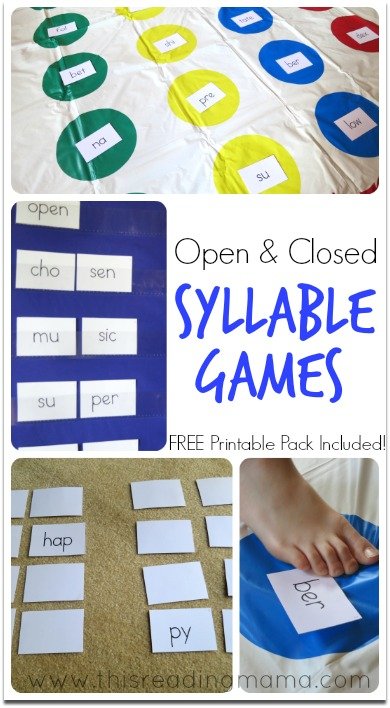
Open and closed syllable games help students practice identifying syllable types, boosting reading and spelling skills through fun, interactive activities.
Do you struggle with teaching syllables? Maybe your students need a more engaging way to learn. Open and closed syllable games offer a playful approach to phonics instruction.
These games make learning syllable types enjoyable. Students actively participate while reinforcing their understanding of reading rules.

`
Open and Closed Syllable Games
`
Understanding open and closed syllables is fundamental to reading and spelling success. These concepts unlock phonics skills.
These skills are crucial for decoding unfamiliar words. They also aid in accurate encoding when writing.
What are Open and Closed Syllables?
An open syllable ends in a vowel sound. The vowel typically says its long sound (e.g., “go,” “be,” “hi”).
A closed syllable ends in a consonant. The vowel typically says its short sound (e.g., “cat,” “dog,” “up”).
Why Teach Open and Closed Syllables?
Recognizing syllable types helps with pronunciation. It supports accurate spelling.
Students learn to predict vowel sounds. This builds reading fluency and comprehension.
Engaging Games for Teaching Open and Closed Syllables
Many games can make learning these concepts fun and interactive. We will cover a variety of engaging methods below.
Syllable Sort
Create cards with single-syllable words. Include both open and closed syllable examples.
Have students sort the cards into two categories: “Open Syllable” and “Closed Syllable.” This reinforces recognition.
Word Building with Tiles
Use letter tiles to build words. Focus on creating open and closed syllables.
For example, build “he” (open) and “hen” (closed). Encourage students to say the sounds.
Open or Closed? A Movement Game
Call out a word. Students perform a corresponding action based on the syllable type.
For example, if you say “so,” students stretch their arms wide (open). If you say “sock,” they clap their hands (closed).
Syllable Bingo
Create bingo cards with open and closed syllable words. Call out words, and students mark them on their cards.
The first student to get bingo wins. This provides repetitive practice in a fun format.
Mystery Word Game
Provide clues to a word that is either an open or closed syllable. Students guess the word based on the clues.
The clues should reference syllable type to help them. This challenges their understanding in a different way.
Digital Games and Apps
Utilize online resources for interactive practice. Many apps and websites offer syllable-focused games.
These can provide immediate feedback and personalized learning experiences.
Advanced Open and Closed Syllable Games
These games build upon basic understanding. They target multisyllabic words.
Multisyllabic Word Breakdown
Provide multisyllabic words. Students break them down into individual syllables.
Then, they identify each syllable as open or closed. This encourages analytical skills.
Syllable Division Rules Practice
Teach the rules for dividing words into syllables. Use games to practice applying these rules.
This deepens understanding of word structure. It also improves decoding skills.
“I Have, Who Has” Syllable Game
Create cards with “I have…” and “Who has…” statements related to syllables. This game encourages active listening and participation.
Example: “I have the word ‘table’. Who has a word with an open syllable?”
Sentence Building with Syllables
Provide syllables on cards. Students create sentences using those syllables to form words.
This integrates syllable knowledge into sentence construction. It encourages creativity and wordplay.
Rhyming with Open and Closed Syllables
Challenge students to find rhyming words. Focus on words with specific syllable types.
For example, find a word that rhymes with “me” (open syllable) or “hat” (closed syllable). This reinforces the connection between sound and structure.
Open and Closed Syllable Games for Different Learning Styles
Consider adapting games to suit different learning styles. Incorporate visual, auditory, and kinesthetic elements.
Visual Learners
Use color-coded cards to represent open and closed syllables. Create charts and diagrams illustrating syllable types.
Provide visual aids to support understanding. This helps these students connect with the material.
Auditory Learners
Focus on games that involve listening and speaking. Use rhymes, songs, and chants to reinforce syllable concepts.
Read aloud words and sentences, emphasizing syllable sounds. This caters to their auditory processing strengths.
Kinesthetic Learners
Incorporate movement and hands-on activities. Use letter tiles, building blocks, or manipulatives to create words and syllables.
Have students act out syllable types. This brings the concepts to life.
Creating Your Own Open and Closed Syllable Games
Design games tailored to your students’ needs and interests. Use readily available materials.
Adapt existing games to incorporate syllable focus. This promotes engagement and ownership of learning.
Using Common Household Items
Turn everyday objects into learning tools. Use beans, buttons, or toy cars as markers for syllable games.
Create a “syllable hopscotch” on the floor. This makes learning fun and accessible.
Adapting Board Games
Modify existing board games to focus on syllables. Create new rules that incorporate syllable identification.
This leverages familiar formats for educational purposes. It also adds a new challenge to classic games.
Incorporating Technology
Use online tools and apps to create interactive games. Design digital flashcards or quizzes on syllables.
Utilize multimedia elements to enhance engagement. This caters to tech-savvy learners.
Addressing Common Challenges
Some students may struggle with syllable identification. Provide targeted support and differentiated instruction.
Confusion with Vowel Sounds
Review the difference between long and short vowel sounds. Use visual aids to reinforce these concepts.
Provide ample practice with minimal pairs (e.g., “bit” vs. “bite”). This helps students distinguish the sounds.
Difficulty Dividing Words into Syllables
Teach the syllable division rules explicitly. Use visual cues and mnemonics to aid memory.
Provide guided practice with increasingly complex words. This builds confidence and proficiency.
Lack of Engagement
Make learning fun and relevant. Incorporate games, activities, and real-world examples.
Provide opportunities for students to collaborate and share their learning. This fosters motivation and engagement.
The Importance of Ongoing Practice
Regular practice is essential for mastering open and closed syllables. Incorporate syllable activities into daily routines.
Daily Phonics Warm-ups
Start each reading lesson with a quick syllable review. Use flashcards, short games, or oral drills.
This reinforces learning and prevents forgetting. It keeps syllable knowledge fresh in students’ minds.
Integration into Reading and Spelling Instruction
Explicitly teach syllable types during reading and spelling lessons. Connect syllable knowledge to decoding and encoding skills.
Provide opportunities for students to apply their knowledge in authentic contexts. This demonstrates the practical value of syllable understanding.
Home Practice Activities
Provide parents with simple syllable activities to do at home. Suggest games, word sorts, or reading exercises.
Encourage families to support their child’s learning outside of the classroom. This reinforces concepts and promotes a love of reading.
Tracking Student Progress
Monitor students’ understanding of open and closed syllables. Use formative and summative assessments to track progress.
Informal Assessments
Observe students during games and activities. Note their ability to identify and manipulate syllables.
Use this information to adjust instruction and provide targeted support. This ensures that all students are progressing.
Formal Assessments
Use quizzes, tests, and writing samples to assess syllable knowledge. Track student performance over time.
Identify areas where students need additional support. This informs future instruction and intervention efforts.
Data-Driven Instruction
Use assessment data to inform instructional decisions. Tailor instruction to meet the specific needs of your students.
Provide individualized support and challenge for all learners. This maximizes student growth and achievement.
Examples of Open and Closed Syllable Games
Here are some more detailed examples of engaging games you can use. These will show you how to make the lessons more fun.
Open and Closed Syllable Board Game
Create a game board with spaces representing open and closed syllables.
Players roll a die and move their game piece.
When they land on a space, they must say a word that matches the syllable type.
If they are correct, they stay on the space. If incorrect, they go back to their previous space.
The first player to reach the end wins.
“Go Fish” with Syllables
Create cards with words representing open and closed syllables.
Players try to make matches of words with the same syllable type.
“Do you have a word with an open syllable like ‘so’?”
The player with the most matches at the end wins.
Syllable Relay Race
Divide the class into teams.
Place sets of syllable cards at the end of the room.
One player from each team runs to the cards, chooses a syllable card, and runs back to their team.
They must correctly identify if it’s an open or closed syllable.
If correct, their team gets a point. The team with the most points wins.
Creating Sentences with Syllables
Write individual syllables on separate pieces of paper.
Give each student a selection of syllables.
Have them create sentences using words formed from those syllables.
Encourage creativity and humor in their sentences.
The Impact of Play-Based Learning
Games make learning fun and engaging. Students are more likely to remember concepts when they are presented in a playful way.
Play-based learning reduces anxiety and increases motivation. It creates a positive learning environment.
Differentiating Instruction with Games
Games can be easily adapted to meet the needs of different learners. You can adjust the difficulty level, complexity, and pacing of games.
Provide modifications and accommodations to ensure that all students can participate and succeed. This fosters inclusivity and equity.
Using Games to Assess Understanding
Games provide opportunities to assess student understanding in a fun and non-threatening way. Observe students as they play.
Note their ability to identify and manipulate syllables. Use game performance to inform instructional decisions.
Open and Closed Syllables: Common Misconceptions
It’s important to address common misconceptions about open and closed syllables. These include:
- All vowels at the end of a word are open: This is not true. Some words ending in vowels can be modified, impacting the sound.
- All consonants at the end of a word close the syllable: While often true, consonant digraphs and blends need special attention.
- Open syllables are always long: While typically long, vowel teams can create alternative sounds.
Addressing these misconceptions directly will aid in student comprehension. It promotes accurate understanding of syllable types.
Open and Closed Syllable Games: A Summary
Using games to teach open and closed syllables is highly effective. This approach makes learning fun, engaging, and memorable.
By incorporating a variety of games into your instruction, you can cater to different learning styles. You can also address common challenges.
Continuous practice and assessment are essential. This allows students to master these fundamental reading skills.
What is a Syllable? | Open and Closed Syllables | Kids Academy
Final Thoughts
Open and closed syllable games must be an engaging way to reinforce phonics skills. Games make learning fun and less intimidating for students.
The focus on these games should be the core of your teaching. It is important for literacy development.
Therefore, use open and closed syllable games to solidify understanding. They are simple and effective teaching aids.

