
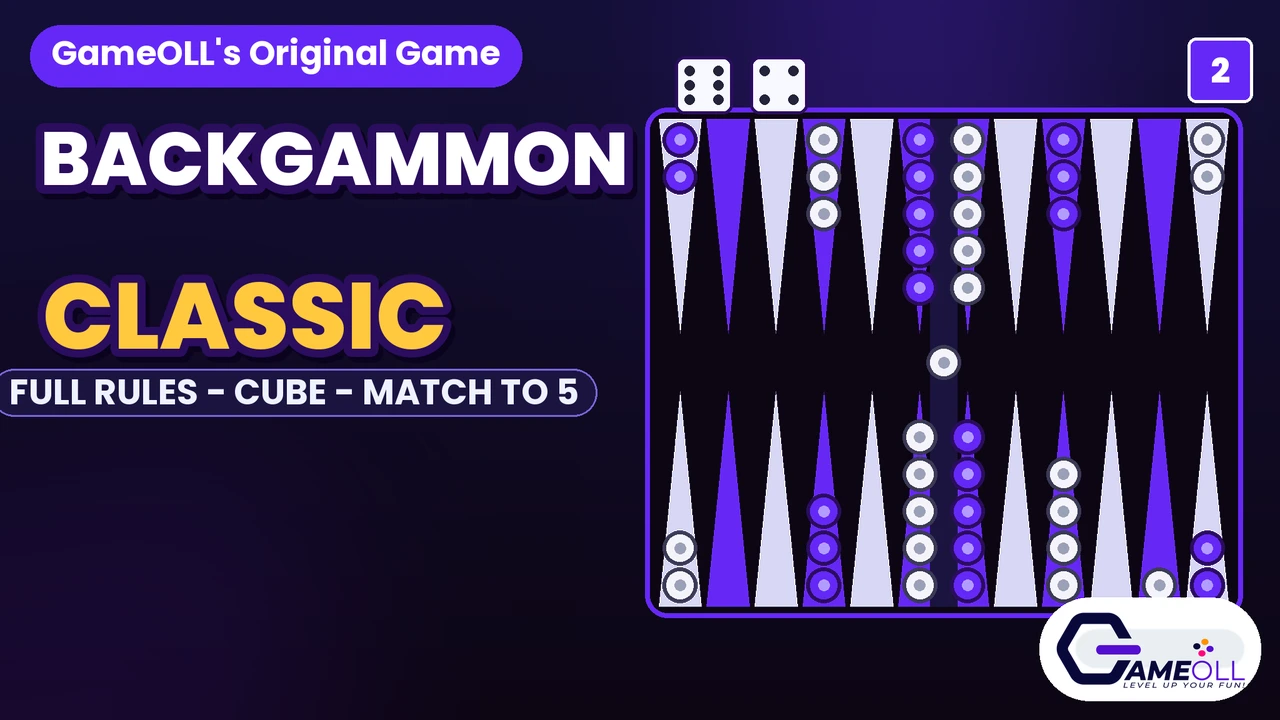
Home » Play Games » Backgammon
Press Play to start a match.
Tap a checker, then a glowing point • Hit lone enemy checkers to send them to the bar • Double the cube when you are ahead
A backgammon game with the full, real rules, playable right here for free. This is Backgammon Classic, an original GameOLL board game. Every rule of the classic game is in: hitting blots, re-entering from the bar, exact bearing off, the doubling cube up to 64, gammon and backgammon scoring, and match play to five points against a proper AI opponent. The board is drawn tall for your phone, the dice are honest, and every legal move glows when you tap a checker. No download. No sign-up. No watered-down rules.
Genre
Board Game · Dice
Players
1 Player vs AI
Platform
Browser · Mobile · PC
Price
Free
In this guide
- How to play
- The full rules
- The doubling cube, gammon and match play
- Meet your AI opponent
- Opening rolls worth knowing
- 7 tips to win more games
- Backgammon game FAQ
- Final verdict
How to play Backgammon Classic
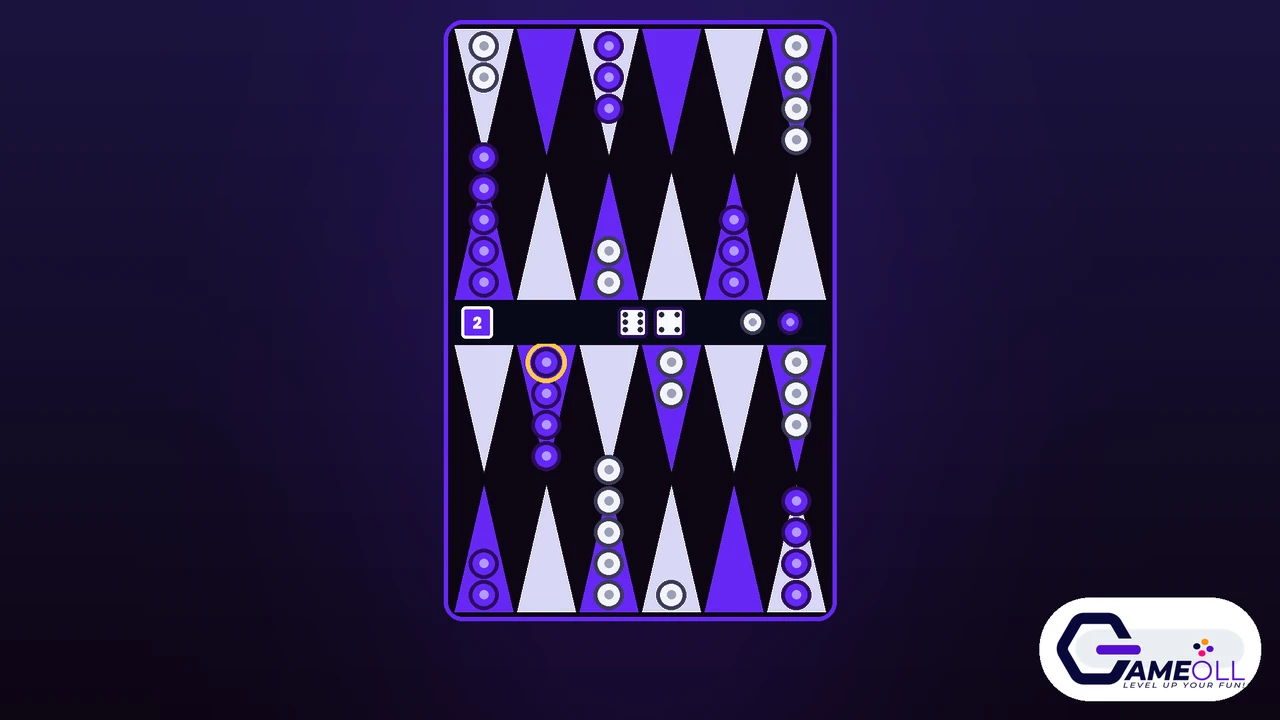
Backgammon is a race with a fight in the middle. You and the AI each own 15 checkers on a board of 24 narrow triangles called points. Your purple checkers travel from point 24 down to point 1, gather in your home board (points 1 to 6), and then bear off the board. White travels the other way. First side to bear off all 15 checkers wins the game — and the doubling cube decides how much the win is worth.
- Press Play and pick a format: a match to five points, or a single game. Then pick your AI: Casual, Club or Master. Every game starts with a roll-off — you each throw one die, the higher throw opens the game with both dice, and ties are thrown again.
- Roll, then move. On your turn you may first offer the doubling cube (see below). Then tap Roll. Each die moves one checker forward by that many points. A double — two equal dice — moves four times instead of two.
- Tap a checker, then tap a glowing point. With hints on, every checker that can move is ringed, and once you tap one, its legal landing points glow gold. The game enforces the real dice rules for you: you must use both dice when you can, and if only one die can be played and either would work alone, you must play the higher one.
- Hit blots. A point holding one lone enemy checker is a blot. Land on it and that checker goes to the bar in the middle of the board. A point with two or more enemy checkers is made — it is blocked, and you can never land there.
- Come in from the bar first. If any of your checkers are on the bar, nothing else may move until they re-enter in the enemy home board, on the point matching a die. If both entry points are blocked, your turn is lost — that is the real rule, and it stings exactly as much as it should.
- Bear off and win. Once all 15 of your checkers are inside your home board, you may bear them off with exact rolls — or with a higher roll from your highest occupied point, never from a lower one while a higher point still holds a checker. Bear off the last checker to win the game and bank the points.
Controls for phone and PC
| Action | Phone / tablet | PC / laptop |
|---|---|---|
| Move a checker | Tap the checker, then tap a glowing point | Click the checker, then click a glowing point |
| Re-enter from the bar | Tap the bar strip, then tap a glowing entry point | Click the bar strip, then click a glowing entry point |
| Bear a checker off | Tap the checker, then tap the gold OFF tab | Click the checker, then click the gold OFF tab |
| Roll the dice | Tap Roll under the board | Click Roll under the board |
| Offer the doubling cube | Tap Double before you roll | Click Double before you roll |
| Answer a double | Tap Take or Drop on the offer panel | Click Take or Drop on the offer panel |
| Undo a turn | Tap Undo (Casual single games only) | Click Undo (Casual single games only) |
| Sound on or off | Tap the speaker button | Click the speaker button |
The full rules, plainly stated
Movement. A turn is two dice, played one checker at a time, in either order. A double is four moves of the same number. You must use as many of your dice as the position allows — passing on a playable die is not allowed, and when only one die can be played but each die has a legal move on its own, the higher die must be the one played. The game checks all of this on every tap, so you can think about strategy instead of bookkeeping.
Hitting and the bar. Landing on a blot sends it to the bar. A player with a checker on the bar must re-enter before moving anything else, entering into the opponent home board: your entry points are 24 down to 19, rolled with the matching die — a roll of 3 enters on point 22. Entry onto a made point is impossible, onto a blot is a hit. If neither die can enter, the whole turn is forfeited.
Bearing off. You may bear off only when every one of your checkers is home. An exact roll takes a checker off its own point. A higher roll may take a checker off only from the highest point you still occupy — with checkers on points 5 and 2, a roll of 6 takes the checker from point 5, never from point 2. Get hit during the bear-off and that checker must travel all the way around again before you may bear off anything else.
The doubling cube, gammon and match play
The cube. The doubling cube starts in the middle at 1, owned by neither side. Before you roll, if the cube is in the middle or it is yours, you may offer a double. Your opponent can take — the cube doubles (2, 4, 8, up to 64), passes to them, and only they may offer the next double — or drop, which ends the game at once and pays you the cube value as it stood before the offer. The AI judges offers the way a club player does: it doubles when its position is strong but not yet overwhelming, and it drops offers it no longer believes in.
Gammon and backgammon. Win a normal game and you score the cube value. Win while your opponent has borne off no checkers and the game is a gammon: double points. Win while your opponent has borne off none and still has a checker on the bar or inside your home board, and it is a backgammon: triple points. These are the scores that swing matches, and they are why a beaten opponent should sometimes drop early.
Matches. A match is a race to five points across as many games as it takes, with a fresh roll-off and a fresh cube at 1 before every game. One honest house note: this game does not use the Crawford rule — the cube stays live in every game of the match, including the one that could end it. Your match score sits above the board at all times, and an unfinished match is remembered if you leave and come back.
Meet your AI opponent
The AI reads the same board you do. It weighs the racing pip count, exposed blots, made points and primes, home-board strength, and checkers on the bar, then picks the move it likes best — and it makes its cube decisions from the same reading. The three levels differ in how faithfully it follows that judgement.
| Level | How it plays | Play it when |
|---|---|---|
| Casual | Sound moves with regular lapses, and one turn in five is a genuine roll of the dice. It also unlocks the Undo button in single games. | You are learning, or you want a relaxed game with take-backs |
| Club | Its full judgement with a small human wobble. It hits, builds primes and doubles sensibly. | You know the rules and want a fair fight |
| Master | Its best move every single turn, no mercy and no noise. Cube play is at its sharpest here. | You want to measure yourself honestly |
Opening rolls worth knowing
The first roll of a game is the only one where best play is fully mapped. The two dice from the roll-off are your opening roll, so these six replies come up constantly. Point numbers below are yours: your home board is 1 to 6, the midpoint is 13, your back checkers start on 24.
| Roll | The classic play | Why it works |
|---|---|---|
| 3-1 | Make the 5 point: 8/5 and 6/5 | The 5 point is the best point in your home board — a landing wall for you and a wall against the enemy |
| 4-2 | Make the 4 point: 8/4 and 6/4 | The second-best home point, made cleanly with no blots left behind |
| 6-1 | Make the bar point: 13/7 and 8/7 | The 7 point blocks enemy checkers trying to escape past your midpoint |
| 2-1 | Slot the 5 point: 6/5, and bring one down 13/11 | You threaten to make the golden point next turn while a builder comes down |
| 6-5 | Run a back checker: 24/13 | The famous leap — one checker escapes all the way to the midpoint in a single roll |
| 1-1 | Make the bar point and the 5 point: 8/7 twice, 6/5 twice | Doubles are point-making gold: four small moves build two walls at once |
Backgammon Classic or Checkers Master?
GameOLL already keeps another classic board duel: Checkers Master, a game of forced captures and long forced chains where every move is pure calculation. Backgammon is its rowdier cousin. The dice mean a weaker player can beat a stronger one in a single game — and the doubling cube means the stronger player wins the match anyway, by knowing when to press and when to fold. Prefer no dice at all but still want a duel? Connect Four Duel is pure tactics. All three live one tap apart on the Play Games hub.
7 tips to win more games
- Make points, not blots. A made point works for you every turn: it blocks, it shelters, it builds primes. A blot is a target. When a roll offers both a made point and a flashy hit, the quiet point is usually worth more.
- Build the prime. Three or more made points in a row are a wall the enemy cannot jump — they must roll the exact number that clears the last point, and every failed roll wastes a turn while your other checkers race home.
- Hit when it hurts them most. A hit in your home board sends a checker back 20 points of travel and costs them at least a turn. A hit far away, with your own blot left exposed in return, often trades even. Hit close to home; be stingier far away.
- Watch the pip count. It is the race score: the total distance your checkers still have to travel. The chips and the AI both respect it. If you are 20 pips ahead, race — break contact and run. If you are 20 behind, stay back, hold an anchor in their home board, and wait for a shot.
- Double earlier than feels safe. Most beginners double too late, when the game is already won and the opponent simply drops for one point. The profitable double comes while you are clearly ahead but the game is still alive — that is when takes happen and big points get scored.
- Drop the lost causes. Taking a double you win less than a quarter of the time is paying double for a funeral. When the cube comes and your board is a ruin, drop it, pay the single point, and spend your luck on the next game.
- Bear off tidy. Keep your home checkers spread across the points instead of stacked on one. A spread board uses every roll; a stacked board wastes high dice on empty points and can leave an ugly blot at the worst moment.
Backgammon game FAQ
Is Backgammon Classic free to play?
Yes. Backgammon Classic is 100% free, with full rules, all three AI levels and match play included. You play it right on this page in your browser. There is no download, no sign-up and no payment.
How do you play a backgammon game?
Roll two dice and move your checkers forward by the numbers shown, from point 24 down to point 1. Land on a lone enemy checker to hit it to the bar, where it must re-enter before anything else moves. Once all 15 of your checkers are in your home board (points 1 to 6), bear them off with exact rolls. Bear off all 15 first to win the game.
What is the doubling cube?
The doubling cube sets the stakes of a game. Before rolling, the player who may offer it can propose doubling the value — 1 becomes 2, then 4, 8, up to 64. The opponent must take, and own the cube and the new value, or drop and lose the game at the value the cube showed before the offer.
What are a gammon and a backgammon?
A gammon is a win where the loser has borne off no checkers at all, and it scores double the cube value. A backgammon is a win where the loser has borne off none and still has a checker on the bar or in the winner home board, and it scores triple.
How strong is the AI?
There are three levels. Casual plays sound moves with regular lapses and allows undo in single games. Club plays its full judgement with a small wobble. Master plays its best move every turn. At every level the AI weighs the pip count, blots, primes, home-board strength and the bar, and it makes its own doubling decisions.
Does Backgammon Classic save my progress?
Yes, in your own browser. Your match score, lifetime stats, best game score, difficulty, sound and hint settings all save automatically. An unfinished match is still waiting when you come back. Nothing leaves your device, and there is no account to make.
Final verdict: should you play Backgammon Classic?
Yes — if you want the real game, not a demo of it. Most free backgammon games quietly drop the hard rules: no bar forfeits, soft bearing off, a cube that is decoration. This one keeps all of them, then wraps them in a tall phone-friendly board with glowing legal moves, a roll-off before every game, three honest AI levels and matches to five that remember where they stopped. The dice will still betray you at the worst possible moment — but here, as at a real table, that is the opponent you were promised.
▶ Play Backgammon 🎮 See All Free GamesLast updated: November 7, 2026. Backgammon Classic v1.0 — the first release of our original backgammon game, with full official rules, a doubling cube to 64, gammon and backgammon scoring, match play to five points, three AI levels and an opening roll-off. An original GameOLL browser game. Found a bug? Tell us in the comments and we will fix it in the next version.