
Home » Play Games » Chinese Checkers
Press Play to start. Race all ten pieces into the far triangle.
Tap a piece, then a glowing hole • Chain jumps to leap across the board • You may stop a chain after any hop
Chinese Checkers Game: Play Chinese Checkers Free Online
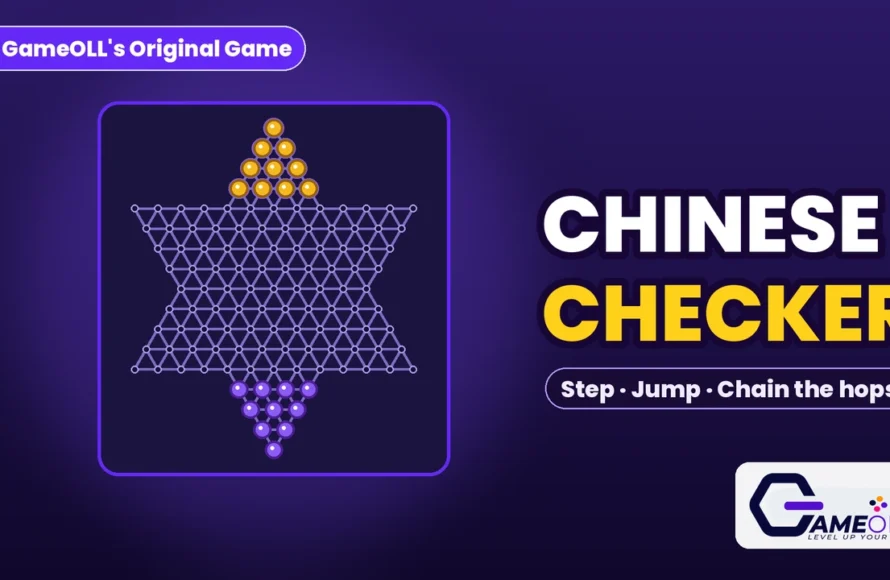
Chinese Checkers is a race, not a fight. Nobody captures anything. Nobody gets sent home. Ten pieces start in your corner of a big star-shaped board, and the whole game is one question: how fast can you get all ten across the board and into the triangle on the far side? The magic is in the jump. Leap over one piece, land in the empty hole behind it, and you may jump again. And again. A well-built ladder of pieces can carry one of yours across half the board in a single turn.
There is no download, no sign-up and no waiting for other players. Race the AI on three levels, from a relaxed Casual game to a Master that plans a reply to your best move. Take on two AI rivals at once in the three-corner Trio Race. Or pass the device to a friend and play a two-player game on the same board. The board is right above this text, and your first race is one tap away.
Free in your browserThree AI levelsTrio race vs two AITwo-player modeNo download
Genre
Board · Strategy · Race
Players
Vs AI, Trio, or 2 players
Game length
About 10 to 25 minutes
Win by
Fill the far triangle
In this guide
- How to play Chinese Checkers
- The star board and its 121 holes
- Jump chains, hop by hop
- Three ways to play
- The three AI levels
- Strategy that wins races
- Questions and answers
How to play Chinese Checkers
Press Play and the board is live. You play the purple pieces at the bottom of the star, and purple always moves first. Your home triangle is the ten holes at the bottom point of the star. Your target is the triangle at the very top, straight across the board. Every piece you own has to end the race inside that far triangle. The first side to get all ten of its pieces home wins, and the win is checked the moment your turn ends.
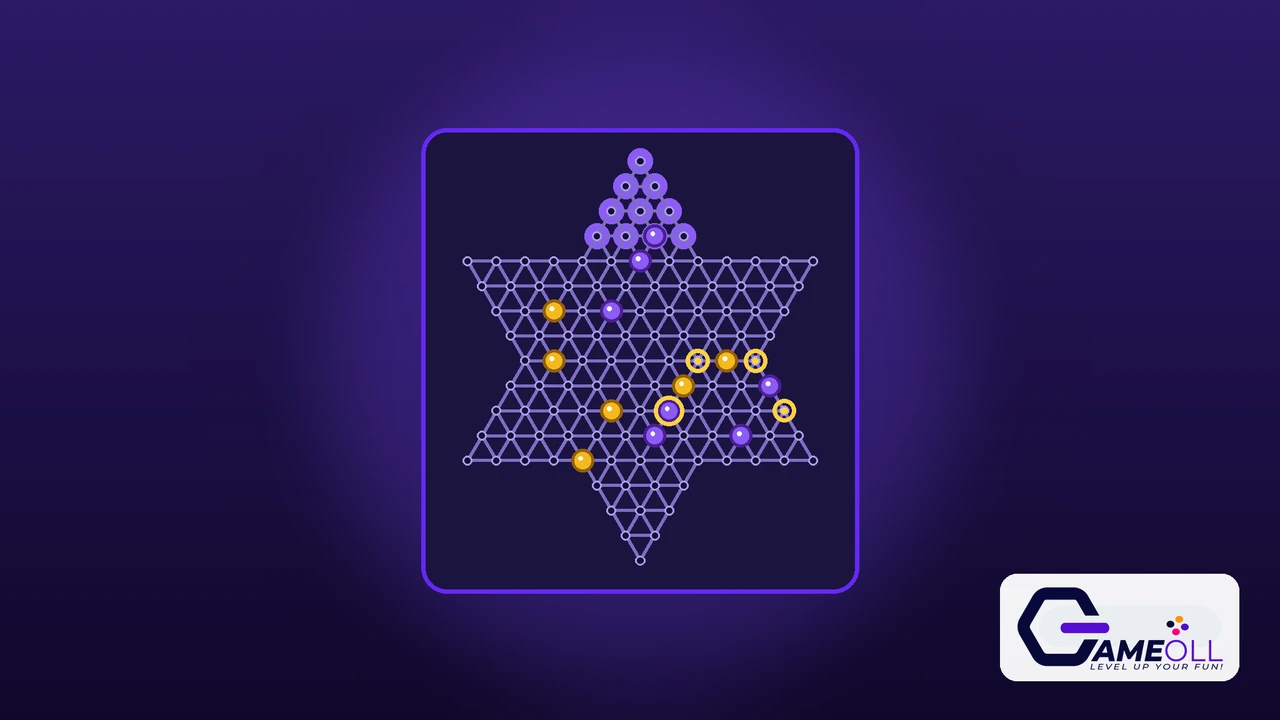
A turn moves exactly one piece. Tap one of your pieces and its legal landings light up in gold. Tap a glowing hole to move there. There are two kinds of move. A step slides the piece into a neighbouring empty hole. A jump leaps over one piece, any piece at all, into the empty hole directly behind it. After a jump, the same piece may jump again, and you choose when to stop. Tap the moving piece a second time, or press the End Turn button, and the turn passes on.
The score chips above the board do the bookkeeping for you. They show how many pieces each side has home, the move count and the race clock. A game in progress saves itself on your device after every hop, so a closed tab or a flat battery never costs you a race. Come back to the page and the game is restored exactly where you left it, even in the middle of a jump chain.
The New game button starts a fresh race with the same settings. Resign hands the current race to the other side when a position is truly lost. There is no undo in this game, and that is deliberate. A race rewards the player who looks before they leap, and every hop you commit to is a hop you own. Think of it as the house rule that keeps everyone honest.
The star board and its 121 holes
The board is a six-pointed star with 121 holes. The middle is a hexagon. Six triangles point out from it, one for each corner of the star. Each triangle holds exactly ten holes, arranged in rows of one, two, three and four. In a duel, two opposite triangles are the start and target. In the Trio Race, three corners play at once, each racing to the corner directly opposite its own.
Every hole touches up to six neighbours along the printed lines of the lattice. Those lines are the whole geometry of the game. Steps follow them one hole at a time. Jumps follow them two holes at a time, over exactly one piece. There are no diagonal surprises hiding off the lines, and no hole is special. The board is perfectly fair, perfectly symmetrical, and small enough to read at a glance once you learn to see it in lanes.
It helps to see the board as three pairs of lanes rather than as a scatter of holes. One lane runs straight up the middle, from your point to the far point. Two more lanes run at angles, crossing the centre. Most long jump chains travel along these lanes, because a chain needs pieces spaced one hole apart in a straight line. When you look at the board, look at the lanes first. Ask which lane is closest to finished, and which lane your slowest piece should join.
One more thing worth knowing: despite the name, the game is not from China, and it is not checkers. It was invented in Germany in 1892 as a game called Stern-Halma, then renamed in America in the 1920s because an exotic name sold more copies. The rules on this page are the classic ones played around the world ever since, with every piece, jump and lane exactly where tradition puts it.
Jump chains, hop by hop
The jump chain is the engine of the whole game. A single step moves a piece one hole. A single jump moves it two. But a chain of jumps, each one landing in an empty hole one step beyond a piece, can cross ten holes or more in one turn. The longest chains feel like magic the first time you play one. They are not magic. They are construction work you did three turns earlier.
| Move | How it works | When it shines |
|---|---|---|
| Step | Slide one piece into any neighbouring empty hole. | Fine adjustments, filling the last holes of the target triangle. |
| Jump | Leap over one adjacent piece, yours or theirs, into the empty hole right behind it. | Steady progress through the crowded middle of the board. |
| Jump chain | After any jump, the same piece may jump again, as many times as the holes allow. You may stop after any hop. | Crossing the board in one turn along a ladder of well-spaced pieces. |
Three details of the jump rule matter in practice. First, the jumped piece is never removed. It stays exactly where it is, ready to be jumped again on a later turn or to carry a chain for its owner. Second, a chain may not land on the same hole twice in one turn, and the game greys those holes out for you. Third, you never have to finish a chain. If the third hop would strand your piece in a bad spot, stop after the second. The glowing holes always show your real choices, so you can plan the whole chain before you commit to the first hop.
Watch how the AI builds its ladders and you will learn the core skill of the game. A ladder is just a line of pieces with one empty hole between neighbours, pointed where you want to go. Your pieces can be rungs for each other, and so can the rival pieces you meet in the middle. Strong players spend whole turns doing nothing but placing one rung in the right hole. It looks slow. Then one piece rides the whole ladder home in a single turn, and it does not look slow any more.
Three ways to play
One board, three races. All three use the same rules, the same star and the same finish line: all ten pieces inside the far triangle. What changes is who is racing you, and how crowded the middle of the board becomes. Pick from the Play row on the menu before you start.
| Mode | The race | Best for |
|---|---|---|
| vs AI | The classic duel. You race from the bottom point to the top point against one AI rival coming the other way. | Learning the game, then climbing the three AI levels. |
| Trio Race | Three corners play at once. You race upward while Gold races from the upper-left and Teal from the upper-right, each to the opposite corner. | Busy boards, borrowed ladders and chaotic jump chains. |
| 2 Players | Two people, one device. Purple moves first, Gold answers, and the board passes back and forth between you. | Playing a friend or family member on the same screen. |
The Trio Race deserves a special word, because it changes the feel of the game more than any setting. With thirty pieces on the board instead of twenty, the middle turns into a market of ladders. Rival pieces crossing your lane are not just obstacles. They are free rungs. A chain that hops off two of your pieces, one gold piece and one teal piece is perfectly legal, and the best Trio players hunt for exactly those mixed ladders. Just remember that the ladder you build for yourself today is a ladder your rivals may ride tomorrow.
The three AI levels
All three AI levels race by the same rules and see the same board. The difference is judgement. Each one weighs progress, stragglers and pieces home, but they weigh them with very different levels of care, and only the top level looks at what you will do next.
| Level | How it races | Best for |
|---|---|---|
| Casual | Honest moves with cheerful lapses. It usually takes a good hop, then daydreams and takes a loose one. | First games, and learning how chains work. |
| Club | Judges every legal move on the whole board: distance covered, the slowest piece, and pieces already home. | A real race against a thinking rival. |
| Master | Everything Club does, plus a look at your best reply. It will block the hole your best move wants to land on. | Players who want the full race, with no gifts. |
The jump from Club to Master is the honest one. Club plays the board in front of it. Master plays the board one reply from now. It is much harder to surprise, because the move you are most proud of is the first move it checks. One thing all three levels share: they hate leaving a camper behind. Late in a race, a piece still sitting in its own home triangle becomes the most urgent piece on the board, and every level will spend real tempo to pull it out before it gets walled in. Watch for that habit, and copy it.
Strategy that wins races
Build ladders, not blobs. Beginners push all ten pieces forward in a tight bunch, and then wonder why nothing moves. A bunch of pieces with no gaps can only step. A line of pieces with one empty hole between neighbours can fly. Spread your pieces along the lane you are travelling, one hole apart, and one piece at the back can ride the whole line forward. The best Chinese Checkers position often looks emptier than the worst one.
Race your slowest piece. The race is not won by your fastest piece. It is lost by your slowest one, because all ten pieces must finish. A piece still in your home triangle after everyone else has crossed is a disaster in slow motion: the far side fills up, paths close, and the late piece can get completely walled in by the rival’s finished triangle, with no legal move at all. Move your rearmost piece early and often, even when a flashy chain is calling from the front.
Borrow every ladder you meet. Jumped pieces are never captured, so rival pieces are free rungs on your ladder. In the crowded middle, the longest chains usually hop over a mix of your pieces and theirs. Do not waste turns moving around a rival piece that is standing exactly where your chain needs a rung. Jump it, thank it silently, and keep hopping. The same rule protects you: a piece you leave behind in the middle is a rung your rival will use, so park your stragglers where they help you, not them.
Fill the far triangle from the back. The hardest holes to fill are the deep ones at the tip of the target triangle, because once the front rows are full, nothing can reach them. Send your early arrivals all the way to the back rows and the tip. Leave the front holes of the triangle open as long as you can, so late pieces still have landing spots and jump lines. Players who fill the front first end up shuffling pieces sideways for turn after turn, hunting for a way in that they closed themselves.
Mind the campers in your target. Sometimes rival pieces are still sitting inside your target triangle late in the race, leftovers from their start that never crossed. You cannot finish until those holes are yours, and the campers must move out on their owner’s turns. Do not seal them in by accident: if a camper is completely surrounded, it has no legal move and can never leave. Keeping one lane open beside a camper is not mercy. It is how you get your triangle back.
Questions and answers
Is Chinese Checkers free to play here?
Yes. This Chinese Checkers game is completely free to play in your browser. There is no download, no sign-up and no limit on races. Your results, settings and any race in progress are saved on your own device only.
How do you win a game of Chinese Checkers?
You win by being the first side to get all ten of your pieces into the triangle on the far side of the star. The win is checked at the end of your turn. Nine pieces home is not enough, and there are no points for finishing second.
Can you jump over your own pieces?
Yes. A jump may pass over any single piece in the way, your own or a rival’s, as long as the hole directly behind it is empty. Jumping your own pieces is the main way to build long chains, and strong players set up ladders of their own pieces on purpose.
Do you capture pieces in Chinese Checkers?
No. Nothing is ever captured or removed in Chinese Checkers. A piece that gets jumped over stays exactly where it is. All twenty pieces, or thirty in the Trio Race, stay on the board from the first move to the last.
Can you stop a jump chain early?
Yes. After any hop you may stop and end your turn on that hole. Tap the moving piece again, or press the End Turn button. You never have to take the longest chain, and stopping early is often the smart play when the next hop would strand your piece.
Is Chinese Checkers the same as checkers?
No. They are different games that happen to share a word. Checkers is a capturing battle on a square board, where you take enemy pieces by jumping them. Chinese Checkers is a race on a star-shaped board with no captures at all. If you want the capturing game, this site has a separate Checkers game too.
Final verdict
Chinese Checkers earns its place on the board shelf because its best moments feel like flight. One quiet piece, standing at the bottom of a ladder you built three turns ago, suddenly hops the whole board in a single turn and lands one hole from home. This version keeps the classic race pure: the full 121-hole star, honest jump chains you may stop at any hop, three AI levels with a real top rung, a three-corner Trio Race, and a proper two-player mode for the same screen. Start on Casual, learn to build ladders, and work your way up. When you beat Master with all ten pieces home, you will have earned it the slow way, one hop at a time.
Last updated: November 8, 2026