Home » Play Games » Dots and Boxes
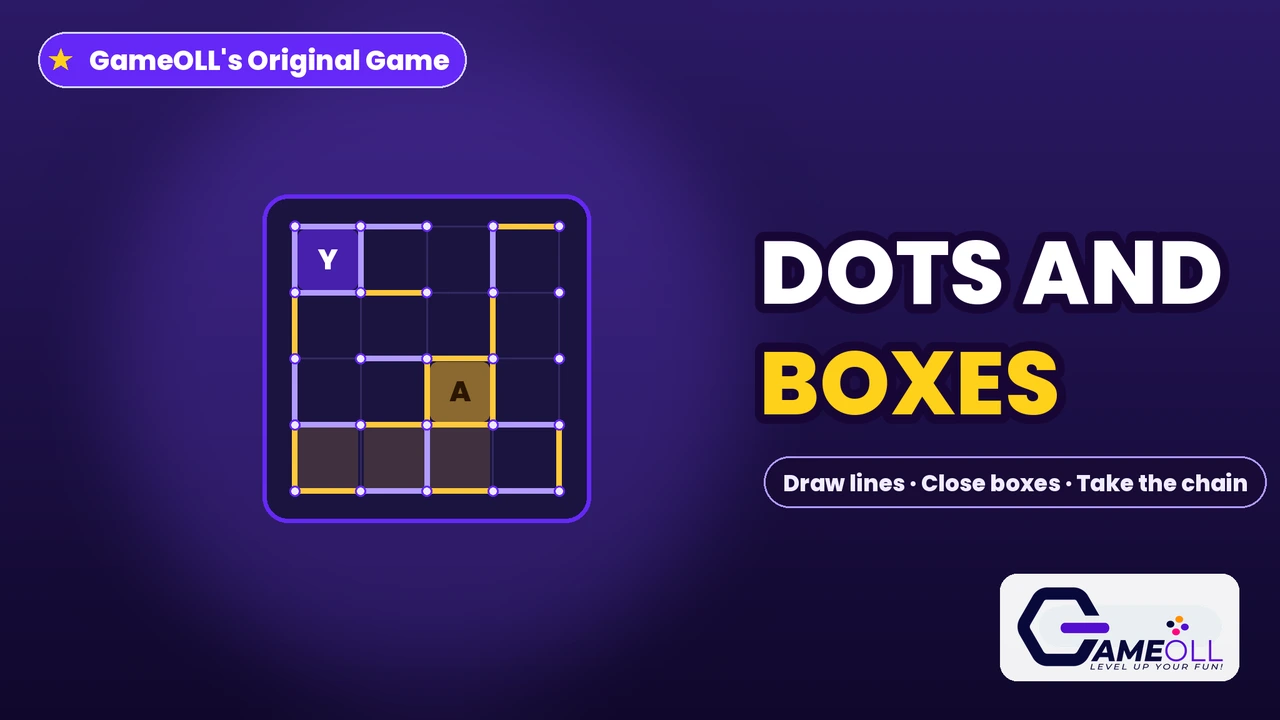
Press Play to start. Draw lines between the dots and close boxes to claim them.
Tap a line to draw it • The fourth side claims the box and draws again • Never open a chain you cannot afford
Dots and Boxes Game: Play Dots and Boxes Free Online
Dots and Boxes starts as the friendliest game on paper. A grid of dots, one line per turn, and a box for whoever draws the fourth side. Then, somewhere around the middle of the game, the board quietly turns into a trap. Long rows of boxes sit one line short of complete, and the next player who touches one of them hands the whole row to the other side. That tension — polite little lines on the surface, a knife fight underneath — is why this simple game has been studied by mathematicians and played in classrooms for well over a century. The board is right above this text, and your first game is one tap away.
There is no download, no sign-up and no clock pushing you. Play the AI on three levels, from a relaxed Casual game to a Master that counts chains and uses the famous double-cross in the endgame. Choose from three grid sizes, pass the device to a friend for a two-player game on the same board, and chase your best box haul. This page holds the full classic game, played by the standard rules, with the deep endgame strategy explained in plain words below.
Free in your browserThree AI levelsThree grid sizesTwo-player modeNo download
Genre
Board · Strategy · Classic
Players
Vs AI, or 2 players
Game length
About 2 to 10 minutes
Win by
Claiming the most boxes
In this guide
- How to play Dots and Boxes
- The rules, line by line
- Chains: where games are really decided
- The double-cross
- The three AI levels
- Strategy that wins games
- Questions and answers
How to play Dots and Boxes
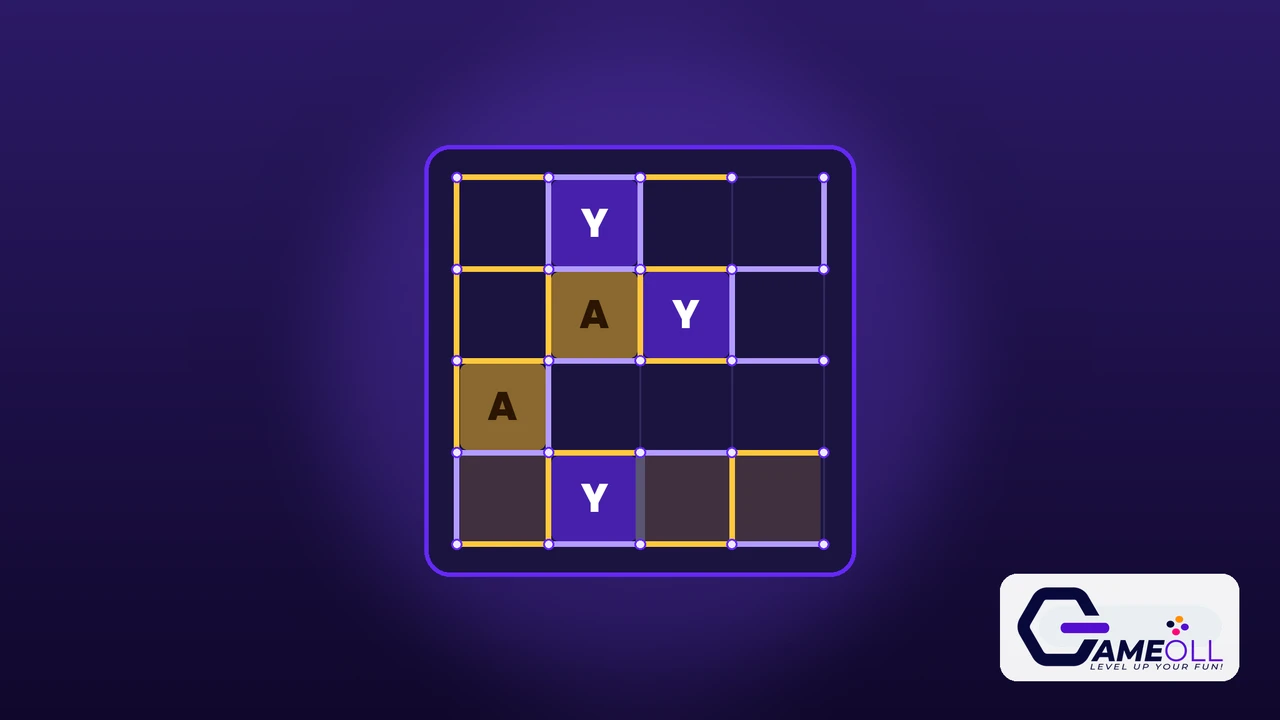
Press Play and the grid is live. You play purple, and purple always moves first. On your turn, tap any faint line between two dots to draw it. There is no confirm step and nothing to drag. One tap draws the line, and if the AI still has to answer, it draws its own line a moment later. The white glow marks the newest line on the board, so you can always see exactly what just changed.
Your goal is to finish boxes. A box is finished when all four of its sides are drawn, and it does not matter who drew the first three. The player who draws the fourth side claims the box: it fills with their colour and their letter, and — this is the rule that drives the whole game — that player draws again. One good turn can claim several boxes in a row, and a great turn can claim half the board. The score bar above the board counts the boxes as they fall.
You win by holding more boxes than your rival when the last line is drawn. On the even grids a draw is possible, and the game will call it honestly. The match score runs across games, so a rematch is always one tap away with the Play again button, and the game remembers your best single-game box haul on the purple board at the top of the page.
Made a mistake? On the Casual and Club levels the Undo button takes back a full round: your last move and every AI reply that followed it. On Master there is no Undo, because every move there is final. The New game button starts a fresh grid with the same settings, and Resign hands the current game to the other side when a position is truly lost. In two-player mode both sides tap the same board in turn, and Undo takes back one move at a time.
The rules, line by line
The full rules fit on an index card, which is exactly why the game survives every generation of players. Players take turns drawing one line between two neighbouring dots, up and down or side to side, never diagonally. A line, once drawn, stays drawn, and it can serve as a side for two boxes at once if it sits between them.
| Grid | Dots | Lines | Boxes | Best for |
|---|---|---|---|---|
| 3 × 3 | 16 | 24 | 9 | A quick first game and learning chains. |
| 4 × 4 | 25 | 40 | 16 | The classic game, with room for two chains. |
| 5 × 5 | 36 | 60 | 25 | The full battle: long chains and a real endgame. |
Claiming is automatic and instant. The moment your line completes a box, the box is coloured in for you and your turn continues. You may claim a second box with the extra draw, and a third, and so on for as long as every draw completes at least one box. A single line can even complete two boxes at once, when it is the last missing side of both neighbours. The turn only passes when a draw completes nothing.
Two smaller rules complete the picture. First, there is no passing: if it is your turn, you must draw a line, even when every line left hurts you. That forced-move rule is what makes the endgame so sharp. Second, nothing is ever hidden. Every line, every box and every score is on the board in plain sight, so a loss is always a lesson you can read backwards from the final grid.
Chains: where games are really decided
Watch a beginner play and you will see them draw lines anywhere. Watch a strong player and you will see them counting something invisible: chains. A chain is a row of boxes joined side to side where every box already has three of its four sides drawn. The boxes are not claimed yet, but they are loaded. The moment any player draws a line inside a chain, the next player can claim the first box, which opens the second, which opens the third, and the whole row falls in one long turn.
This is why the early game feels so polite. Every safe line — a line in a box that has at most one side drawn — gets used up first, because drawing a second side in a box is an invitation, and drawing a third side anywhere is usually a gift. Strong players spend the opening quietly filling the safe lines and watching the map of two-sided boxes grow. The player who runs out of safe lines first has to make the first offering, and on a big grid that offering is often the game.
When you must give a chain away, give the smallest one. A chain of two boxes costs you two boxes. A chain of seven can cost you the match on the spot. This is also why grid size changes the character of the game: on the 3 × 3 grid chains are short and games are snappy, while on the 5 × 5 grid one long chain of six or seven boxes is a weapon that decides everything, and almost every decision in the midgame is really a decision about where that chain will form.
The double-cross
The most famous move in Dots and Boxes sounds like bad manners: when you are sweeping the last chain on the board, you deliberately leave the final two boxes for your opponent. It is called the double-cross, and it wins games that simple greed loses. The logic is turn order. Whoever takes the last boxes of a group has to make the next move somewhere else. If another group of boxes is still waiting, the player who finishes the first group is the player who has to open the second one — and opening a group means giving it away.
So the strong player takes a long group down to its last two boxes, then plays a quiet line inside the pair that completes nothing. The opponent is forced to take those two boxes — there is no way to refuse them — and then, with the turn still theirs and nowhere safe to play, they must draw the first line inside the next group. The strong player then sweeps that group too. Two boxes handed over, a whole group collected in exchange: that trade is the difference between winning the endgame and watching it slip away.
The Master AI on this page plays the double-cross exactly this way, and the Club AI does not, which is the clearest line between the two levels. When Master stops two boxes early and slips a quiet line inside the pair, it is not being generous. It is handing you the bill for the next chain. Once you have seen the move from the receiving end a few times, you will start counting groups from the very first line of the game, which is precisely the habit that makes a Dots and Boxes player dangerous.
The three AI levels
One grid, three very different opponents. All three play by the same rules and see the same board. The difference is how honestly each one reads the position, and how much mercy each one shows. Start at the bottom, learn how chains form, and climb.
| Level | How it plays | Undo | Best for |
|---|---|---|---|
| Casual | Takes every box it is offered, then plays safe lines with cheerful lapses. Now and then it daydreams and hands you a box. | Yes | First games and learning the board. |
| Club | Takes boxes in full chains, never gives one away while a safe line exists, and when it must give, it gives the smallest chain on the board. | Yes | A real game against a thinking rival. |
| Master | Everything Club does, plus endgame chain control: it counts groups, takes long groups down to the last pair, and plays the double-cross. | No | Players who want the full strategic battle. |
The jump from Club to Master is the honest one. Club reacts correctly to the board in front of it, and beating it means you understand chains. Master plays the turn order itself. It will give you two boxes today to take six tomorrow, and it is very hard to surprise in the endgame, because counting what remains is exactly what it does on every single move. Beating Master for the first time is a genuine milestone, and the game keeps your records per level so you can prove it was not luck.
Strategy that wins games
Take the safe lines first. A line is safe when every box it touches still has at most one side drawn. Safe lines can never hand your rival a box, so they are the only free moves in the game. Count them. When safe lines remain, use them, and keep a mental note of how many are left, because the whole midgame is an argument about who runs out first.
Never open a chain by accident. Most games are lost by a player who draws the third side of a box without noticing it belongs to a chain of five. Before every draw, look at the boxes your line touches and the boxes touching those. If your line wakes up a row of three-sided boxes, your rival collects all of them. The ten seconds you spend tracing the chain is the best investment in the game.
Give small, and give late. When no safe line exists, you must give something away, so choose the smallest chain on the board and keep the long ones sealed. A two-box gift early is a shrug. The same gift with two moves left is a plan, because your rival then has to move next in whatever is left. Timing a giveaway is as much a skill as spotting one.
Count the endgame before it starts. Add up the groups. If the board will end as one long group, the player who opens it loses it, so fight to be the one receiving. If it will end as two groups, think about the double-cross: take the first group down to two boxes, hand those over, and let your rival open the second group for you. Players who count groups in the midgame stop being surprised by the final score.
Questions and answers
Is Dots and Boxes free to play here?
Yes. This Dots and Boxes game is completely free to play in your browser. There is no download, no sign-up and no limit on games. Your records, streaks and any game in progress are saved on your own device only.
How do you win a game of Dots and Boxes?
Claim more boxes than your rival. Every time you draw the fourth side of a box, that box is yours and you draw again. When the grid is full, the side with the most boxes wins the game.
What is a chain in Dots and Boxes?
A chain is a row of boxes that are each one line short of complete, joined side to side. Once a player is forced to draw the first line inside a chain, the other player can sweep the whole chain in one long turn, claiming box after box.
What is the double-cross?
The double-cross is an endgame move. When a long group of boxes is down to its last two and another group is still on the board, the Master AI plays a quiet line inside the pair instead of taking them. You must take those two boxes, and then you are the one who has to open the next group.
Can two people play on this page?
Yes. Choose 2 Players on the menu and both sides play on the same device, purple first and gold second. The match score keeps running between games, and Undo takes back the last move so a mis-tap never has to stand.
What is the best first strategy for beginners?
Do not give boxes away. Early in the game, only draw lines in boxes that still have fewer than two sides. Once no safe line exists, give away the smallest chain you can, and count the boxes before you open a long one.
Final verdict
Dots and Boxes looks like a game for rainy afternoons and plays like a knife fight in a phone box. The rules take a minute to learn, the chains take a week to see coming, and the double-cross takes a real opponent to teach you. This version keeps the classic game exactly as it should be, adds an AI ladder with an honest top rung that plays genuine endgame strategy, three grid sizes for short and long battles, and a proper two-player mode for the device in front of you. Start on Casual, learn to count the safe lines, and work your way up. When you first hand Master a pair of boxes and take a whole group in return, you will understand why this little grid of dots has outlasted a century of far louder games.
Last updated: November 8, 2026