
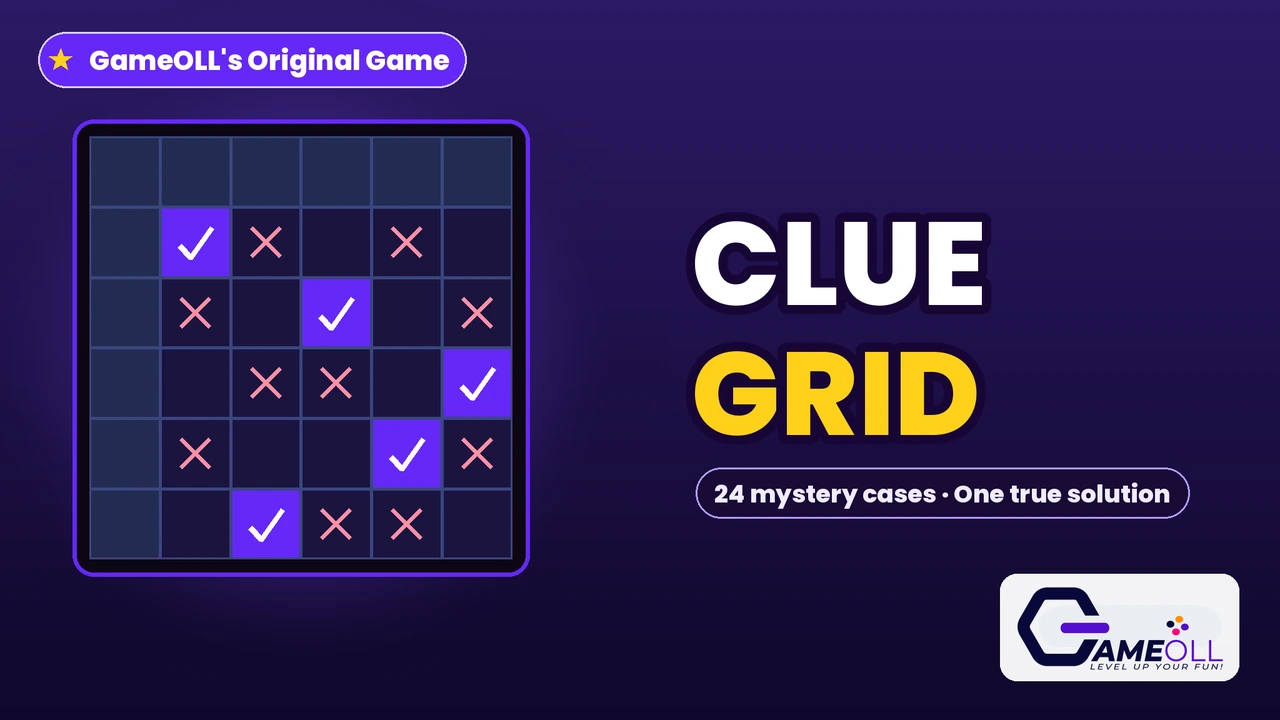
Home » Play Games » Clue Grid
Press Play to open the case. Read the clues, tick the true matches and cross out the rest.
Tap a square to tick it • Tap again to cross it • Every case solves by logic alone
Logic Grid Puzzle: Solve Mystery Cases Free Online
A logic grid puzzle is a small mystery with a perfect alibi: every clue is true, exactly one ending fits them all, and patience plus deduction will always find it. Clue Grid turns that classic format into twenty-four written cases — a muffin stolen from a bake sale, a gem moved in a museum at night, a chess final with a coffee-stained scoresheet — plus a fresh Daily case built for every date. Each case hides one true set of matches across three or four groups. Your job is to tick what must be true, cross out what cannot be, and watch the grid corner the answer on its own. The first case is open in the grid above, one tap away.
There is no download, no sign-up and no timer breathing down your neck. Work the gentle Rookie cases first, climb into the Detective tier, and finish with Master cases that spread five options across four groups. Every case on this page carries a promise most puzzle pages cannot make: before it shipped, a deduction engine proved the clues solve the grid by logic alone, and an independent count confirmed the solution is the only one. Guessing is never required. This guide explains the grid, every clue type, and the habits that close cases fastest.
Free in your browser24 cases plus a DailyThree tiersSolves by logic aloneNo download
Genre
Puzzle · Logic · Mystery
Players
1 player
Case length
About 3 to 25 minutes
Win by
Matching every group
In this guide
- How to play Clue Grid
- The grid, explained
- The clue types
- The three tiers and the Daily
- Strategy that closes cases
- Questions and answers
How to play Clue Grid
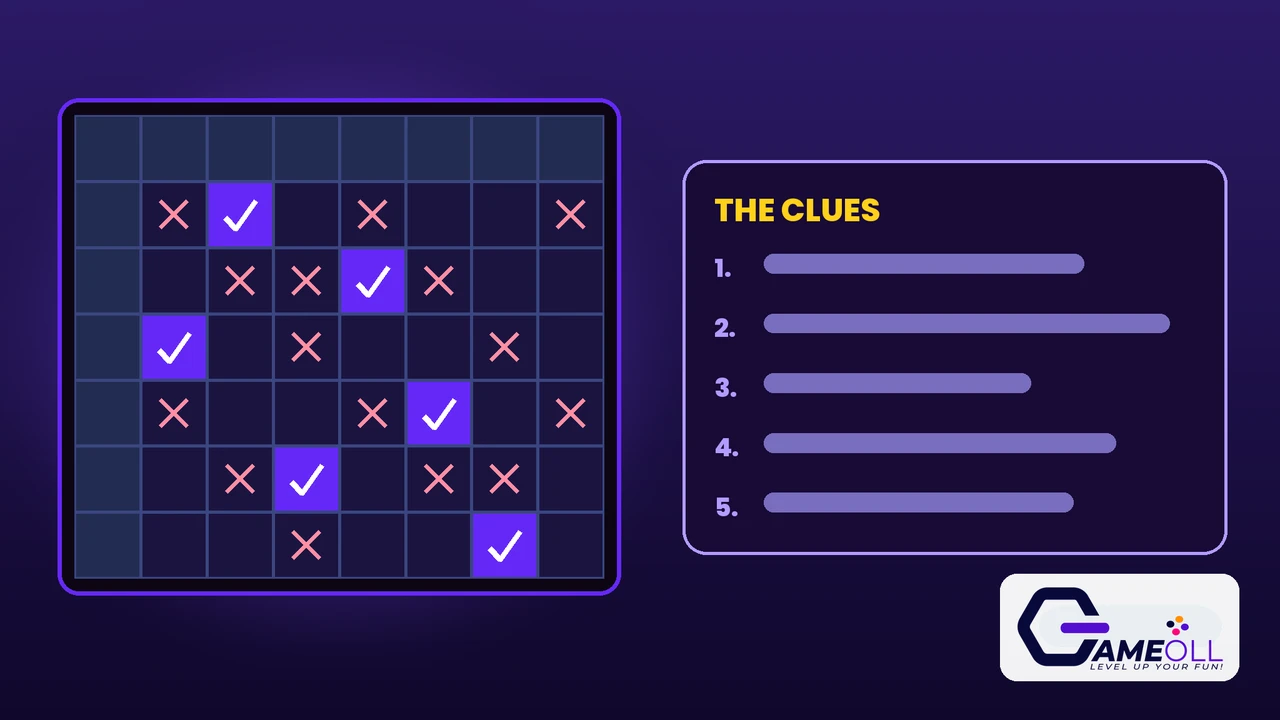
Choose a tier, pick a case, and press Play case. The story at the top of the board tells you what went wrong; the groups listed under it are everything you need to put it right. Read the clues, then work the grid. Tap any square once to tick it: that mark says these two options belong together. Tap again to cross it out: these two can never be a match. Tap a third time to clear the square and think again. There is no submit button and no penalty for changing your mind, because the grid is your notebook as much as your answer sheet.
A case closes the moment your ticks describe the one true set of matches — every true pairing ticked, and no false pairing ticked. You do not have to cross out every other square, though most detectives find the crosses are what make the ticks obvious. When the last correct tick lands, the case closes on the spot, your stars are awarded, and the next case in the tier unlocks. Stars reward clean work: three stars for a solve with no hints and no failed check, fewer when the case fought back.
Two helpers ride along. Check tests every mark you have made against the solution the clues force, and tells you only how many marks contradict it, never which ones — finding them is still your job, and a check that finds a contradiction costs you a star. Hint walks one forced step with you: it places the next tick the clues guarantee and tells you, in plain words, why that match must be true. Tap any clue to dim it once you have squeezed it dry; dimming is only a reading aid, and the case remembers your dimmed clues if you leave and come back.
Everything saves as you play, on your own device. Close the page halfway through a Master case and it reopens with your ticks, crosses, timer and hints exactly where you left them. Your stars, your unlocked cases and your Daily streak live on the same device, so the board at the top of the page always shows your own record, not a stranger's.
The grid, explained
The grid looks dense for the first ten seconds and simple forever after. Each case has groups — Bakers, Bakes and Drinks in the first case, for example — and every option in one group is matched with exactly one option in every other group. One baker brought one bake and carried one drink. The grid lays every pair of groups against each other in its own block of squares, arranged in a staircase so no pair appears twice. The block where the Bakers row meets the Bakes column is where you record who baked what; the block where Bakes meets Drinks records what was served alongside each bake, and so on.
Because the matching is one to one, a single tick does a lot of quiet work. If Ana is ticked with the lemon tart, then Ana cannot go with any other bake, and the tart cannot belong to any other baker. Strong players cross out the whole row and column of every tick they place, because those crosses are free facts the clues already paid for. The same logic runs in reverse: when a row has only one square left uncrossed, that square is a tick whether a clue named it or not. Most of a solve is simply collecting these two kinds of fallout until the grid fills itself in.
Options carry short codes along the top and side of the grid — three or four letters — so a Master grid with twenty options per group pairing still fits a phone screen. The legend under the grid spells out every code in full, and the clues always use full names, so you never have to decode anything while you reason. Read the clue, find the names in the legend, and mark the square where their row and column meet.
The clue types
Every clue in Clue Grid is one of a small family of sentence shapes, and learning what each shape is worth is most of the game. The plainest clue pairs two options outright: Ana is paired with the lemon tart. Its mirror image rules a pair out: Ben is not paired with the plum scone. Direct clues feel generous, but the cases lean harder on the compound shapes as the tiers rise, because those are the clues that reward real deduction.
| Clue shape | What it tells you | What it is worth |
|---|---|---|
| Paired with | Two options belong together. | A tick, plus a full row and column of crosses. |
| Not paired with | Two options never belong together. | One cross — small alone, powerful in piles. |
| Paired with X or Y | One option goes with one of two named options. | Crosses out every other option in that group at once. |
| Neither X nor Y | One option avoids two named options. | Two crosses from a single sentence. |
| Exactly one of A and B | Of two options, exactly one is paired with a third. | A trapdoor: rule one side out and the other side is a tick. |
| Order clues | Before, immediately before, first or last in an ordered group. | Squeezes options into slots until only one fit remains. |
The exactly-one clue deserves a second look, because it is the closest thing these cases have to a loaded spring. Of Ana and Ben, exactly one is paired with the fig flan. The sentence ticks nothing by itself. But the moment another clue rules Ana out of the flan, Ben and the flan become a tick — and if a clue ticks Ana with the flan first, Ben is crossed out of it. Order clues work the same way over time: in a case with shifts, prizes or finishing places, before and immediately-before clues pin options into a line, and a first or last clue anchors the ends of that line. When two anchored options squeeze a third into the only slot that fits, the grid hands you a match no clue ever stated.
One more deduction does more work than all the others combined: matching across blocks. If Ana is settled with the dawn shift, and the dawn shift is settled with the fish stew, then Ana is settled with the fish stew, and every cross around either match applies to the other. The cases are built so this cross-referencing is always enough. You will never reach a grid where two endings both fit the clues and a coin flip decides the case — the proof described below forbids it.
The three tiers and the Daily
Rookie cases use three groups of three options, and most close in a few minutes once the tick-and-cross rhythm clicks. They are the right place to learn the clue shapes, because every shape appears but no grid is big enough to hide in. Detective cases move to four groups of four, where cross-referencing starts to matter more than any single clue: matches chain through third and fourth groups, and the exactly-one clues begin to earn their keep. Master cases keep four groups but widen each to five options, which stretches every block of the grid to twenty-five squares and makes the order clues and the long cross-out chains genuinely demanding. Expect a Master case to hold you for fifteen minutes or more.
Cases unlock in order inside each tier — close one to open the next — while the tiers themselves are all open from the start, so a confident solver can walk straight into Master. The Daily is a Detective-size case built fresh for every date, the same case for every player that day. Close it to build a Daily streak, shown on the menu beside your case record. A missed day restarts the streak, but stars and closed cases are permanent.
The fairness promise deserves its own paragraph, because it is the whole point of the format. Every case here, set or Daily, is generated together with its proof. A deduction engine works the clue set using only the moves a human solver is allowed — direct clues, one-per-row-and-column, hidden singles, cross-group matching and order squeezing — and the case ships only if that engine reaches the full grid. An independent counter then enumerates the possible matchings to confirm exactly one solution exists. A case that needs a guess, or that quietly allows a second ending, fails both tests and never reaches this page.
Strategy that closes cases
Open with the compound clues. Either-or and neither clues cut the most squares per sentence, and order clues anchor whole lines. Sweep them first, crossing out everything they forbid, before you spend a single direct clue. Direct pairings are worth more after the grid is already cut down, because their rows and columns then cross out squares the compound clues were aiming at.
Work every settled match to exhaustion. A tick is not one fact; it is a fact in every block that shares either of its groups. When Ana settles with the dawn shift, visit the block where Ana meets the suppers and the block where the shift meets them, and carry the crosses with you. Half of all stalled solves are just a settled match whose fallout was never collected in a far corner of the grid.
Watch for the last square standing. After every round of crossing out, scan the rows and columns for a single open square. That square is a forced tick, and placing it usually starts a small avalanche: its own row and column cross out, which strands another square, which strands another. Cases rarely end in a slow grind; they end in one of these cascades, and the cascade starts with a scan you almost skipped.
Save Check for real doubt, and read its answer properly. Check counts contradictions without naming them, so it is a smoke alarm, not a map. Zero contradictions does not mean your ticks are right — an unticked true match is not a contradiction yet — it means nothing you have marked fights the clues. A count above zero means at least one tick sits on a false pairing or one cross sits on a true one, and the cheapest place to hunt is your most recent marks.
Questions and answers
Is this logic grid puzzle free to play here?
Yes. Every case on this page is completely free to play in your browser, including the Daily. There is no download, no sign-up and no limit on attempts. Your stars, unlocked cases and any case in progress are saved on your own device only.
How do I solve a case without guessing?
Start with the clues that cut the most. An either-or clue removes every other option in its group at a stroke, and a settled match crosses out its whole row and column. Keep crossing out what the clues rule out, and the true matches are the ones left standing. Every case here is built to fall to that process alone.
What do the short codes on the grid mean?
Each option has a short code, printed along the top and the side of the grid, so the grid stays readable on a small screen. The legend under the grid spells out every code in full, and the clues always use the full names.
How does the Daily case work?
A fresh Detective-size case is built for every date, and it is the same case for every player on that day. Close it to start or extend your Daily streak. Miss a day and the streak restarts, but your stars and your closed cases are never lost.
What happens if I close the page in the middle of a case?
The case waits for you. Your ticks, crosses, dimmed clues, hints and timer are saved on the device as you play, and the page reopens the case exactly where you left it, with a welcome-back note so you know nothing was lost.
Can a case have more than one solution?
No. Before a case is published here, a deduction engine proves the clues lead to one full grid by logic alone, and an independent count checks every possible matching to confirm exactly one solution exists. If the clues ever allowed two endings, the case would not ship.
Final verdict
Clue Grid is the logic grid puzzle in its purest playable form: real little mysteries, honest clues, and a grid that always — always — gives up its one true ending to a patient solver. The Rookie cases teach the language in minutes, the Detective tier turns that language into genuine detection, and the Master cases will stretch strong solvers over five-option grids where a single exactly-one clue can hold the whole case together. Add a Daily that is provably fresh and provably fair, stars that reward clean deduction over lucky tapping, and saves that respect a half-finished case, and this is the page to bookmark if your idea of a good puzzle is one that never once asks you to guess. Open the first case. The muffin is not going to find itself.
Last updated: November 8, 2026