
Home » Play Games » Futoshiki
Tap a cell, then a digit • The > sign points at the smaller digit • ✔ Check is free • 💡 3 hints per puzzle
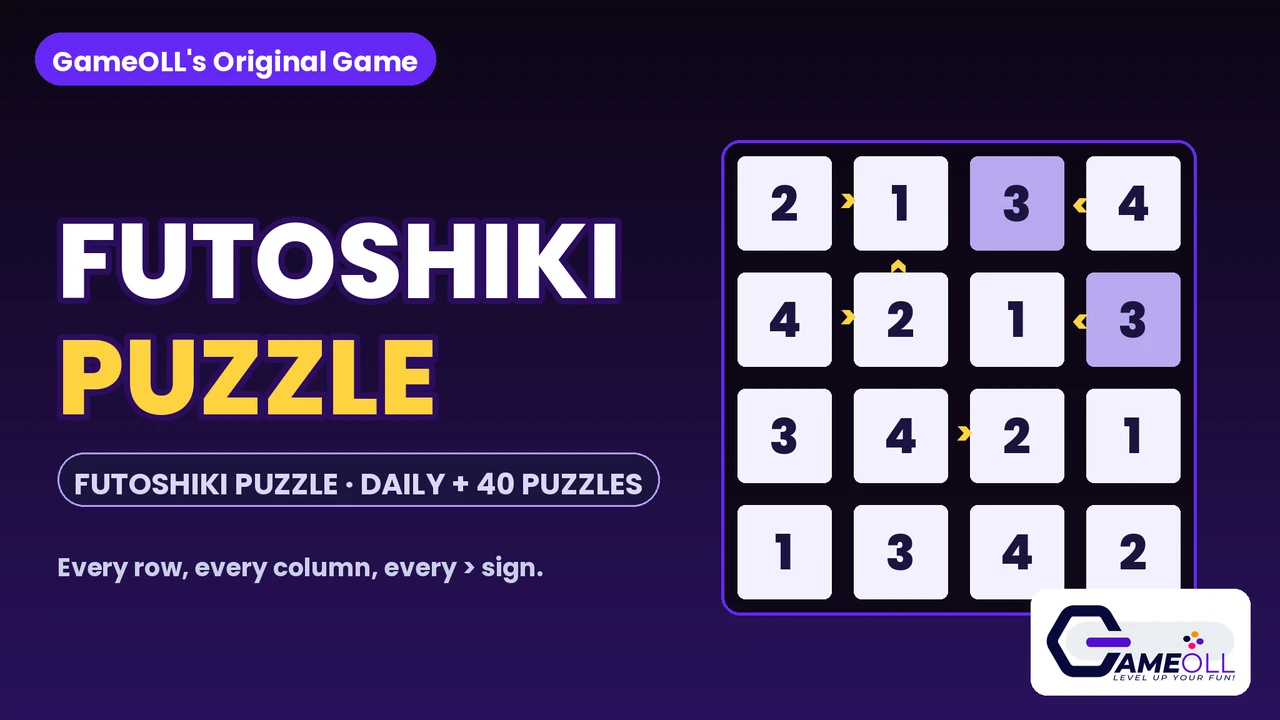
Futoshiki is a pure logic race against your own brain. Fill the grid so every row and column holds each digit once, and every printed > sign between two cells tells the truth: the digit on the open side is bigger. No guessing is ever needed. Every puzzle here has exactly one solution, and this page gives you 40 set puzzles in four sizes plus a fresh Daily Futoshiki every day.
New to the signs? Start on the 4×4 Starter tier. The first puzzles teach you the whole game in a few minutes. Then climb to 5×5, 7×7 and the full 9×9 Expert grid.
🧩 Logic📅 Daily Puzzle🆓 Free📱 Mobile Friendly🔢 4×4 to 9×9
🔢 The Rules
Digits 1 to N, once in every row and once in every column. That is the whole base rule.
➡️ The > Sign
The sign sits between two cells. Its open side faces the bigger digit. Its point touches the smaller one.
⭐ One Solution
40 set puzzles plus a Daily. A solver proves each one has exactly one solution before it reaches you.
✏️ Notes and Hints
Pencil notes, a free Check button and 3 hints per puzzle. Clean solves earn 3 stars.
In this guide
- How to play Futoshiki
- How the > sign works
- The sizes on GameOLL
- Solving strategies that actually work
- The Daily Futoshiki and your streak
- Stars, Check and hints
- 7 tips for faster solves
- Frequently asked questions
How to play Futoshiki
Tap any empty cell. Then tap a digit on the pad. The digit goes into the cell. Tap ⌫ to clear a cell. Some digits are printed on the board as givens. Givens never change.
The game enforces both rules as you play. A digit that already appears in the row or column is refused, with a message that says why. A digit that breaks a sign against a filled neighbour is refused too. So you can never break the grid by accident. You only have to think.
| Step | What to do |
|---|---|
| 1 | Pick a puzzle, or tap 📅 Daily for today’s grid. |
| 2 | Tap a cell, then tap a digit from 1 to N. |
| 3 | Keep every digit once per row and once per column. |
| 4 | Obey every sign: the open side holds the bigger digit. |
| 5 | Use ✏️ Notes for candidates, ✔ Check to test your work, 💡 Hint when stuck. |
| 6 | Fill the last cell correctly and the puzzle completes. |
How the > sign works
Read the sign like an open mouth. The mouth opens toward the bigger digit and points at the smaller one. If a sign says 4 > an empty cell, the empty cell can only be 1, 2 or 3. If an empty cell sits on the open side of a filled 4 on a 5×5 grid, that cell must be 5. Nothing else is big enough.
Signs also link into chains. On a 4×4 grid, a chain of three signs running the same way through four cells fixes all four digits at once: 4, then 3, then 2, then 1, in the chain’s direction. Even a short chain of two signs removes the extreme digits from the middle cell. Watch for chains first. They are the fastest wins in the game.
The biggest digit, N, can never sit on the point side of any sign. The digit 1 can never sit on the open side. Those two facts alone clear a surprising amount of fog on the bigger grids.
The sizes on GameOLL
Four tiers, ten puzzles each. The grid grows, the digits grow, and the sign webs get longer. Every tier is free, and your stars are saved per puzzle.
| Tier | Grid | Digits | Best for |
|---|---|---|---|
| Starter | 4×4 | 1 to 4 | Learning the signs |
| Classic | 5×5 | 1 to 5 | The classic newspaper size |
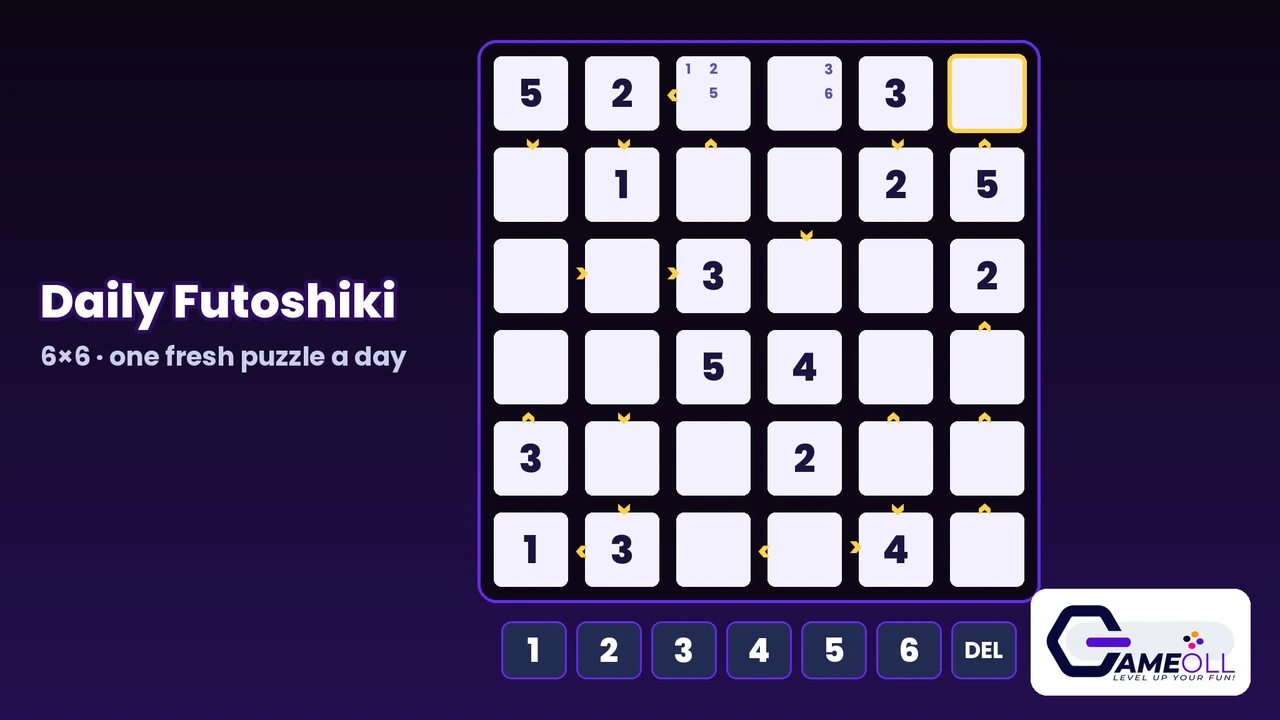
| Daily | 6×6 | 1 to 6 | One fresh puzzle every day |
| Tough | 7×7 | 1 to 7 | Long chains, deep logic |
| Expert | 9×9 | 1 to 9 | The full-size challenge |
Solving strategies that actually work
Start with the extremes
Find where N and 1 can live. N is banned from every point side. 1 is banned from every open side. On many puzzles that leaves only one or two homes for the biggest digit, and placing it unlocks its whole row and column.
Read every chain to the end
A chain of k signs in a row forces k + 1 strictly rising or falling digits. A chain of three on a 5×5 grid uses four of the five digits, so the middle cells are squeezed hard. Write the tightest possible run into your notes before you place anything.
Use last-in-row and last-in-column
When a row has one empty cell, its digit is forced: it is the one digit the row still misses. Then check that the forced digit obeys the signs around it. If it does not, one of your earlier digits in that row is wrong, and Check will confirm it.
Let filled neighbours speak
A sign next to a filled digit is a hard limit. Greater than a filled 2 means 3 or more. Smaller than a filled 5 means 4 or less. Combine the limits from two sides and many cells drop to a single candidate. The game refuses digits that break a filled neighbour’s sign, so test bold ideas freely.
Keep notes honest
Notes are your scratchpad, not decoration. Add a digit to a cell’s notes only if the row, the column and every sign still allow it. When a digit gets placed, clear it from the notes of its whole row and column. A cell left with exactly one note is a free placement, so sweep for those after every move.
The Daily Futoshiki and your streak
Every day brings one fresh 6×6 puzzle, built from the date itself, so every player in the world gets the same grid on the same day. Solve it to start or grow your streak. Miss a day and the streak restarts, but your stars and best times never reset.
Leave a puzzle half done and it waits for you. Your grid, your notes and your remaining hints are saved in this browser and restored exactly where you left them, with a welcome-back line when you return.
Stars, Check and hints
Every set puzzle pays up to 3 stars. Finish with no hints used and no wrong Checks to earn all 3. Use one hint, or let one Check come back wrong, and the puzzle pays 2. Anything heavier pays 1, and a finished puzzle always pays at least 1.
Check is free and unlimited. It tells you how many of your filled cells are wrong, but never which ones. Finding them is the game. Hints are the opposite trade: a hint fills one correct digit for you, and you get exactly 3 per puzzle.
7 tips for faster solves
- Mark where N and 1 can live before placing anything else.
- Trace every sign chain to its end and note the tightest run.
- Fill forced cells first: last-in-row and last-in-column never lie.
- Let filled neighbours cap your candidates from both sides.
- Keep notes honest, and sweep for single-note cells after each move.
- Stuck? Press Check before you spend a hint. It is free.
- Climb one size at a time: 4×4 teaches signs, 9×9 tests everything.
Frequently asked questions
What is Futoshiki?
Futoshiki is a Japanese logic puzzle played on a square grid. You place the digits 1 to N so each one appears once in every row and column, and every printed greater-than sign between two cells points from the bigger digit to the smaller one.
How is Futoshiki different from Sudoku?
Sudoku adds 3×3 boxes and starts with many printed digits. Futoshiki has no boxes at all. It starts with few or no printed digits and guides you with inequality signs instead, so the challenge is about order and comparison, not box patterns.
How is Futoshiki different from KenKen?
KenKen groups cells into cages with arithmetic targets, so you add, subtract, multiply and divide. Futoshiki has no cages and no arithmetic at all. Its only extra rule is the inequality signs: one digit must simply be bigger than its neighbour.
Does every puzzle have exactly one solution?
Yes. Every puzzle on this page, set and Daily alike, was generated and then proven by a solver to have exactly one solution. If your grid obeys every row, column and sign, it is the solution.
How does the Daily Futoshiki work?
A new 6×6 puzzle is generated from the date every day, the same for every player. Solve it to build your daily streak. Your streak, stars and best times are saved in your browser.
Can I play Futoshiki on my phone?
Yes. The game runs in your browser with no download and no sign-up. Tap a cell, then tap a digit. Pencil notes, Check and hints all work with touch, and the 9×9 grid is sized to fit your screen.
🏆 Final Verdict
Futoshiki is the cleanest logic workout on GameOLL. Two rules, zero luck, and every puzzle proven to have exactly one answer. Start with the 4×4 tier, earn your stars, keep the Daily streak alive, and take on the 9×9 Expert boards when the signs start talking to you.
A note on the name: Futoshiki is the Japanese inequality puzzle style popularised by Nikoli. This page is an independent GameOLL implementation. Every grid, sign layout and line of code here is original to GameOLL, and the puzzle format itself is a classic logic format anyone may implement.
Last updated: November 8, 2026