Home » Play Games » Globle
Press Play Daily, then type a country name to make your first guess.
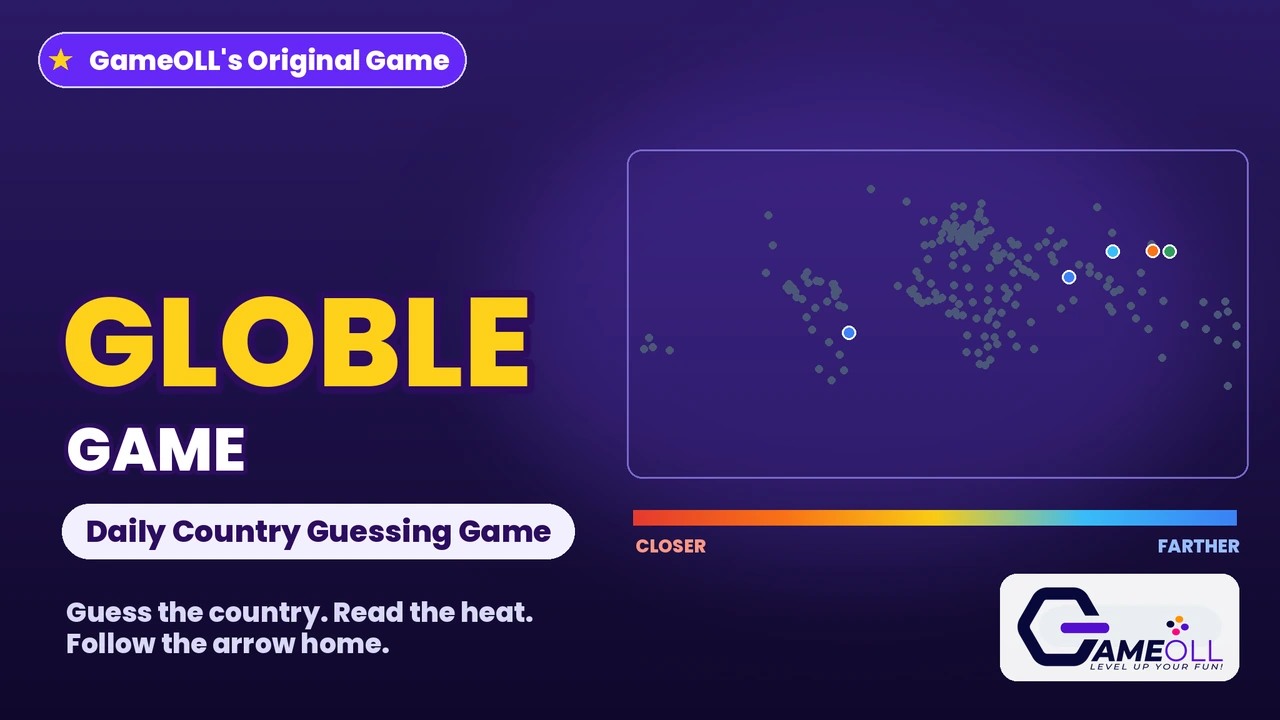
Red is close, blue is far • The arrow points the way • A new Daily Country every day
Somewhere on a map of 201 dots, one country is hiding. You do not get its shape. You do not get its flag. You get something better: the truth, one guess at a time. Type any country and this globle game tells you exactly how far it sits from the mystery country in kilometres, points an arrow the way you need to travel, and paints your guess on the map in a colour that runs from ice cold blue to burning hot red. This page holds GameOLL's own version of Globle — a Daily Country that is the same for every player, unlimited Practice rounds, a streak worth protecting, and a world map that fills in with colour as you close in. It is free, it runs in your browser on phone or PC, and there is nothing to download or sign up for.
🎮 Genre: Geography Quiz · 👤 1 Player · 📱 Browser (no download) · 💰 Free
Genre
Geography · Quiz
Players
1 Player
Platform
Browser · Mobile · PC
Price
Free
In this guide
- How to play Globle
- How proximity works — bands, kilometres, arrows
- A worked game, guess by guess
- The Daily Country and your streak
- Practice rounds and your best score
- Six tips to close in faster
- The dot map and the distance data
- Globle FAQ
- Final verdict
How to play Globle
One country out of 201 is picked as the mystery country. Your job is to name it. There is no limit on guesses, so the score that matters is how few you need.
Type a country name in the box under the game and press Guess, or tap one of the suggestions that appear as you type. Only names on the list are accepted, which keeps the spelling honest — if you type something the game does not know, it says so and asks you to pick a suggestion instead. Every accepted guess earns three pieces of feedback at once: the distance in kilometres, an arrow, and a colour. The guessed country lights up on the dot map in that colour, and the guess joins your list under the map, most recent first, with its distance and arrow beside it.
That is the whole loop, and it is tighter than it sounds. A cold first guess is not a failure — it is a fence. It rules out a whole side of the planet. Two or three fences, read properly, leave only one region standing. The worked game further down this page shows a real solve, with real distances from this page's own data, so you can watch the fences go up.
How proximity works — bands, kilometres, arrows
Every guess is measured the same way. The game takes the centre of the country you guessed and the centre of the mystery country, and works out the straight-line distance between them over the surface of the Earth. That distance, in kilometres, is the number you see. The arrow is the compass direction you would travel from your guess to reach the mystery country, rounded to the nearest of the eight compass points. And the colour is the distance squeezed into five bands:
| Distance to the mystery country | Band | Colour on the map | What it means |
|---|---|---|---|
| Under 500 km | Burning hot | Red | You are on the doorstep. The answer is this country or a direct neighbour. |
| 500 to 1,499 km | Hot | Orange | Same region, close. One or two hops should finish it. |
| 1,500 to 2,999 km | Warm | Yellow | Same part of the world. Follow the arrow and halve the distance. |
| 3,000 to 5,999 km | Cool | Light blue | Same hemisphere, wrong neighbourhood. The arrow matters more than the colour now. |
| 6,000 km and over | Ice cold | Deep blue | A long way off. Treat the guess as a fence: the answer is far from here, in the arrow's direction. |
Two details are worth knowing before you trust the numbers. First, distances run from country centre to country centre, not border to border. Two giant neighbours can share a long border and still read over 2,000 km apart, because their centres are far apart — Russia and Kazakhstan work like this. Second, the arrow is a compass bearing, so it can surprise you near the poles or across the Pacific: from South America, the arrow to Japan points up and across, following the shortest path over the sphere, not the flat route your eye draws on a wall map.
A worked game, guess by guess
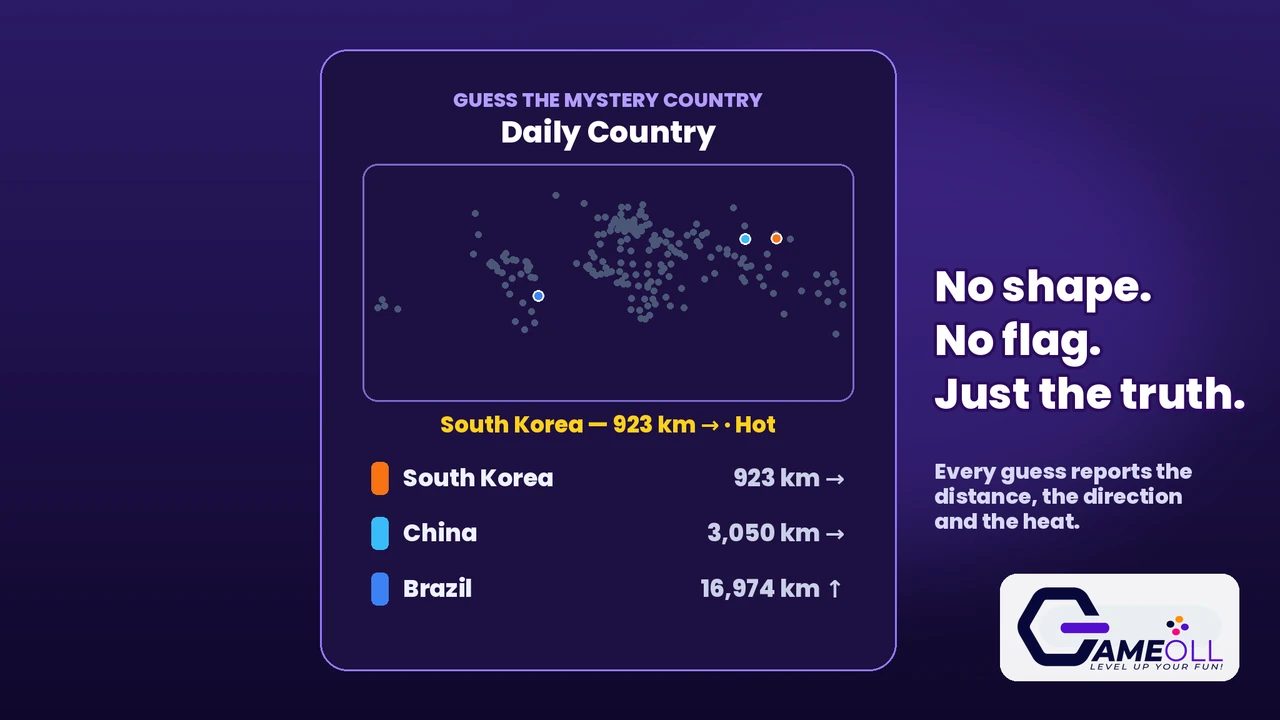
Here is a real solve using this page's exact distance data. The mystery country — no peeking at your map — is Japan.
- Brazil — 16,974 km ↑ · Ice cold. A deliberate fence. Brazil is about as far from anywhere in Asia as a guess can be, and the arrow points north: the answer is nowhere near South America. One guess has cleared a continent.
- China — 3,050 km → · Cool. A jump to East Asia lands 3,050 km short, with the arrow pointing due east. The mystery country is east of China's centre: that means the Pacific side — Japan, or one of the Koreas, or a Pacific island.
- South Korea — 923 km → · Hot. Hot, and still pointing east. South Korea sits west of Japan across a narrow sea, so an answer 923 km east of it fits Japan almost exactly. Taiwan would read south-west from here, and the Philippines far to the south — the arrow rules both out.
- Japan — found in 4 guesses. The reveal shows the capital, Tokyo, a one-line fact about the country, and your score. Four guesses is a strong round: most first-time players need six to nine while they learn how the bands feel.
Notice what did the work: not the colours alone, and not the kilometres alone, but the arrows read against the map. Every guess is a measurement, and measurements corner things.
The Daily Country and your streak
Every day there is one Daily Country, and it is the same mystery country for every player on Earth that day. It is picked by walking a fixed shuffled order of all 201 countries, one step per day — which means no country can repeat until every country has had its day. You will not see the same Daily twice in a row, or twice in a season.
Solve the Daily and your streak grows by one. Miss a day and the streak restarts at 1 on your next solve — no freezes, no second chances, which is what makes a long streak worth bragging about. You can replay a solved Daily as often as you like to hunt a cleaner score; the replay never touches your streak or your stats. A half-finished Daily is saved too: leave mid-round, come back later, and your guesses are restored exactly where you left them.
Practice rounds and your best score
Practice mode deals a random mystery country, as often as you like, with nothing on the line. It is where the game is learned: try an opening guess, watch the band, follow the arrow, and notice how quickly your fences improve. Your best score — the fewest guesses you have ever needed to find a country — is kept across both modes and sits at the top of the game, next to your win count. There is also a Give Up button for the rounds that beat you; the country is revealed with its capital and a fact, and the round counts as played, not won. Honest stats, no padding.
If this format bites you, GameOLL's geography shelf has two more daily habits with different muscles: Terra Daily shows you a country's shape and asks you to name it, and Flag Unveil reveals a flag tile by tile. Same daily streak idea, three very different kinds of knowledge.
Six tips to close in faster
- Open with a fence, not a hope. A central guess like Kazakhstan, Brazil or DR Congo splits the world hard. Wherever the mystery country is, one big central guess plus its arrow throws away half the map.
- Read the arrow before the colour. Ice cold with a clear direction is better information than warm with a vague one. The arrow is a line across the whole planet — the answer sits somewhere along it, at the stated distance.
- Triangulate with two fences. Two far guesses pointing at each other trap the answer where their distance circles cross. If Brazil says 17,000 km north and Spain says 9,000 km east, the overlap is a small patch of Earth.
- Mind the centre rule. Big countries measure from their middle. A guess of Russia tells you about central Siberia, not about Moscow; a guess of the United States tells you about Kansas. Shrink your target area accordingly.
- When you are Hot, think neighbours. Under 1,500 km, list the guessed country's neighbours and near-neighbours and work through them in the arrow's direction. Burning hot — under 500 km — is almost always the country itself or the one right next door.
- Use the map, not just the list. Your guesses stay painted on the dot map in their band colours. A red-orange cluster growing in one region is the shape of the answer — guess into the gap in the cluster, not back into covered ground.
The dot map and the distance data
The map is drawn as one dot per country, placed at that country's centre on a simple equal-spaced grid of longitude and latitude. A dot map is the honest choice for this game: it shows where every country's measuring point actually is, so the distances you are quoted always match the dots you see. Island nations stay visible instead of vanishing, and no country's dot is bigger just because the country is wide.
The data underneath is plain geography: for each of the 201 countries and territories on the map, the game stores its name, its capital, the latitude and longitude of its approximate centre, and its region. Distances are true great-circle distances between those centres — the same maths pilots use — rounded to the nearest kilometre. Centres are approximations, as any single point for a whole country must be, but they are the same approximations for every guess and every player, so the game is always fair: the feedback never bends.
Globle FAQ
What is the Globle game?
Globle is a geography guessing game. One country out of 201 is picked as the mystery country, and you guess country names to find it. Every guess tells you the distance in kilometres from your guess to the mystery country, shows an arrow pointing the way, and colours your guess on a world dot map — from ice cold blue when you are far away to burning hot red when you are close. This version has a Daily Country that is the same for every player, plus unlimited Practice rounds.
How do you play Globle?
Type a country name in the box under the game and press Guess, or tap one of the suggestions that appear as you type. Read the three pieces of feedback — the kilometres, the arrow and the colour band — then guess again, closer. There is no guess limit; your score is how few guesses you need. Only names on the game's list of 201 countries are accepted, so the spelling always matches.
How does the proximity feedback work?
Distances are measured between country centres, the middle of each country, as a true great-circle distance over the Earth. The colour bands are fixed: under 500 km is Burning hot, under 1,500 km is Hot, under 3,000 km is Warm, under 6,000 km is Cool, and 6,000 km or more is Ice cold. The arrow is the compass direction from your guess toward the mystery country, rounded to the nearest of the eight compass points.
When does the Daily Country change, and can it repeat?
The Daily Country changes at midnight in your own time zone, and it is the same country for every player that day. It is picked by walking a fixed shuffled order of all 201 countries, one step per day, so no country can come up twice until every country has had a day — repeats are more than 200 days apart. Solve it to grow your streak; miss a day and the streak restarts at 1 on your next solve.
Why is the distance different from what I expected?
Because distances run from country centre to country centre, not from border to border or capital to capital. Big countries have centres far from their edges, so two neighbours that share a border can still read thousands of kilometres apart — Russia and Kazakhstan are a good example. The map dots sit exactly on those centres, so the number always matches the dots you can see.
Is Globle free to play on mobile?
Yes. Globle is completely free and runs in your browser, so it works on phones, tablets and PCs with nothing to download and no account to create. Your Daily streak, your best score and even a half-finished round are saved in your own browser and restored when you come back.
Final verdict: should you play Globle?
Yes — if you like a guessing game that never lies to you. Globle hands you no shape, no flag and no letters, just three honest measurements after every guess, and that turns out to be plenty: kilometres fence off continents, arrows draw lines across the planet, and the dot map quietly fills with colour until the answer is the only country left standing. The Daily is a two-minute habit with a streak that punishes a missed day, Practice is an endless geography lesson disguised as a game, and the centre-to-centre distance rule keeps every round fair and every surprise explainable. Add guesses that survive a closed tab and a reveal that always teaches you a capital and a fact, and this is the version of the country-guessing game we would hand to anyone: no downloads, no accounts, no noise — just you, the map, and the truth, one guess at a time.
▶ Play Globle 🎮 See All Free GamesLast updated: November 8, 2026. Globle v1.0 — the first release of our original country proximity guessing game, with 201 countries on a world dot map, kilometre distances with direction arrows and five heat bands, a Daily Country that cannot repeat inside its 201-day cycle, unlimited Practice rounds, streaks, best-score tracking, and mid-round saves. An original GameOLL browser game. Found a bug? Tell us in the comments and we will fix it in the next version.