
Home » Play Games » Peg Solitaire
Press Play to start. Clear the board down to a single peg.
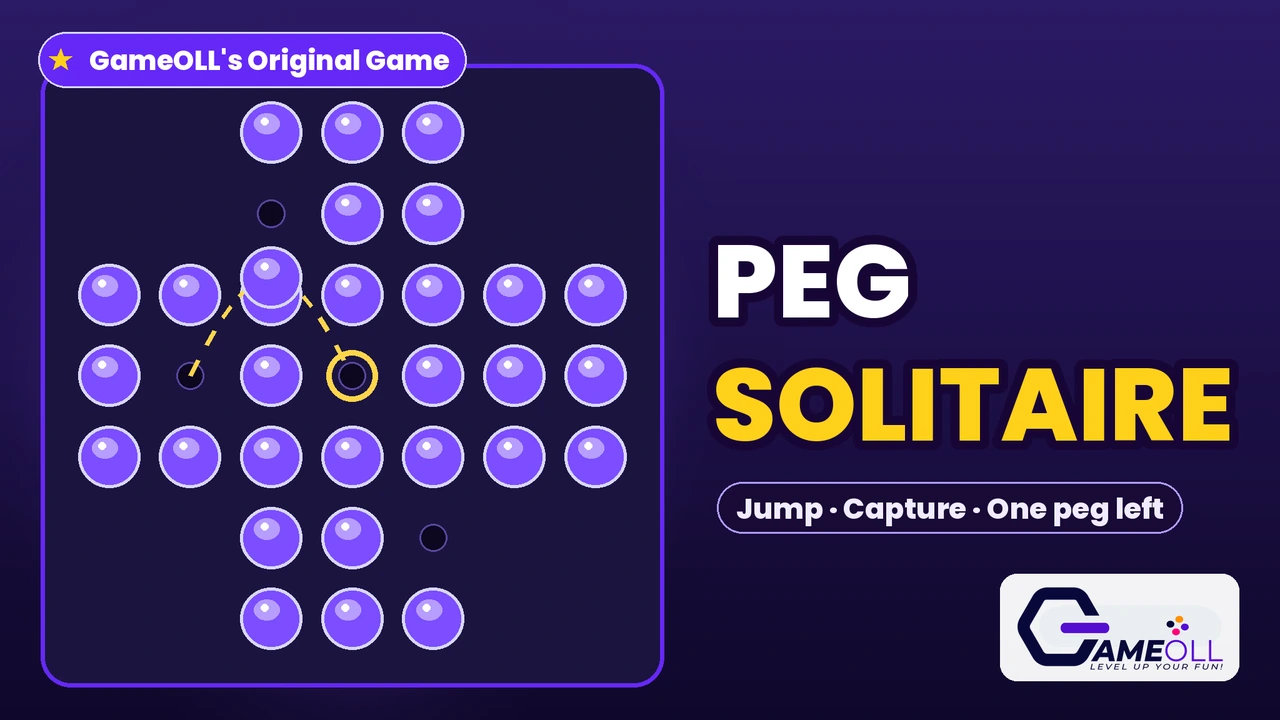
Tap a peg, then a glowing hole • Every jump removes the peg you leap over • One peg left is the perfect game
Peg Solitaire Game: Play Peg Solitaire Free Online
Peg Solitaire looks harmless. A wooden board, a neat pattern of pegs, one empty hole in the middle. Then you start jumping, the board starts emptying, and somewhere near the end you realise the last few pegs are stranded in far corners with nothing left to jump over. That slow squeeze — plenty of pegs, plenty of moves, and somehow never the right ones — is why this quiet solo puzzle has kept players busy for more than three hundred years. The board is right above this text, and your first game is one tap away.
There is no download, no sign-up and no opponent rushing you. This page holds the full classic game on three boards: the 33-hole English board, the larger 37-hole European board, and the 15-hole Triangle board. Every start is verified by a built-in solver, so a one-peg finish always exists — and the Hint button will show you the next jump on the road to it, or tell you honestly when that road has closed. A fresh Daily challenge arrives every day, and your game saves itself as you play.
Free in your browserThree boardsNine solver-verified startsDaily challengeNo download
Genre
Board · Puzzle · Classic
Players
1 player, solo
Game length
About 3 to 10 minutes
Win by
Finishing with one peg
In this guide
- How to play Peg Solitaire
- The rules, jump by jump
- The three boards
- How the perfect game works
- Dead ends, and how to dodge them
- Questions and answers
How to play Peg Solitaire
The idea fits in one sentence: jump pegs over each other, remove the pegs you jump, and finish with as few pegs as you can — ideally just one. Tap any peg that has a jump available and its landing holes light up. Tap a glowing hole and the peg leaps over the neighbour between, which is taken off the board. Tap the peg again to put it down if you change your mind, or tap a different peg to look at its jumps instead.
Keep jumping until no peg has a legal jump left. The game then grades what remains. One peg is the perfect result, and on the English board there is a famous extra flourish: if your last peg stands in the centre hole you started from, you have played the classic perfect game that solvers have admired for centuries. Two or three pegs is still a strong finish. A board scattered with stranded pegs is an invitation to press Restart and take a better line.
Three tools sit under the board. Undo takes back your last jump, as far back as the very first move if you want to unpick a whole line. Restart deals the same board and start again for a clean run. Hint asks the built-in solver for the next jump: while a one-peg finish is still reachable from your position, the hint is a genuine step on a complete solution; when it is not, the hint says so plainly and offers the jump that leaves the fewest pegs at the end. Your move count, pegs left and time are always on screen, and the best finish for each board is saved.
The rules, jump by jump
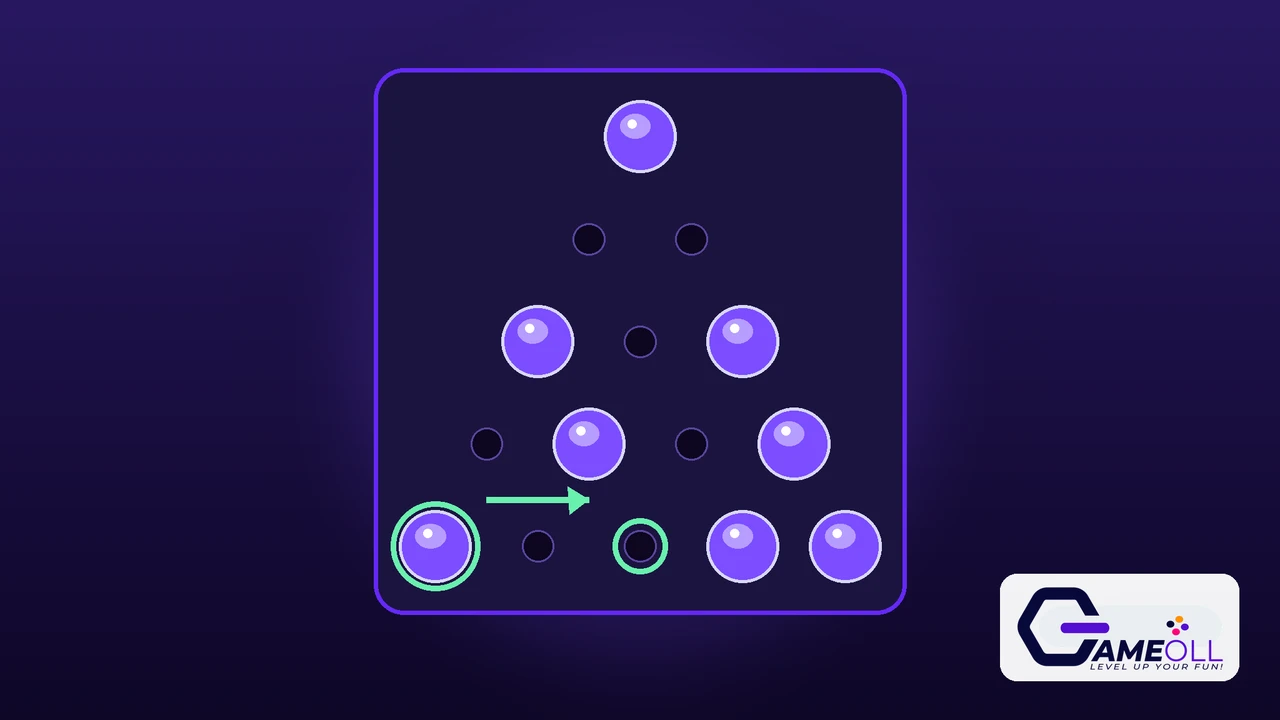
A jump needs three holes in a straight line: a peg, a neighbouring peg directly beside it, and an empty hole immediately beyond. The first peg hops over the second and lands in the empty hole, and the jumped peg is removed. On the English and European boards, jumps run horizontally and vertically only — never diagonally. On the Triangle board, jumps follow the three directions of the triangular pattern, which adds the two diagonal lines of the lattice.
That is the whole rulebook. You cannot jump over an empty hole, you cannot land on a peg, you cannot jump two pegs at once, and there is no passing: if a jump exists, the game continues, and it ends only when no jump exists anywhere on the board. Every jump removes exactly one peg, so the English game can never last more than 31 jumps from its 32-peg start. Your score is simply the pegs left when the music stops — fewer is better, and one is best.
At the end of a game the board awards stars and a grade from the pegs remaining. The bands stretch a little on the bigger European board, which starts with four more pegs:
| Pegs left | Grade | Stars | What it means |
|---|---|---|---|
| 1 | Perfect! | ★★★ | The complete clear. On the English board, a last peg in the centre is the classic perfect game. |
| 2 | Brilliant | ★★★ | One jump away from glory. |
| 3 | Good | ★★ | A tidy finish most players would take. |
| 4 to 5 (4 to 6 on European, 4 on Triangle) | Fair | ★ | The endgame slipped away, but the board is far from full. |
| More | Try again | — | Too many pegs stranded. Restart and take an earlier turn differently. |
The three boards
The English board is the one in the old paintings: a cross of 33 holes on a 7 by 7 frame, starting with every hole filled except the centre. It is the best-studied solo board game in the world, and its central game — empty centre at the start, one peg in the centre at the end — has a known solution that strong players learn the way chess players learn a favourite opening. The two extra English starts move the first empty hole to the top arm and beside the centre, which quietly changes the whole geography of the game.
The European board adds four holes at the shoulders of the cross, for 37 holes and 36 pegs. Those four holes look like a small change and behave like a large one: pegs survive longer, routes multiply, and the endgame is more forgiving of one loose jump and less forgiving of two. It is the connoisseur’s board — the same rules, a noticeably richer game.
The Triangle board is the sprinter: five rows, 15 holes, 14 pegs, and jumps along three directions instead of two. Games take two or three minutes, dead ends arrive faster, and the small board makes it the perfect place to learn how peg solitaire really works before graduating to the cross. Each board offers three starts, and all nine were proven solvable down to a single peg by the solver before they were allowed onto this page.
How the perfect game works
Here is the secret the board hides in plain sight: a jump can only ever help the region it happens in. Pegs do not walk; they teleport two holes at a time and delete the neighbour they crossed. So the whole game is really about supply lines. An area of the board stays alive only while it holds pegs close enough to jump each other into the gaps. The moment a corner or an arm is left with pegs too far apart to interact, those pegs are already dead — the last rites just happen later.
Strong play follows from that one idea. Work region by region instead of chasing jumps all over the board. Keep your pegs in touching distance, feed pegs from crowded areas into thinning ones, and be suspicious of any jump that leaves a peg alone at the far end of an arm. The centre of the board is the engine room: jumps through the middle keep every region supplied, which is why so many solutions pass the same pegs through the centre again and again.
The endgame has its own arithmetic. With six or seven pegs left, stop and count what each candidate jump leaves behind: you want the survivors paired up or in short lines, each pair with an empty hole at one end, so the final jumps can cascade. If a line of play strands a single peg on an edge with no partner, back up — Undo is free, and studying exactly where a game dies is the fastest way to stop killing it there. And when you are truly stuck, the Hint solver is a patient teacher: follow its jumps for a few moves, then take the board back and try to see why they worked.
Dead ends, and how to dodge them
Almost every peg solitaire game dies the same three deaths. The first is the stranded corner: a peg alone in a corner hole can only be saved by a peg landing beside it and jumping out, and by the late game there is rarely a peg to spare. Treat corners as hotels — a peg that checks in early may never check out. The second death is the hollow middle: clearing the centre too enthusiastically leaves a ring of pegs facing each other across a desert, none able to reach the others. The third is the orphan pair’s opposite, a solid block: a clump of pegs with no empty hole inside it cannot move at all, because every jump needs an empty landing.
The daily challenge is the training ground built for exactly these lessons. Everyone who plays on a given day gets the same board and the same start, chosen from the nine verified starts on this page, so a finish you find today is the same mountain every other player climbed. Yesterday’s board is gone at midnight; today’s streak is yours to start. Finish a daily with one peg and you will feel the whole guide above click into place in a single game.
Questions and answers
Is Peg Solitaire free to play here?
Yes. This peg solitaire game is completely free to play in your browser. There is no download, no sign-up and no limit on games. Your best finishes, daily results and any game in progress are saved on your own device only.
How do you win Peg Solitaire?
Finish with one peg. Jump pegs over neighbouring pegs into empty holes, removing the peg you jumped, until no jumps remain. One peg left is a win, and on the English board a last peg standing in the centre hole is the classic perfect game.
Can every start on this page be finished with one peg?
Yes. All nine starts — three on each board — were proven solvable down to a single peg by the built-in solver before they were published. The Hint button shows the next jump on a real solution whenever one is still reachable from your position, and says so honestly when it is not.
What is the Daily challenge?
Every day, one of the nine verified starts is chosen as the Daily challenge, and every player that day gets the same board and the same start. Your best result on the day is saved, and finishing dailies on back-to-back days builds your streak.
What do the grades mean?
Your grade comes from the pegs left when no jumps remain. One peg is Perfect, two is Brilliant, three is Good, a small handful is Fair, and more than that is Try again. The Fair band stretches slightly on the bigger European board, which starts with more pegs.
Does the game save where I left off?
Yes. A game in progress saves itself after every jump, including your full move history, so if you leave and come back the board is restored exactly where you left it and Undo still reaches all the way back to your first jump.
Final verdict
Peg Solitaire is the purest puzzle on this site: one move, endlessly repeated, and a board that always tells you the truth about the choices you made five jumps ago. This version keeps the classic game exactly as it should be — the English and European crosses and the quick Triangle board — and adds the two things the wooden original never had: a solver standing behind every start, so a one-peg finish is always genuinely there, and an honest Hint that teaches instead of cheating. Start on the Triangle to learn how games die, graduate to the English centre game, and save the European board for when you want the deep water. When your last peg finally stands alone in the centre hole, you will understand why players have been chasing that single quiet moment for three hundred years.
Last updated: November 8, 2026