
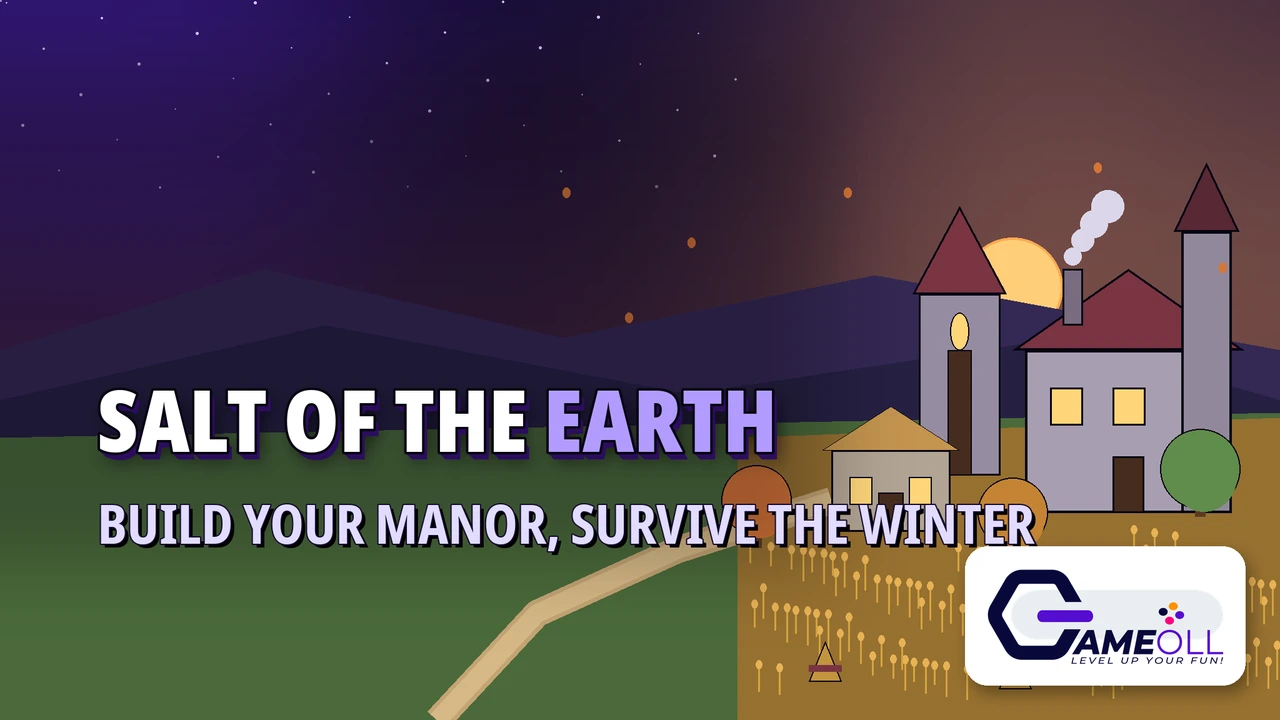
Salt of the Earth launches on Thursday, November 19, 2026, on PC, Mac and Linux. It is an isometric medieval settlement builder about a single manor held by charter, and the families who live on it. No price is listed on Steam yet, and there is no demo to try on the store page today.
This guide covers only what Steam confirms before launch: the platforms and the missing price, how roads and housing tiers shape your town, the 28 goods and their chains, and how to store enough food to survive winter. There is no walkthrough here, because the game is not out yet. We will update this page once real hands-on time exists.
Release Date
Thursday, November 19, 2026
Price
Not listed yet on Steam
Developer and Publisher
Cattrall Games
Platforms
PC (Steam), Mac and Linux
Platforms, price and system requirements
Salt of the Earth launches on Thursday, November 19, 2026, on PC through Steam, and on Mac and Linux too. Cattrall Games is both the developer and the publisher. The one gap in the launch picture is the price: Steam lists no price yet, so the store page shows only a wishlist button for now.
| Platform | Release date | Price | System note |
|---|---|---|---|
| PC (Steam) | November 19, 2026 | Not listed yet | Windows 10 64-bit, dual-core 2.0 GHz, 4 GB RAM, 1 GB storage |
| Mac | November 19, 2026 | Not listed yet | macOS 11 Big Sur, Apple Silicon or 64-bit Intel |
| Linux | November 19, 2026 | Not listed yet | Ubuntu 20.04 or SteamOS 3 |
The recommended specs sit a little higher: Windows 11, a quad-core 3.0 GHz processor and 8 GB of RAM on PC, and macOS 13 Ventura on Mac. The minimum display is 1280×720, and the game needs a mouse and keyboard. The interface is offered in 11 languages, including English, French, German, Spanish and Korean.
There is no demo on the store page today, so launch day itself is the first chance to play. Wishlist the game if you want Steam to tell you when the price appears.
How the manor works
Everything in Salt of the Earth grows from one manor held by charter. You place the buildings, lay the roads, and the families who move in do the work. The game has no research tree, so progress comes from building the right thing in the right place, not from unlocking tech.
Roads come first, because every building has to touch the road network. Workshops take their labor from houses within walking distance, so a workshop far from housing stands idle while one beside housing runs full. Lay the road first, then build along it, and keep housing close to the workshops that need hands.
More than 40 buildings fill the roster, from a hovel and a well up to a cathedral, a keep, and border outposts. Every one of them has to touch a road, so the road plan is the town plan.
| Tier | House |
|---|---|
| 1 | Hovel |
| 2 | Peasant house |
| 3 | Half timbered house |
| 4 | Town house |
There are four housing tiers: a hovel, a peasant house, a half timbered house and a town house. A household moves up when its needs are met: food, water, a market in reach, a church, an inn, and a school for the children. Variety matters too: a family living on bread alone eats through it far faster than one with bread, meat and fruit on the table.
Families whose needs go unmet do not wait around. They leave, and the yard behind the house goes unworked, so a street of empty houses is a warning that something in the chain has broken. Watch the needs first, and the tiers will follow.
Buildings unlock from what already stands, not from research. The bakery needs a mill, the tower needs a barracks, the school needs a church and a half timbered house, and the goldsmith needs a town house. Plan each new building around the one it depends on, and build the dependency first.
Production chains: 28 goods that feed each other
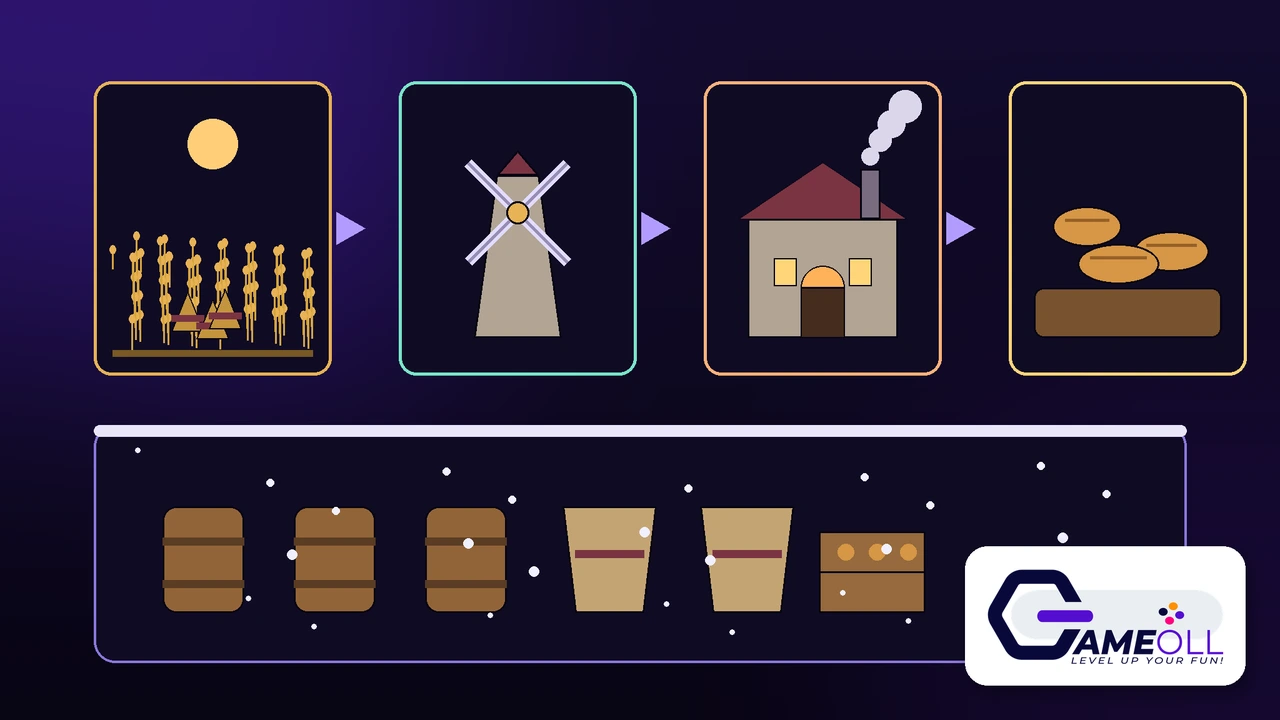
The manor runs on 28 goods, and most of them are made in chains. Grain becomes flour at the mill, and flour becomes bread at the bakery. Ore becomes iron, and iron becomes tools.
| Chain | Steps |
|---|---|
| Grain | Grain to flour to bread |
| Ore | Ore to iron to tools |
| Clay | Clay to tiles |
| Grapes | Grapes to wine |
| Wool | Wool to fabric |
Surplus sells at the market square, so a chain that makes more than the town eats is income. Any good can be forbidden outright, which tells the town to stop eating what was meant for sale. Forbid a good only when you are sure the town can live without it, because a forbidden good is gone from every table.
Surviving winter
The year turns through four seasons, and winter is the test that decides whether a manor survives. Nothing grows in winter, so the food stored from spring to autumn has to last until spring. A town that eats well in summer and stores nothing will be hungry long before spring.
Weather comes and goes through the year: rain, hail, snow and thunderstorms. Rain has one upside: it helps put out fires. Plan your stores around the seasons, not around the good weeks, and keep food in reserve above what the town eats each day.
Raiders and fire
Raiders start arriving once the manor is a market town. They walk in from the edge of the map and set fire to the nearest building they can reach. Fire spreads between buildings that stand next to each other, and it stops at gaps such as roads.
A well can put out one fire, and then it takes weeks to refill, so wells are a last resort rather than a plan. The real answer is towers with soldiers stationed in them. Build the barracks first, because the tower needs a barracks standing before it can be built.
Roads do double duty here: they carry your workers and they break a fire’s path. Leave gaps between clusters of buildings, and a fire that starts in one cluster cannot walk across the whole town.
Charters, honours and neighbours
You begin by picking one of four charters, and the choice sets the land you build on. They run from rich river soil to a lean northern frontier, so a charter shapes how hard the early years feel. Pick rich soil for a first manor, and save the lean frontier for a later run.
Five honours carry the manor from Minor Lord to Castellan, and each one unlocks what follows. Raiders and foreign correspondence arrive at A Proper Market Town, while border outposts and knights wait at Seat of Power. Every honour changes what the town has to deal with, so each step up is a new problem as much as a new reward.
Four neighbouring towns keep score, and couriers arrive with export offers once the manor is a market town. Each town has its own temperament: one is demanding and quick to take offense, another is patient. Relations improve or worsen over the years depending on how you deal with each town, so an export deal is never just about the goods.
Over 50 decision events will interrupt the quiet years. A company of masons out of work may ask to be taken on, the bishop’s collector may ask for a larger tithe, and families from a neighbouring manor may wait at the boundary asking to settle. Each one asks for a choice, and the choice has a cost either way.
Your first hours: six tips that hold up
- Lay roads before buildings. Every building has to touch the road network, and workshops need housing within walking distance, so plan the road first and build along it.
- Feed variety, not just volume. A family on bread alone eats through it far faster than one with bread, meat and fruit, so grow more than one food.
- Build the mill before the bakery. Buildings unlock from what already stands, so check the dependency before you place anything.
- Store food from spring to autumn. Nothing grows in winter, and the stores you build in the warm months have to last until spring.
- Leave gaps between building clusters. Fire spreads between neighbours and stops at roads, so a gap is the cheapest firebreak you own.
- Watch the needs before you chase the tiers. Families whose needs go unmet leave, so fix food, water and the market before you build for the next tier.
Salt of the Earth questions
When does Salt of the Earth launch?
Salt of the Earth launches on Thursday, November 19, 2026, on PC through Steam, and on Mac and Linux. Cattrall Games is both the developer and the publisher.
How much does Salt of the Earth cost?
No price is listed on Steam yet. The store page shows only a wishlist button for now, so check the page again near launch for the price.
Is there a Salt of the Earth demo?
No. There is no demo on the store page today, so launch day is the first chance to play.
How do families move up to better houses?
A household moves up when its needs are met: food, water, a market in reach, a church, an inn, and a school for the children. Variety counts too, because a family on bread alone eats through it far faster than one with bread, meat and fruit.
Final verdict
Salt of the Earth is a slow, careful builder for players who like chains, seasons and small decisions that add up. The launch is set for November 19, the price is still unlisted, and there is no demo to try first, so wishlist it and check the price on launch day. If a manor of your own sounds like a good winter, this one is worth watching.
📖 Salt of the Earth on Steam 🎮 See All Free Games