
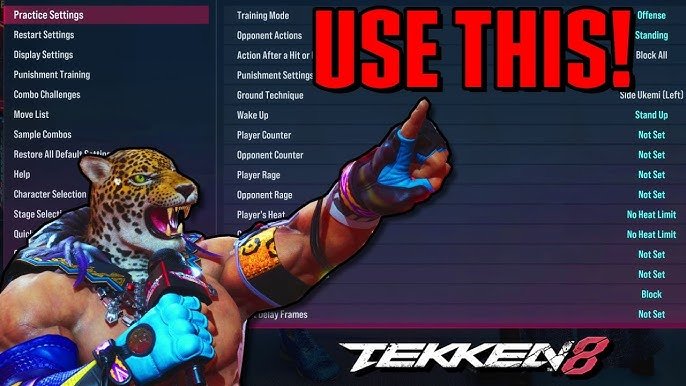
To train effectively in Tekken 8, focus on learning your character’s move list, practicing combos, and understanding frame data. Additionally, consistently play against opponents of varying skill levels to adapt and improve.
Want to get good at Tekken 8? It’s not just about button mashing, you know. The path to victory requires smart, focused effort. If you’re wondering about Tekken 8 how to train effectively, you’re in the right place.
We’ll break down the crucial elements to level up your game. From practice modes to real-world fights, it will guide you towards improvement. So, get ready to enhance your skills.

Tekken 8 how to train effectively
Okay, so you’re ready to level up your Tekken 8 game! That’s awesome. Just jumping into matches and button mashing might be fun for a bit, but to really get good, you need a solid training plan. Think of it like learning to ride a bike – you wouldn’t just hop on and expect to be a pro, right? You need practice and guidance. This guide will break down the best ways to train effectively in Tekken 8, covering everything from the very basics to more complex stuff.
Understanding the Fundamentals
Before you can pull off crazy combos and read your opponent like a book, you gotta nail down the basic stuff. These are the building blocks of your Tekken 8 skills. Think of these fundamentals as your ‘ABC’s’ – without them, you’ll be struggling later on.
Movement: The Key to Success
Tekken is a 3D fighting game, which means movement is super important. It’s not just about going left and right. You need to get used to moving in all directions: forward, backward, sidestepping, and even crouching. You use these to get into position, avoid enemy attacks, and set up your own offense. Here’s what to focus on:
- Walking: Walking is basic. Use the directional pad (or stick) to slowly move in your chosen direction.
- Dashing: Tapping forward (or backward) twice quickly will make your character dash. Use this for closing the gap or creating space.
- Sidestepping: Tapping up (or down) will have your character step to the side. This helps dodge linear attacks and can open up opportunities to counter.
- Backdash Canceling: This technique takes a bit of practice, but it’s very useful. You quickly backdash, then cancel into another move (usually a standing guard). It creates space and makes you harder to hit.
- Crouching: Holding down will cause your character to crouch, which lets you avoid some high attacks. You can also do special moves from crouch.
Learning the Block
Blocking might seem simple, but it’s actually more complex than you think. A strong defense is as important as a strong offense. Here’s the deal:
- Standing Guard: Holding back will make your character stand and block. This protects against high and mid attacks.
- Low Guard: Holding down-back will make your character guard low. This stops low attacks, but leaves you vulnerable to highs and mids.
- Punishing: After successfully blocking an unsafe move by an opponent, you can punish them back with your own attack. Learning which moves are unsafe and how to punish them is key.
Basic Attacks and Punishes
Every character has a set of basic attacks. These might include jabs, kicks, throws, and special moves. It’s important to know how to perform them and when to use them.
- Jabs: Quick punches with short range. Jabs are good for interrupting opponents, and getting space.
- Kicks: Kicks vary depending on the character, some characters use their legs for longer range.
- Throws: Usually performed by pressing LP + LK (Left punch + Left kick), throws are a basic mix-up that you should be using. Learn your character’s common throw options.
- Punishers: After blocking an unsafe move, you can retaliate. Learn which moves are safe or unsafe on block.
Remember to get comfortable with your character’s basic move set and the universal commands. You don’t have to master everything at once, but you should learn at least a few simple attacks that you can reliably use. Practice these until they become second nature.
Character Selection and Exploration
Choosing the right character for you is an important step. Don’t just pick the one who looks the coolest! Each character has a unique fighting style, moves, and strengths/weaknesses. Try to find a character that matches your style of play.
Experiment with Different Characters
Tekken 8 has a wide range of fighters. The best way to find your main is to try out a few different characters. Here are some pointers:
- Check their movelists: Each character has a complete move list, found in the game’s menu. Look through them to get a feel for how they play. Some characters use lots of projectiles (think laser beams), while others are focused on up-close brawling.
- Use Practice Mode: The game includes a practice mode which is a great place to try out characters without the pressure of a real match. Practice against a dummy to learn their different moves.
- Play a few matches: After some practice, jump into a few casual matches with each character to see if they click with you.
- Look at online resources: There are many online guides and videos about each character. Look at guides and community discussions to learn more.
Stick with One or Two Characters
Once you’ve found a character or two you enjoy, it’s time to focus on them. It’s much better to be good with one or two characters than to be mediocre with all of them. Concentrate your training on your chosen characters. This will make your learning faster.
Training Modes and Resources
Tekken 8 provides some excellent training resources. Don’t skip them! They’re designed to help you improve. The training mode is your best friend, it will be where you spend most of your time training.
Practice Mode: Your Training Dojo
This is the most important training tool you have. Use practice mode to do the following:
- Movement drills: Practice your walking, dashing, sidestepping, and backdash cancelling. Spend at least 15 minutes each session just on movement.
- Combos: Use the command list to learn your character’s combos. Practice them until you can execute them easily. Start with simple combos and add complexity as you get better.
- Punishment practice: Set the dummy to perform unsafe moves. Then, practice punishing those moves. This is a really important skill.
- Character-specific tech: Dive deep into your character’s command list. There are so many possibilities to discover. Spend time practicing new and advanced character tech.
- Record and Playback: You can record your moves and play them back. Use this feature to analyze your performance and fix errors.
Replay Analysis
Tekken 8 allows you to watch replays of your matches. Use this to identify your mistakes and areas for improvement. Here are a few tips:
- Watch your movement: Are you moving properly, or are you getting caught by attacks because you’re standing still?
- Analyze your attacks: Are you using the right attacks in the right situations? Are you predictable?
- Study your opponent: What tactics are your opponents using, and how can you defend against them?
- Look at mistakes: What mistakes are you making that you can fix next time?
Online Resources
The Tekken community is full of helpful people and information. Don’t be afraid to look online for help.
- YouTube tutorials: There are many channels that provide tutorials for Tekken 8. Search for character-specific guides, as well as basic tips.
- Online forums and communities: Sites like Reddit and Discord are good places to ask questions, get tips, and discuss the game with other players.
- Professional players: Learn from pro player matches. Watching what they do can give you an idea of what advanced techniques you should learn.
Advanced Techniques and Strategies
Once you’ve mastered the basics, you can move on to more advanced techniques and strategies. These will make you a more dangerous and difficult opponent.
Frame Data: Understanding the Math of Tekken
Frame data is the information about each move in the game. It tells you how long a move takes to start, how long it’s active, and how long it takes to recover. Understanding frame data allows you to learn which moves are safe to use, and how to punish your opponent. Here’s the gist:
- Startup Frames: The amount of time it takes for a move to begin.
- Active Frames: The time a move can hit an opponent.
- Recovery Frames: The time it takes for the move to finish and your character to recover.
- Understanding the Plus/Minus Numbers: Moves can be + on block, meaning you can act immediately after, or – on block, meaning you must wait to act. This is crucial for punishing.
You can search online for frame data for your character. While it might sound difficult, it is a powerful tool for improving your strategy.
Matchup Knowledge
Every character has a unique fighting style, so knowing how to fight against each of them will improve your win rate. Some matchups are easy, some are hard, it’s important to know each characters weakness/strengths.
- Know their moves: Try to learn your opponent’s character’s basic moves and tactics. This will help you anticipate and counter their attacks.
- Identify their weaknesses: What do they struggle with? Do they have weak low attacks, are they bad at dealing with sidestep attacks, or do they leave themselves open after certain attacks?
- Adjust your strategy: Adapt your tactics based on the opponent’s character. It’s not always about playing the same way.
Mix-Ups: Keeping Your Opponent Guessing
Mix-ups are about using different kinds of attacks to make your opponent have to guess how to block. Using high, mid and low attacks, as well as throws, creates opportunities for you to open up your opponent.
- Vary your attacks: Don’t always use the same moves. Use a mix of highs, mids, and lows.
- Throws: Add throws into your mix-ups to keep them from only guarding against attacks.
- Patience: Don’t be predictable. Your opponent will be looking for patterns. You need to change it up frequently, to keep them guessing.
Spacing and Positioning
Knowing how much distance to keep from your opponent is critical. Spacing is one of the most difficult concepts in fighting games. Here are some pointers:
- Character Ranges: Know your character’s optimal range. Some characters thrive up close, some do better at a distance.
- Movement: Use movement to get into the right range for your attacks. Use movement to create space from attacks and gain an advantage.
- Punishing: Understanding spacing lets you punish unsafe attacks effectively.
Developing a Training Routine
Consistency is essential to improving your game. You need to train frequently to progress in Tekken. Think of it like going to the gym – it’s about working out regularly, not just once in a while. You need a proper routine.
Regular Practice Sessions
Set aside some time each day or every few days to practice. Even 30 minutes of focused training is more helpful than hours of unfocused playtime. Try setting a schedule.
Structured Training
Create a plan for your practice. Break your training down into sections. Here’s a sample training schedule:
- Warm-up (5 minutes): Practice your movement and basic attacks.
- Combo practice (15-20 minutes): Work on your combos. Focus on one or two combos at a time.
- Punishment practice (10-15 minutes): Focus on punishing moves your opponent uses.
- Match play (20-30 minutes): Apply what you’ve learned against real opponents (or AI).
- Replay Analysis (5-10 minutes): Review your performance in practice and match play.
Consistency is Key
Training consistently is what will give you long-term results. You won’t see big improvements overnight. Be patient with yourself and keep at it. Remember, everyone starts somewhere.
Improving at Tekken 8 takes time and effort, but with the right training approach, you’ll progress quickly. The key is to be patient, consistent, and to always look for ways to improve. If you keep practicing, you’ll be a great player before you know it.
Get Good at Tekken 8! Using Training Mode Efficiently
Final Thoughts
Effective Tekken 8 training involves focused practice on combos and movement. Use the replay system to analyze your matches; identifying mistakes will help you learn.
Next, spend time in practice mode, experimenting with different characters and moves. Understanding frame data is also a key aspect of improving, and must be worked on.
Finally, to train for Tekken 8 how to train effectively, consistent effort and patience are crucial. You must dedicate regular training time.

