
Practicing efficiently in Tekken 8 involves focusing on specific character matchups, utilizing the replay system to analyze mistakes, and prioritizing consistent execution of core combos and movement.
Okay, you’re diving into the world of Tekken 8 and want to get better, faster? It’s a feeling we all know. This article focuses on practical strategies for Tekken 8 maximizing practice efficiency. We won’t waste time with generic advice.
Instead, we’ll explore techniques that will truly improve your gameplay. This includes breaking down training into manageable sections and optimizing your time. Think smart training, not just endless button mashing.

Tekken 8 Maximizing Practice Efficiency
Okay, so you’re diving deep into the world of Tekken 8! That’s awesome. But let’s be real, just jumping into matches and button mashing isn’t going to make you a fighting game god. You need a plan, a way to practice that gets you results, and that’s exactly what we’re going to talk about. It’s all about being smart with your practice time, so you get good fast and have even more fun in the long run. Think of it like this: you wouldn’t try to build a skyscraper without a blueprint, right? Well, consider this your blueprint for becoming a Tekken 8 pro (or at least way better than you are now!). We will walk through the most effective ways to train, breaking down the process into smaller, more understandable chunks so you can understand the game more thoroughly and get better quickly.
Understanding Your Fundamentals: The Building Blocks
Before you start trying crazy combos, you need a solid foundation. Think of this like learning your ABCs before you start writing stories. Fundamentals are the basic movements and techniques every character in Tekken 8 uses. These are what make or break most situations and they include things like movement, guarding, and understanding the basic attacks of your character.
Movement is Key
Tekken is not a game where you stand still and trade blows. Movement is absolutely critical to your success. If you only walk back and forth and trade a few hits, then that means you’re just wasting an opportunity to move around and position your character. Good movement means you can avoid attacks, create opportunities, and control the pace of the fight. Here are some key movement techniques to learn:
Forward Dash: Quickly moving towards your opponent. It can help to get into range for a combo.
Back Dash: Quickly moving away from your opponent, creating space. Also, a good way to avoid attacks.
Side Step: Moving to the side to evade linear attacks. Essential for countering moves that only track straight ahead.
Korean Backdash (KBD): An advanced movement technique that combines back dashes with crouch canceling, allowing for quick and precise backwards movement. This takes practice, so don’t worry if you don’t get it right away. Many players dedicate a lot of time to learning this.
Walking: Sometimes, just walking slowly forward or backward is all you need to keep the pressure on or get away from an aggressive player. Walking can also open up mixups, which is something a lot of players use.
Practice these movements individually first, getting the rhythm down, before trying to use them in a match. Use the practice mode to practice movement, where there is no opponent to rush you or put you under pressure.
Guarding: Your Best Friend
Guarding is a fundamental mechanic that’s sometimes overlooked by newer players. Holding back on the controller will block most high and mid attacks. It’s crucial to learn when to guard and when to stop guarding. Guarding is not just a passive action; it’s a way to take a breather and decide your next move, and it’s a way of avoiding a big damage hit, so it’s important to know how to guard and when to guard. If you don’t learn to guard, you will take more damage and lose a lot more matches. You also want to mix up guarding with other defensive options such as movement to confuse the opponent. There are several kinds of attacks that you need to pay attention to:
High Attacks: These can be ducked, but they hit standing opponents, so you need to block them.
Mid Attacks: These must be blocked while standing and cannot be ducked.
Low Attacks: These have to be blocked low by pressing down and back on the controller. You can’t block these while standing.
Unblockable Attacks: These require you to dodge with movement or interrupt with a quick attack.
Learn which attacks are which, and how to guard them effectively. Many new players focus solely on offense, but defense is just as important. If you can’t guard, then you will get hit by all the opponent’s attacks.
Basic Attacks: Jabs and Pokes
Every character in Tekken 8 has basic attacks like jabs and pokes. Don’t just randomly swing buttons; learn which attacks are quick, safe, and effective in various situations. These are great for interrupting the opponent, or setting up bigger damage. Learn each of your character’s moves by going into practice mode and looking at the command list, this will help you understand which of your moves are good for what.
Jabs: Quick, short punches that are good for interrupting.
Pokes: Fast attacks that can annoy the opponent and chip away at health.
Safe on Block Attacks: Attacks that don’t leave you vulnerable even if they’re blocked by the opponent. You are safe to use these attacks since you won’t get heavily punished if they are blocked.
Punishable Attacks: Attacks that leave you vulnerable if they’re blocked. These attacks need to be used carefully. These attacks usually deal high damage, or push the opponent very far away.
Experiment with your character’s basic attacks in practice mode and pay attention to how long they take to come out, what range they have and their recovery. Understanding these small details is important. These are also a good way to learn to punish the opponent when they make a mistake.
Character Specifics: Dive Into Your Main
Once you’ve got a handle on the fundamentals, it’s time to focus on your character. No two characters in Tekken 8 are alike, so understanding the ins and outs of your chosen fighter is important. Some characters might be better for beginners and some might be harder. Some characters might have very long-range attacks and some will be more close range. Don’t be afraid to try different characters to find one that you like.
Command Lists: Your Character’s Bible
The first thing you need to do is study your character’s command list. Every single move a character can do is listed there. But don’t just glance at it, take the time to understand what each move does, its speed, its range, and how unsafe or safe it is. Command lists may seem intimidating to new players, but they are your character’s move bible. You have to understand what your character can do before you can use them effectively. Here are some things to pay attention to:
Attack Properties: Is the move high, mid, or low? Does it launch the opponent? Does it stun?
Frame Data: This refers to how quickly an attack comes out, how long it stays active, and how quickly you can recover. You can look up your character’s frame data online.
Range: How far an attack will reach. Learn which of your attacks cover a lot of range, or which of them are up close attacks.
Purpose: What is the attack good for? Is it a poking tool, a launcher, or a mix-up tool? Understanding what each of your attacks are good for is important.
Developing Your Game Plan
Once you’ve studied the command list, it’s time to create a game plan for your character. This involves understanding your character’s strengths and weaknesses. Here are some ideas to think about:
Character Strengths: Does your character excel at close-range pressure or long-range zoning? Do they have very damaging combos? Or perhaps they have very good poking?
Character Weaknesses: Does your character struggle against rushdown? Or do they have a hard time in a poke war? Perhaps their combos are very hard to execute?
Your Personal Playstyle: Do you prefer playing defensively, aggressively or as a mix up character?
Specific Combos and Strings
Start with some simple combos and strings. Don’t try to learn every combo at once. Instead, focus on one or two combos that are easy to execute and deal good damage. As you get more comfortable, add to your repertoire. You should start by learning combos that will always work on any character. Then you can start to branch off into more specific combos that work on specific situations. Here’s the breakdown:
Simple Launch Combo: A combo that begins with a move that launches the opponent into the air.
Wall Carry Combo: A combo that pushes the opponent to the wall. These combos are very important in Tekken, as being next to the wall can severely limit your movement.
Wall Combo: A combo that continues once the opponent hits the wall. Wall combos usually deal a lot of damage.
Utilizing Practice Mode Effectively
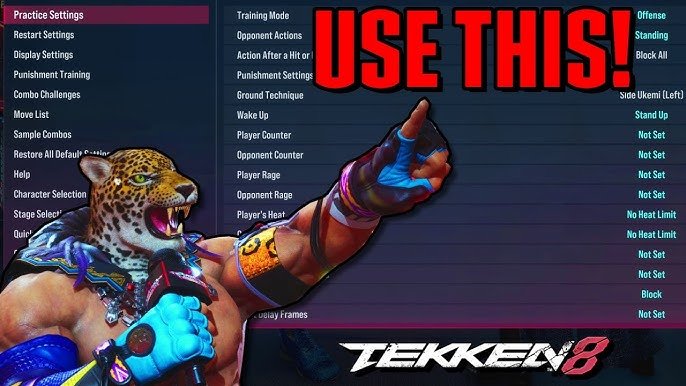
The practice mode in Tekken 8 is your best friend. It’s where you can experiment, learn, and hone your skills without the pressure of a real match. But simply being in practice mode is not enough. You need to use it correctly.
The Recording Feature
The recording feature in practice mode is extremely helpful. It lets you record your opponent (the dummy) doing specific actions or a series of attacks, which you can then practice countering. Here’s how to use it:
1. Record a specific sequence that gives you trouble.
2. Play back that sequence as many times as you need.
3. Try to counter the sequence, learn how to deal with the sequence, and then try again.
Frame Data Display
Turning on the frame data display can be very valuable, especially if you are an experienced player. It shows you how many frames each attack takes, so you can better understand what attacks are punishable and when to take your turn. You can access frame data outside the game using third party sites or apps, but if you are starting out, then you should probably avoid this and instead focus on your fundamentals and your basic combos.
Customize the Dummy
The practice mode lets you customize the dummy’s behavior, such as making it guard after every move, attack after every move, or even just walk back and forth. This can be very helpful to practice specific scenarios. You can even choose what moves to use when the dummy attacks. You can set the dummy to only attack low, or only attack high, which can help you practice dealing with these situations.
Match Analysis: Learn From Every Fight
Every match you play, whether you win or lose, is a learning opportunity. Don’t just move on to the next match without thinking about what happened in the last one. Take some time to analyze your fights.
Review Your Replays
Tekken 8 lets you save replays of your matches. Watch these replays to see what you did well and what mistakes you made. When you watch a replay, focus on the following:
Where you were punished: What moves did your opponent punish? This will show you what attacks are unsafe.
How you got hit: How did your opponent open you up? This can help you learn how to deal with these scenarios.
Opportunities missed: Did you miss chances to attack or to punish?
Focus on the Problem Areas
If you notice you keep getting hit by the same move, that’s a problem area to focus on. Go into practice mode, record that move with the practice dummy, and learn how to counter it. If you have trouble with certain types of characters, then you should go into practice mode and practice with that character. If you play against a character in online and you get completely destroyed, then you need to figure out what you did wrong and learn how to avoid those mistakes.
Don’t Get Discouraged
Everyone loses, even pros. Don’t let losses get you down. Instead, use them as motivation to improve. Every loss is a learning experience, as long as you don’t make the same mistake again. Being able to learn from a loss, is what makes a player good.
Community Resources: Learn From Others
There’s a whole community of Tekken players out there. Don’t be afraid to reach out and learn from others.
Online Forums and Discord Servers
There are many online forums and Discord servers where players discuss Tekken, give advice and share information. Find one that suits you and join in. You can learn a lot from reading other people’s comments, and by interacting with them. You can even find a training partner that is the same skill level as you, so you guys can both get better at the game.
YouTube Tutorials
YouTube is a goldmine of Tekken 8 content. There are many skilled players creating videos explaining advanced techniques, character-specific strategies, and more. If you are struggling with a certain character or scenario, you should look up videos about them. Many of the content creators also go in depth about how they play their character and what their gameplan is.
Professional Play
Watching professional Tekken players can be very useful. Pay attention to their movement, their combos, their mix ups, and what kind of pressure they apply to the opponent. This can give you new ideas on how to play and can show you what techniques are good. There are lots of professional matches you can find online, or even watch in real life.
By combining dedicated practice with an open mind for learning, you will become a much better Tekken 8 player. Remember, improvement takes time. So don’t get discouraged if you don’t see progress right away, keep practicing and focusing on your weaknesses and you will get better. Focus on each aspect of the game and then try to put everything together. Don’t try to learn everything at once. The journey is just as fun as the destination, so relax and enjoy. Remember to use your practice time effectively, and you will see improvements in your gameplay. It’s a marathon, not a sprint.
Get Good at Tekken 8! Using Training Mode Efficiently
Final Thoughts
In short, effective practice involves focusing on specific areas. Identify your weaknesses, drill particular combos, and study character matchups. This approach provides quicker gains than random play.
Use the replay function to analyze your mistakes. Then, consistently implement corrections. Consistent, targeted training is key to improvement.
Tekken 8 maximizing practice efficiency requires dedicated effort. Stick to your plan, and you’ll see noticeable skill growth. This focused method is absolutely necessary for progression.

