
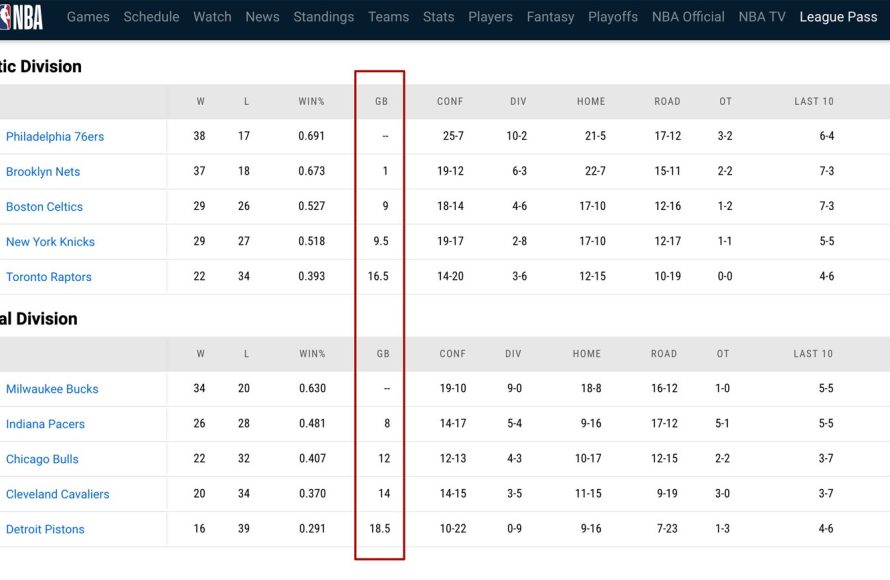
Games back in basketball represents the difference between a team’s wins and losses compared to the leading team in their division or conference.
Ever wondered how teams are ranked mid-season? It’s not just about total wins, and that’s where “what does games back mean in basketball” becomes important. It offers a clear picture of how far a team trails the frontrunner. This metric provides context on where they stand in the competition.

What Does Games Back Mean in Basketball?
Alright, let’s dive into the world of basketball and figure out what “games back” really means. It’s a phrase you’ll hear a lot when people talk about standings and how teams are doing. If you’re new to the game or just want a clearer understanding, you’ve come to the right place! We’re going to break it down into simple terms, so you can follow along like a pro.
Understanding the Basics: Wins and Losses
Before we can understand “games back,” we need to be comfortable with wins and losses. Every basketball game has a winner and a loser (except for those rare ties in very specific leagues, but we won’t worry about those here!). A team’s record is simply how many games they’ve won compared to how many they’ve lost. You’ll see it written like this: 20-10. This means the team has 20 wins and 10 losses. It’s a quick snapshot of how successful they’ve been.
The Importance of the “Leading” Team
Now, “games back” is always in relation to a leading team. This leading team has the best record in a particular situation. This could be the best record in a league, a conference, or even a division. Think of the leading team as the standard for everyone else. To figure out “games back”, we see how far behind the other teams are compared to this leader.
What “Games Back” Actually Represents
So, what does “games back” mean then? It’s not just about the total difference in wins. It’s about how many games a team is behind the leading team in terms of the win column. It accounts for both wins and losses, and it helps paints a clearer picture of how much ground a team needs to make up. It tells us how many games a team would have to win, and another team would have to lose, to catch up to the leading team.
The Calculation Explained
Let’s get into the nitty-gritty of the calculation. Here’s the formula:
(Games Back) = [(Wins of the Leading Team) – (Wins of the Following Team)] / 2 + [(Losses of the Following Team) – (Losses of the Leading Team)] / 2
That looks complicated, but it’s actually pretty simple when we do it step by step. But here’s another way to think about it:
- First, subtract the team’s wins from the leading team’s wins.
- Then, subtract the leading team’s losses from the team’s losses.
- Add those two numbers together and divide by two.
The result gives you the “games back.” Let’s make things clearer with an example.
Example to illustrate Calculation
Imagine we have these two teams:
- Team A (Leading Team): 30 Wins, 10 Losses
- Team B: 25 Wins, 15 Losses
Now, let’s do the calculation.
(30 Wins of Team A – 25 Wins of Team B) / 2 = 5/2 = 2.5
(15 Losses of Team B – 10 Losses of Team A) / 2 = 5/2 = 2.5
Add the results
2.5 + 2.5 = 5
So, Team B is 5 games back of Team A.
Why does dividing by two make sense?
The reason we divide by two is because one win by the trailing team and one loss by the leading team equals two games difference in the standings. Think of it like this: To catch up, the trailing team needs to win and the leading team needs to lose. It’s a two-sided effect.
The Importance of Games Back
So why is “games back” so important? Here’s why it matters to players, coaches, and fans:
Measuring the Gap
Games back shows you exactly how far behind a team is from the top spot. It’s not just about how many total wins they have, but the actual gap in the standings. It helps teams and fans understand the real distance they need to cover. It gives a realistic picture of the uphill climb that a team might face. A large number of “games back” means that a team needs to make a significant improvement to challenge for the top spot.
Playoff Implications
In most basketball leagues, there are playoffs at the end of the season. Teams with better records have a better chance of making the playoffs. Therefore, “games back” often determines whether a team makes the playoffs. Even if a team is close in the overall win column, the “games back” may still make a big difference.
Motivation for Teams
“Games back” serves as a vital tool for a basketball team to stay motivated. When teams see they are only a few games back from the leaders, it gives them a push to improve. A team might see themselves 3 games back and focus on that to give them the incentive to play their very best. On the other hand, a large deficit in games back may cause the team to evaluate their approach and restrategize.
Tracking Team Progress
Teams follow their “games back” closely because it is a way to monitor their progress throughout the season. A team would likely track this to see how they are faring against other teams. If the games back number shrinks, it shows they are gaining ground; a growing number shows that they are falling behind.
Situations Where “Games Back” is Important
Let’s look at some specific situations where “games back” becomes super important:
Divisional Races
In many leagues, teams are grouped into divisions. “Games back” becomes important in these divisional races because teams often want to win their division to gain a higher seed in the playoffs. Divisional games are especially important because it allows teams to close the gap between them and the leading team in the division.
Conference Standings
Leagues are usually divided into conferences (like the Eastern and Western Conference in the NBA). The best teams in each conference get a higher playoff seed. Following your “games back” in your conference is crucial to see if you are in the running for the playoffs.
Wild Card Spots
Some leagues offer “wild card” spots for teams that don’t win their divisions, but still have good records. Knowing your “games back” in the overall conference standings is key for wild card contention. This is especially true for the teams trying to sneak into a playoff spot.
Games Back in Different Scenarios
Tied Records
When teams have the same record, “games back” becomes zero between the teams. It shows that the teams are completely equal in wins and losses. It is only when a team has more wins than another team that “games back” comes into play.
Multiple Teams
If there are more than two teams, you calculate the games back by comparing each team to the leading team separately. For instance, if the leading team has 40 wins and team B has 35 wins and team C has 33 wins, you would calculate two “games back” values, the value between the leading team and B, and the value between the leading team and C.
What happens at the Start of the Season?
At the very beginning of a season, all teams will be zero games back because no one has any wins or losses yet. As games are played, teams will begin to establish their position in the standings.
Games Back and the Season’s Narrative
The “games back” number is not just a statistic; it’s part of the story of the season. It tells a story of teams striving to get to the top, facing challenges, and the effort teams make to reach their goals. Each game played adds to that story.
The Uphill Climb
A team with a high “games back” number faces a big challenge. They need to win consistently, while hoping the leading teams lose games. The closer a team gets to the leading team in “games back”, the more suspense and excitement builds.
The Tight Race
A close “games back” situation between teams shows an incredibly tight race. Every game means much more. Teams battle intensely with each win and loss making a huge difference in the standings. This is the sort of exciting finish that keeps fans on the edge of their seats.
The Importance of Head-to-Head Matchups
Direct matchups between teams that are in a tight “games back” race are very important. A team can win the season series and make up a game, or lose to a team in the standings and fall back in the race. These games have high stakes because of the impact on the “games back” metric.
A Quick Recap
Let’s sum up what we’ve learned:
- “Games back” is how many games a team is behind the leader.
- It is calculated using both wins and losses.
- It helps you understand a team’s progress throughout the season.
- It’s important for determining playoff standings.
- It adds to the excitement and drama of the season.
Why this is useful for Basketball fans
For fans, “games back” provides context for the games that are coming up. This allows them to better understand what each game means and to understand the stakes of the game. “Games back” can help fans know what to cheer for. If your favorite team is a few games back from the leaders, it makes you want to cheer them on more!
So, that’s the scoop on “games back” in basketball! It’s not as complicated as it might seem at first. It’s a key concept to understand so you can follow all the ins and outs of the sport. It’s a vital tool for measuring a team’s progress and understanding their chances of success. This simple phrase is what makes every basketball game so meaningful and entertaining.
Unwritten rules in basketball…
Final Thoughts
Games back signifies the difference in wins between a team and the leading team in their division or conference. It shows how far behind a team is in the standings.
A higher games back number indicates a larger deficit that the team needs to overcome. So, the smaller the number is the better position they have. Understanding what does games back mean in basketball is crucial for following the playoff race.

