
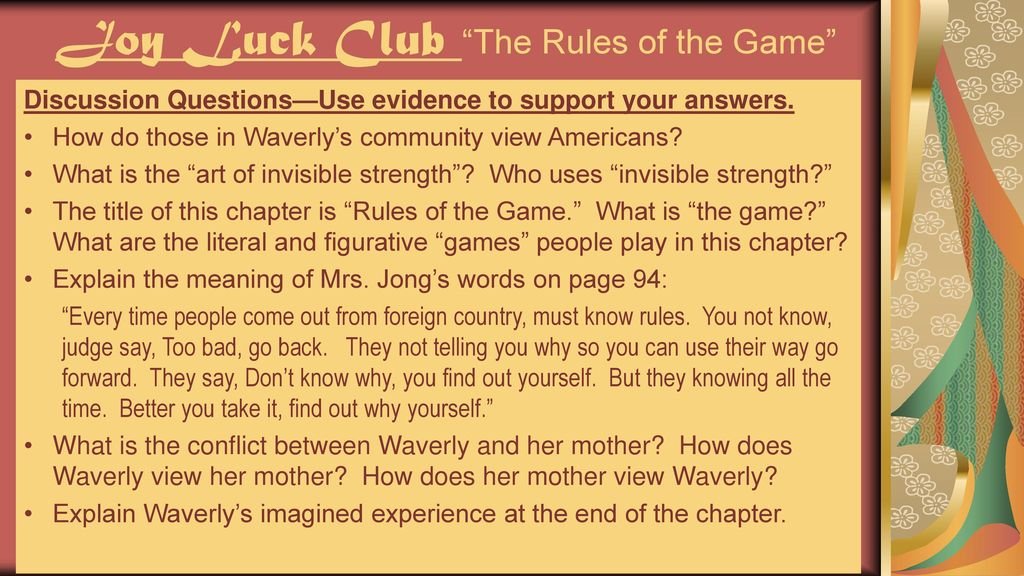
Invisible strength in “Rules of the Game” refers to the strategic and manipulative power Waverly Jong gains through her understanding of her mother’s expectations and cultural values, allowing her to get what she wants without direct confrontation.
Have you ever wondered about the subtle ways people gain power? It’s not always about shouting or overt actions. The story “Rules of the Game” introduces us to a complex idea – what does invisible strength mean in rules of the game?
Waverly Jong, the chess prodigy, uses this type of strength. It’s about knowing how to play the game with her family and society. She uses her mother’s expectations to achieve her own goals, manipulating situations with a quiet brilliance. This hidden advantage helps Waverly navigate her world.

What Does Invisible Strength Mean in Rules of the Game?
In Amy Tan’s powerful story, “Rules of the Game,” we learn about a young girl named Waverly Jong and her complex relationship with her mother. The story isn’t just about playing chess; it’s also about something called “invisible strength.” But what exactly does this phrase mean? It’s not about having superpowers or being able to disappear. Instead, it’s a special kind of power that comes from understanding how things really work and using that knowledge to your advantage. It’s about being smart and strategic, not just in a game, but in life itself. Let’s dive deeper into this important idea.
Understanding the Core Concept of Invisible Strength
Invisible strength is about having inner power and a deep understanding of a situation without always showing it outwardly. Think of it like a quiet but powerful current running beneath the surface of a river. You might not see it, but it’s definitely there, guiding the water’s flow. In “Rules of the Game,” Waverly learns to use this kind of strength in her chess games and, more importantly, in her interactions with her mother.
The Contrast With Visible Strength
Before we can fully grasp invisible strength, it’s helpful to understand what it’s not. Visible strength is what we usually think of when we think of power: being loud, forceful, and obviously in charge. It’s like a big, strong wrestler flexing his muscles. But in the story, Waverly’s mother teaches her a different approach. She doesn’t want Waverly to be aggressive or confrontational. Instead, she encourages her to be like the wind, which can be very powerful without anyone seeing it. Visible strength is easy to see, but invisible strength is the smart kind of power.
How Invisible Strength Manifests in Waverly’s Chess Strategy
Waverly’s journey in chess provides a great example of how invisible strength works. At first, she plays like many beginners, simply moving pieces without a lot of strategy. But as she learns from the men in the park and observes her mother, she begins to understand that chess isn’t just about moving the pieces; it’s about thinking several steps ahead. She learns to control her emotions, not revealing her intentions, just like her mother taught her. Here are some key ways this manifests:
- Patience and Observation: Waverly learns to wait and watch. She studies her opponents, figuring out their weaknesses before making her move. This is a key part of invisible strength: not rushing in, but taking time to understand.
- Strategic Thinking: She develops a plan for each game. She doesn’t just react to what her opponent does; she anticipates their moves and sets traps. This is all about thinking several steps ahead, a skill that is rooted in invisible strength.
- Maintaining a Calm Demeanor: Waverly learns to keep a cool head, not letting her emotions show. This keeps her opponent from figuring out her plans. She appears calm, but she’s thinking very intensely. This ability to hide your feelings is a big part of invisible strength.
- Using Opponent’s Expectations Against Them: By appearing unassuming, Waverly often lets her opponents underestimate her. This lets her strike at the perfect moment, proving that her quiet nature is not a sign of weakness, but a source of her power.
Invisible Strength in Waverly’s Interactions with Her Mother
Invisible strength isn’t just about playing chess; it’s about navigating social situations, particularly family relationships. Waverly uses what she learned from chess in her interactions with her mother, and her mother also uses it on her. The mother-daughter dynamic is a constant back-and-forth, full of unspoken rules and hidden meanings. Let’s look at a few key aspects:
The Art of Subtle Manipulation
Waverly’s mother doesn’t use brute force to get what she wants. Instead, she uses subtle methods and emotional intelligence, what we’ve been discussing as invisible strength. She knows how to influence Waverly by using words that seem like encouragement but actually push her to achieve what she desires. For example, she would say things like, “It’s not easy to be a good chess player.” This is something the mother uses to encourage Waverly to be her best.
Similarly, Waverly learns to be sneaky. For example, after receiving the chess set, she understands that her family is showing off, and decides to go practice in her room, hiding her excitement. This shows the invisible strength she’s learning, the ability to keep her true intentions hidden from others.
The Power of Silence
A big part of their relationship is what isn’t said. Waverly’s mother often uses silence to communicate. For instance, when Waverly receives her chess set as a gift, her mother does not say much, but her reaction shows her pride. This is another sign of her using invisible strength, using the power of not saying anything, to make her point. Silence, in this context, isn’t about being quiet; it’s about being powerful without speaking.
Emotional Control
Both Waverly and her mother demonstrate a remarkable amount of emotional control. Waverly doesn’t let her excitement show when she’s winning at chess, and her mother doesn’t always express her happiness or disapproval openly. Instead, both women express their feelings indirectly. This kind of control is a crucial aspect of invisible strength. Waverly learns to play her mother just as she learns to play her chess opponents.
The Game of Control
Much of the mother-daughter dynamic is about who has the upper hand. Waverly challenges her mother’s expectations in subtle ways, and her mother tries to control her daughter. This power play between them isn’t always obvious; often, it happens through unspoken actions, little comments, or even in the tone of voice. It’s like a chess game, with each person trying to make the best moves to gain an advantage, using the power of their invisible strength.
The Cultural Context of Invisible Strength
The concept of invisible strength is deeply connected to Chinese culture. In many traditional Asian cultures, outward displays of emotion or power are often considered impolite or even weak. Instead, people are encouraged to be reserved and thoughtful, controlling their inner power and showing strength through actions rather than words. Waverly’s mother uses this idea to guide her. Here’s how cultural aspects affect the meaning of invisible strength:
Respect for Elders and Authority
In Chinese culture, children are expected to respect their elders and authority figures, especially their parents. Waverly is taught that being respectful doesn’t mean being a pushover. Instead, it means being strategic in how she interacts with her elders. It’s about choosing when to speak up and when to be quiet. She uses invisible strength to navigate these family dynamics by knowing when to submit and when to push back, understanding her mother’s expectations.
The Value of Humility
Humility is also very important in traditional Chinese culture. Showing off or bragging is often seen as inappropriate. This is why Waverly’s mother encourages her to be quiet and observe. The lesson here is that true strength doesn’t come from bragging but from quiet confidence. It’s about understanding your abilities without needing to show them off. This approach is closely related to invisible strength; you don’t have to scream, to be heard, it comes from within.
The Power of Indirect Communication
Direct communication can sometimes be seen as confrontational or rude in Chinese culture. Waverly’s mother communicates with her through innuendo and indirect language, instead of being straightforward. This style of communication helps the family avoid direct conflicts and maintain harmony. Waverly learns to interpret these subtle cues, which is another part of invisible strength. She learns to read between the lines, a skill that will serve her later in life.
Invisible Strength as a Life Lesson
Ultimately, the idea of invisible strength in “Rules of the Game” is not just about chess; it’s about how to navigate the world. It’s a way of thinking, a method for not only achieving personal goals, but for understanding the people around us. Here are some general life lessons we can learn from this concept:
The Importance of Observation and Planning
Like Waverly, we can learn to watch and observe. By understanding the world and the people in it, we can make better decisions and achieve our goals more efficiently. Rushing in without thinking can lead to mistakes. Instead, we should take our time, plan things out, and act with purpose.
The Value of Emotional Intelligence
Being aware of our emotions and how they affect others is crucial. Controlling your emotional reactions helps you to think more clearly and make better choices. When we allow our emotions to take control, we may say and do things we regret later. Waverly learns that keeping calm and composed makes her a better chess player, and it helps in other areas of life as well.
The Power of Inner Confidence
True strength is not found in outward aggression or boasting; it’s found in inner confidence and self-knowledge. Knowing your strengths and using them wisely is a key aspect of invisible strength. Waverly demonstrates this perfectly in her chess matches, as she learns to outplay her opponents not by force, but by strategic thinking and inner confidence.
Adapting to Different Situations
Being flexible and adaptable is very important. We might have to deal with people from different backgrounds or beliefs, we might have to adjust our approach. Waverly learns to adapt to different opponents and her mother’s constant expectations, teaching us that the ability to adjust and adapt is a form of invisible strength. You learn to deal with different situations by using what you’ve learned through life.
The Ongoing Nature of Invisible Strength
It’s important to remember that developing invisible strength is not something that happens overnight. It is a journey of learning and growing, it is a skill that needs time to be built up. Waverly, at the end of the story, is still learning, her mother is still teaching, this ongoing cycle is how invisible strength is passed down. Like learning to play a musical instrument, it requires dedication, patience and practice. Invisible strength is always an ongoing process; it’s a skill to be developed over time and something you can continually improve.
In conclusion, “invisible strength” in “Rules of the Game” is about the kind of power that comes from within. It is not about being loud or aggressive; it is about being smart, observant, and strategic. It is about understanding the world and using that knowledge to your advantage. It’s about a quiet kind of power, a hidden strength that lies in patience, strategy, and emotional control. It is a very important lesson that we can all learn from Waverly and her mother.
Rules of the Game – Amy Tan
Final Thoughts
Invisible strength, in Rules of the Game, represents the power of strategic thinking and emotional control, rather than physical force. It’s about manipulating situations subtly to achieve a desired outcome. The story shows how Waverly employs these skills in both chess and life.
This concept emphasizes that true power lies in perception, patience, and the ability to outmaneuver opponents mentally. Therefore, what does invisible strength mean in rules of the game is the quiet, effective force a person cultivates internally. This subtle control is a must for success.

