
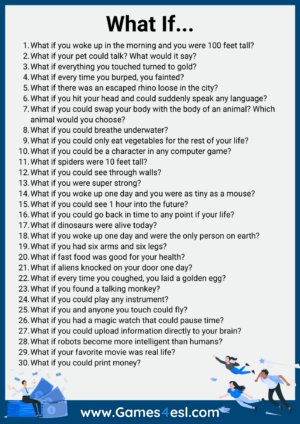
What if game questions explore hypothetical scenarios and their potential consequences, encouraging imaginative and critical thinking.
Ever found yourself pondering the impossible? That’s the magic of what if game questions. They transport us to different realities, pushing the boundaries of our imagination and helping us consider alternative paths. They’re not just silly scenarios; they’re tools for thought.
These questions can range from the mundane to the fantastical. They invite us to explore consequences, big or small. They make us think differently and consider perspectives we might otherwise miss.

Exploring the Wonderful World of What If Game Questions
Have you ever found yourself daydreaming, letting your imagination run wild with possibilities? That’s the magic of “what if” questions! They’re like little keys that open doors to exciting and sometimes silly scenarios. These aren’t just random thoughts; they’re the heart of “what if” games, a fun way to spark creativity, boost thinking skills, and have a whole lot of laughs with friends and family. Let’s dive deep into what makes these questions so awesome.
The Power of “What If”: Why We Love These Questions
“What if” questions are more than just idle curiosity. They encourage us to think outside the box and consider situations that we might never encounter in real life. Think about it: a question like, “What if animals could talk?” immediately takes us on a mental adventure, picturing what our pets might say or how conversations with squirrels might go! This kind of playful thinking helps to develop our imagination. When we explore “what if” scenarios, we exercise our brain’s ability to hypothesize, reason, and problem-solve. It’s like giving our minds a daily workout. It is not just for kids, it’s a beneficial exercise for individuals of all ages.
Cognitive Benefits of What If Questions
The benefits of engaging with “what if” scenarios extend beyond mere entertainment. These questions sharpen cognitive skills in a variety of ways:
- Enhancing Creativity: “What if” questions force us to imagine things that don’t exist, making our minds more flexible and creative. This type of mental exercise helps in generating novel ideas and solutions to problems in various areas of life. It is a playful training ground for the imagination.
- Improving Problem-Solving: When we contemplate “what if” scenarios, we naturally start thinking about how we would respond to the situation. This involves considering different options and their potential outcomes which develops analytical abilities and teaches us to approach challenges from various perspectives.
- Boosting Critical Thinking: Asking “what if” often requires us to evaluate different possibilities and consequences, which improves our capacity for critical thought and helps us to make better choices. This is not just about hypothetical situations, but it also transfers to real-world decision-making.
- Expanding Perspective: These questions enable us to see the world from a new perspective. When we think about “what if,” we consider realities that are different from our own, fostering understanding and empathy.
- Fostering Flexibility: This playful thought process makes our thinking more flexible. We are better equipped to handle unexpected situations and find creative approaches to challenges if we’re used to entertaining wild possibilities.
Types of “What If” Questions: Categorizing the Fun
The beauty of “what if” questions is that there are countless possibilities. Let’s look at some popular categories:
Silly and Whimsical “What If” Questions
These questions are all about having fun and sparking laughter. They often involve funny scenarios that are not meant to be taken seriously. Examples include:
- What if cats could fly?
- What if trees grew candy instead of fruit?
- What if everyone had to wear their clothes backward?
- What if dogs could write poetry?
- What if the moon was made of cheese?
Fantasy and Sci-Fi “What If” Questions
These questions take us to other worlds and explore the possibilities of magic, technology, or the unknown. They appeal to our sense of wonder and curiosity. Examples include:
- What if we could teleport anywhere?
- What if humans could breathe underwater?
- What if magic was real?
- What if we could travel to other planets?
- What if we could communicate with aliens?
Everyday and Practical “What If” Questions
These questions apply to our daily lives and allow us to think through common scenarios in new and creative ways. They can even help us prepare for potential problems. Examples include:
- What if we had no internet for a week?
- What if we could change one thing about the school day?
- What if we had to walk to school instead of taking the bus?
- What if we had a snow day in the summer?
- What if our chores were replaced with fun games?
Ethical and Philosophical “What If” Questions
These questions dive into deeper issues of right and wrong or the nature of reality. They can lead to interesting conversations and reflections. Examples include:
- What if you could change a mistake from your past?
- What if you could read other people’s minds?
- What if you were the only one who knew the truth about something?
- What if you could have any job in the world?
- What if you had the power to make the world a better place?
How to Play the “What If” Game
Playing the “what if” game is incredibly easy and flexible. There are no strict rules, making it adaptable for all kinds of situations and groups. Here are some ways to play:
Simple Round Robin
This is a straightforward way to play. One person asks a “what if” question, and then each person takes a turn to answer. The next person can ask a different “what if” question or build on the last one. It’s a great way to get everyone involved and see the variety of answers that come up.
Storytelling Style
Instead of just answering, take the “what if” question as a starting point for a story. Each person adds a sentence or a paragraph to the story, building upon the previous contribution. This makes the game more collaborative, fostering creativity and collaborative storytelling skills.
“Would You Rather” Variation
This variation combines “what if” questions with choices. Present two “what if” scenarios and ask, “Which would you rather?” This can create some fun dilemmas and is a good way to see how different people make decisions.
Drawing and “What If”
For those who love to draw, use “what if” scenarios as prompts. Ask a question like “What if dogs had wings?” then have everyone draw their vision of that idea. It brings a visual aspect to the game and sparks visual imagination, which can be just as beneficial as the creative thought involved in brainstorming answers to the questions.
The Benefits of Playing “What If” Games Regularly
Making “what if” games a part of your routine can be very rewarding. These are some of the key advantages of doing it regularly:
Increased Creativity and Imagination
Regular engagement with “what if” questions helps to cultivate a habit of thinking creatively and outside the box. It keeps your mind flexible and imaginative, not just during game time but in all areas of life. The more you use your imagination, the stronger it becomes.
Stronger Communication Skills
Playing “what if” games with others encourages active listening and constructive dialogue. You learn to articulate your ideas effectively and respond to the ideas of others which helps in improved conversation skills and ability to build on each other’s thoughts.
Enhanced Cognitive Flexibility
Regularly pondering “what if” scenarios can make your thinking process more flexible and adaptable. The more comfortable you become with imagining different realities, the better you become at handling real-life challenges that require adaptability. It makes you better at adjusting your thoughts to new information and unexpected events.
Fun and Engaging Learning
The “what if” game creates a fun and stimulating learning environment. It transforms learning into a enjoyable experience, making it easy for everyone to get involved and learn something new in the process. When learning is fun, it’s easier to stay engaged.
“What If” Questions for Different Age Groups
While “what if” games can be played by all age groups, the complexity and nature of questions might need to change a bit. Here are some ideas tailored for different groups:
“What If” Questions for Younger Children
For younger children, it’s best to focus on simple, concrete scenarios that relate to their daily lives. Some good examples include:
- What if all your toys came to life?
- What if you could fly like a bird?
- What if you had a pet dinosaur?
- What if you could live inside a cartoon?
- What if you could talk to the animals in the zoo?
“What If” Questions for Older Children and Teens
As children get older, they can handle more complex and abstract ideas. Questions can start involving problem-solving or ethical considerations. Examples include:
- What if you could invent anything you wanted?
- What if you could go back in time and change one thing?
- What if you had to be in charge for one day?
- What if your favorite book or movie came to life?
- What if you found a mysterious object?
“What If” Questions for Adults
For adults, “what if” questions can become even more thought-provoking and philosophical. Examples include:
- What if you could live forever?
- What if you could know the answer to any question?
- What if your dreams became reality?
- What if everyone told the truth all the time?
- What if you could change the world in a significant way?
Making the Most of “What If” Games
Here are a few quick tips to make “what if” games even more engaging and beneficial:
- Encourage Wild Ideas: Let the imagination soar! The more out-there the ideas, the better.
- Don’t Judge: There are no wrong answers in “what if” games. Let everyone share their thoughts without critique.
- Build Upon Ideas: Try to add to each other’s answers and expand upon the scenarios.
- Be Patient: Some people might need more time to think. Give everyone space to share their thoughts.
- Most Importantly, Have Fun: The goal is to enjoy the process of creativity and thinking together.
By embracing the joy and curiosity of “what if” questions, you open up a world of imaginative possibilities. These games are not just entertaining; they are powerful tools for growing our minds, improving our communication, and seeing the world in new and exciting ways. Whether you play with kids, adults, or even just your own mind, “what if” questions are the key to endless fun and learning.
So, the next time you find yourself with a few spare moments, ask a “what if” question and see where your imagination takes you. You might be surprised at what you come up with!
Who’s Most Likely To…? (General Questions)
Final Thoughts
Thinking through various scenarios helps us prepare for the unexpected. Asking “what if game questions” is crucial for creative problem-solving. We must actively consider possible outcomes.
This method sharpens critical thinking. It enables individuals to be more adaptable. Practicing with “what if game questions” strengthens our capacity to navigate complex situations.

