
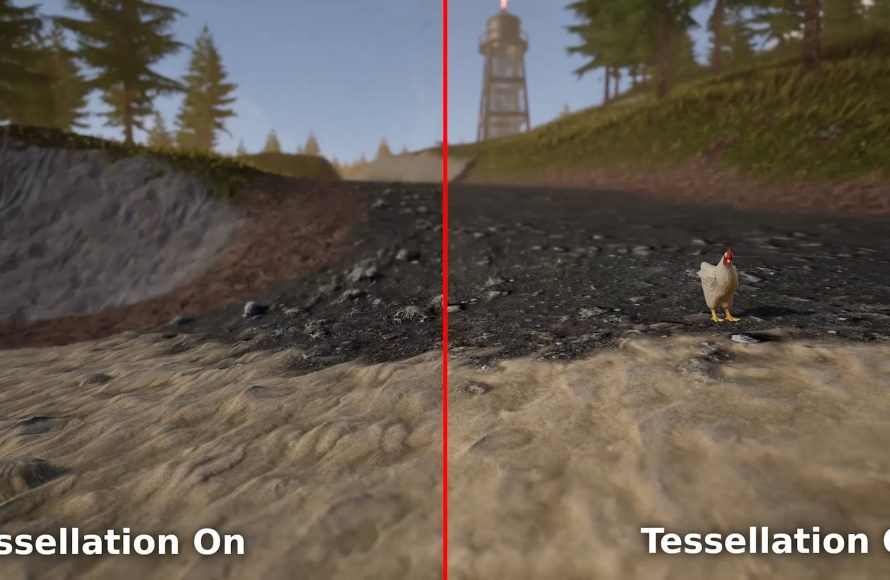
Tessellation in games is a graphics rendering technique that divides simple polygons into smaller ones, adding geometric detail to surfaces, which can enhance visual quality.
Have you ever wondered how game environments achieve such incredible detail? One key method involves a technique called tessellation. It’s a powerful tool that adds visual richness by subdividing basic geometric shapes into finer pieces. This process is crucial for rendering realistic curves and textures.
Understanding what is tessellation in games helps explain the impressive visuals we now experience. Developers use it to make objects and environments look more complex without requiring highly detailed models. This is why we see smoother, more intricate surfaces.

What is Tessellation in Games?
Have you ever looked at a video game and wondered how the mountains look so bumpy, or how the characters’ clothes seem to have so many tiny details? It’s not magic! One of the cool tricks game developers use to make things look more real is called tessellation. Think of it like this: imagine you have a flat piece of paper, and you want to make it look like a crinkly piece of aluminum foil. You wouldn’t actually crumple the paper, would you? No, you’d use a clever technique to pretend it’s crumpled! That’s kind of what tessellation does in games.
The Basic Idea of Tessellation
At its heart, tessellation is all about making simple shapes look complex. Instead of creating a super-detailed 3D model (which takes lots of computer power), developers start with a basic shape, often a flat polygon like a triangle. Then, tessellation breaks that simple shape into smaller shapes, adding extra detail. It’s like taking a single square tile and dividing it into four smaller squares, then each of those into four more, and so on. The more you divide, the more detailed the surface appears. When done well, the result is a far more realistic and immersive gaming experience.
How Tessellation Works: The Nitty-Gritty
Now, let’s get a little more into how this process actually works. Games use your computer’s graphics card (GPU) to do most of the heavy lifting. Here’s a simplified look at the steps:
- Initial Model: Game developers start with a basic 3D model made of simple shapes called polygons, mostly triangles. These low-poly models are the starting point for tessellation.
- Tessellation Engine Activation: Then the game activates the tessellation engine of the GPU. This engine reads the properties of the starting model.
- Dividing the Polygons: The tessellation engine looks at these shapes and follows instructions on how many times to divide each polygon. It can divide each triangle into multiple smaller triangles.
- Adding New Vertices and Displacement: With the new triangles, new points or vertices appear. The engine then displaces these new vertices, pushing them out or pulling them in using displacement maps, height maps or algorithms to create a bumpy surface. These maps tells the GPU how far to move the new vertex to create the surface texture like bumps or ditches.
- Smooth Surface Creation: After displacing all the vertices, the GPU then smoothes out the surface which is created from smaller and displaced polygons, to make the surface look more natural.
Think of it as a sculptor starting with a block of clay and then carefully carving out details. But instead of using hands, the sculptor is using a computer program! This allows for a dramatic increase in detail without bogging down your computer.
Why do Game Developers use Tessellation?
You might wonder why game developers use tessellation when they could just create highly detailed models from the start. Well, there are several good reasons:
- Improved Visual Quality: Tessellation allows game developers to achieve extremely realistic looking surfaces. Think of rocks, bumpy grounds, character skins, or even the scales on a dragon. The added detail makes everything seem more believable and less blocky.
- Reduced Resource Usage: It might seem counterintuitive, but tessellation can actually be more efficient than creating highly detailed models from the get-go. Using a low-poly model with tessellation lets the game handle the scene with less data and resources. This means games can run smoothly, even on not-so-powerful computers. The graphics card does all the detailed work, rather than loading heavy, pre-made models.
- Flexibility and Dynamic Detail: Developers can adjust how much tessellation is applied. For example, objects closer to the camera can have more details, while objects far away use less tessellation. This adjusts the level of detail dynamically and efficiently. It allows for a very flexible level of detail, which can increase and decrease with respect to distance and the position of objects from camera.
- Realistic Lighting and Shading: Tessellation creates much more complex shapes, it interacts with light in a more realistic way, making highlights and shadows look more accurate, and contribute to a better visual appearance of objects and the whole game.
Types of Tessellation in Games
The way tessellation is implemented can be done in various ways, although conceptually the approach remains the same, lets see some of the most common implementations of this tech.
Hardware Tessellation
Hardware tessellation uses the special instructions directly on the GPU to add details. This is the most common form of tessellation used today. Because the GPU handles the tessellation, it speeds up the process compared to relying on the CPU. Your graphics card is made to handle these calculations quickly and efficiently. So, when you have a GPU that supports hardware tessellation, you’re getting the best performance and most detailed graphics.
Software Tessellation
Software tessellation means that the CPU or game engine handles the division and displacement calculations. While this method is still possible to implement tessellation, it is usually slower because the CPU is not designed for these type of processes. Also the CPU handles lots of other important processes like input, physics etc. Using CPU for tessellation is usually not preferred due to the huge performance drawbacks. But software tessellation can be useful if hardware tessellation isn’t available, or for special situations in the game.
Adaptive Tessellation
Adaptive tessellation is a clever technique where the level of tessellation depends on how important that object is in the game scene. It increases tessellation only when more detail is needed. For instance, objects closer to the player get more tessellation, which means they look super detailed. Things further away get less detail because you won’t notice it that much anyway. This helps keep the game running smoothly.
Think of it as a smart way to use tessellation, only adding details where they’re needed most. This approach keeps the computer from working too hard and allows it to focus on the areas of the game world that are important and in view. This is a common technique to maximize the benefit of tessellation while minimizing the performance cost.
Examples of Tessellation in Games
Tessellation can be seen in many modern games, here are some of the most common examples where tessellation creates much more immersive experience.
Terrain Detail
Ever seen a mountain in a game with all its crags and rocky faces? That’s often the power of tessellation in action! Instead of creating a huge, complex model of every single rock, the game uses tessellation to add that level of detail to a simpler underlying mesh. It makes the mountains feel real and not just flat surfaces. The same can be said for muddy grounds, sand dunes and more. It makes the terrain really feel like you are there!
Character Models
Tessellation helps make characters look much more realistic. Character skin, armor, clothing, hair, all use tessellation to create a more detailed, realistic surface. For instance, instead of just a flat shirt, tessellation can create the texture of the fabric itself, with all the tiny folds and wrinkles visible. It adds depth and life to the game’s characters.
Water Surfaces
Water, with its ever-changing ripples and waves, is another common place where you’ll find tessellation. A flat plane of water looks boring, but add a bit of tessellation and it looks like real water. Tessellation can create realistic waves, foam, and surface distortions of water making the scene much more immersive.
Architectural Details
From the bricks in a castle wall to the carvings on an ancient monument, tessellation makes these details stand out. Game developers use it to create realistic architectural elements, bringing the game worlds to life. Using tessellation, the textures are more detailed and adds life to the world and the objects within it.
Other Examples
Tessellation is also commonly seen in:
- Vehicle Damage: Dents and bends on car bodies in racing games.
- Vegetation: Detailed tree bark and leaf surfaces in nature-heavy games.
- Special Effects: Used for effects like smoke, fire, or explosions.
Tessellation and Performance
While tessellation is great for visuals, it is important to note that if not handled correctly, it can cause performance issues. The more tessellation applied, the more work the GPU has to perform, and if its not an optimized implementation, it can slow down the game and create low FPS (Frames per Second). Here are some important factors which are needed to be considered when implementing tessellation.
- GPU Power: Not all GPUs are created equally. High-end graphics cards can handle a lot of tessellation easily. Lower-end cards can struggle with too much tessellation and may cause the game to run sluggishly.
- Distance to Camera: As previously mentioned, adaptive tessellation adjusts the level of detail based on the distance of the object from the camera. Closer things get more detail, farther things less to prevent the game from slowing down unnecessarily.
- Optimization Techniques: Game developers use various techniques to optimize the use of tessellation. Level of Detail (LOD) management is one of the most common ways to control the amount of tessellation applied to objects at specific distance of camera, but this is also coupled with various algorithms. They work to maximize the benefit while minimizing the performance hit of using tessellation.
The Future of Tessellation
As graphics cards become more powerful, and more modern technologies become available, tessellation will continue to become more and more important in game development. As technology advances, the usage of tessellation in games is only expected to increase. Here are a few key points:
- More Detail: Expect games to have even more detailed objects and environments because of the advancement in hardware and software. As hardware becomes faster, game developers will be able to use higher degrees of tessellation.
- Better Performance: New advancements in hardware and software could improve tessellation performance, with better adaptive tessellation techniques, and lower performance impact.
- Real-Time Effects: New techniques will make real-time effects even more detailed and convincing, further enhancing the immersion of gaming.
- Broader Applications: Tessellation techniques developed for gaming will likely be used in other areas, such as modeling, simulations and more.
In short, tessellation is a really cool technique that helps make games look amazing. It is an important tool for game developers, allowing them to create impressive graphics. It’s a big part of why modern games are so visually captivating, with detailed terrain, realistic characters, and immersive environments. It shows how simple shapes can be made to look super detailed with the power of computer graphics and algorithms. As the technology keeps improving, we’ll see even more realistic and immersive games using tessellation. So, next time you’re playing a game with really impressive graphics, remember: tessellation might be one of the hidden magic tricks behind the scenes!
Tessellation makes a simple flat surface look like a rough rock or bumpy terrain, without requiring a highly complex model from the start. It allows for efficient and dynamic details that change with distance, and also provides developers the ability to craft visually impressive and immersive gaming experiences. As technology continues to advance, tessellation will become more prevalent in the gaming world, and also in other fields, becoming even more important, and more powerful.
What the Heck is Tessellation?!
Final Thoughts
Tessellation in games is a technique that divides polygons into smaller ones, adding detail. It dynamically adjusts mesh complexity. This allows for smoother curves and more realistic surfaces.
This process greatly enhances visual fidelity. Game developers use it to create impressive and immersive environments. What is tessellation in games? It is essentially a powerful tool for better graphics.

