
Playing Zelda games in release order is often the best way to experience their evolution, though you can also play them by the in-game timeline.
Embarking on a Legend of Zelda adventure can feel daunting, with so many titles to choose from. Deciding where to begin is a common question, isn’t it? That leads to the crucial point of what order to play Zelda games for the best experience.
Many players find value in experiencing the games in the order they came out, which shows the series’ development. However, some prefer to follow the fictional timeline within the games themselves. Both options provide a unique, yet enjoyable, journey.

What Order to Play Zelda Games
So, you want to dive into the magical world of Hyrule, huh? That’s fantastic! The Legend of Zelda series is packed with amazing adventures, but with so many games, it can feel a bit like figuring out a giant puzzle. Don’t worry! You don’t need to be a puzzle master to get started. The good news is, you don’t have to play them in any strict order. Each game tells its own story, and you can usually jump in wherever you like. However, there are a few ways to think about playing them that can make your experience even better. Let’s explore some popular options.
Release Order: A Trip Through Time
One way to experience the Zelda games is to play them in the order they came out. This is like watching a movie series from the very first episode. It lets you see how the games have changed and improved over time. You’ll witness the graphics getting better, the game mechanics evolving, and the storytelling becoming more complex. This path is great for understanding the history of the series and appreciating its legacy.
The Classic NES Era
Our journey starts with the two original Nintendo Entertainment System (NES) games:
- The Legend of Zelda (1986): This is where it all began! It’s a bit different from the later games. The world is huge, but not always in a way that’s easy to figure out. It can be challenging, but it’s a cornerstone of video game history. You will start in the world where you are a hero who needs to save the princess from the evil.
- Zelda II: The Adventure of Link (1987): This is a very different game! It has side-scrolling action and role-playing elements. It’s often considered the black sheep of the family because it stands out so much. It does not play like other Zelda games and have a unique story to the game.
The Super Nintendo Era
Next, we jump to the Super Nintendo Entertainment System (SNES) for a true classic:
- The Legend of Zelda: A Link to the Past (1991): Many consider this to be one of the best Zelda games. It’s a top-down adventure that greatly improves upon the first game with richer graphics and better gameplay. It has a complex story involving a parallel world.
The Nintendo 64 Revolution
The series took a huge leap into 3D with two amazing games on the Nintendo 64:
- The Legend of Zelda: Ocarina of Time (1998): This game is often called the best video game ever made. It introduced many things that are now standard in Zelda games and in video games in general, such as targeting enemies and riding a horse.
- The Legend of Zelda: Majora’s Mask (2000): This one is darker and stranger than Ocarina of Time. It has a time-loop mechanic that makes the gameplay unique. It also shows the emotional side of its characters.
The GameCube and Beyond
The series continued to evolve on the GameCube and subsequent consoles:
- The Legend of Zelda: The Wind Waker (2002): This game has a beautiful, cel-shaded art style. It has a big, open world to explore by sailing on a boat.
- The Legend of Zelda: Twilight Princess (2006): This game is much darker in tone than Wind Waker and has a more realistic art style.
- The Legend of Zelda: Phantom Hourglass (2007): A direct sequel to The Wind Waker that was released on the Nintendo DS. It brings sailing action to the handheld.
- The Legend of Zelda: Spirit Tracks (2009): This is another Nintendo DS game that has you traveling by train.
- The Legend of Zelda: Skyward Sword (2011): This one is a prequel to all the other games in the timeline and focuses on the origin story of the Master Sword.
- The Legend of Zelda: A Link Between Worlds (2013): A sequel to A Link to the Past, with the player moving between two worlds.
- The Legend of Zelda: Tri Force Heroes (2015): A multiplayer Zelda game where you team up with other players to solve puzzles.
- The Legend of Zelda: Breath of the Wild (2017): This game completely changed the series with its huge open world and focus on freedom.
- The Legend of Zelda: Tears of the Kingdom (2023): The newest game and a direct sequel to Breath of the Wild. It expands the world and offers new abilities.
Playing in release order gives you a historical context, letting you see how gameplay concepts and storytelling have developed through the series.
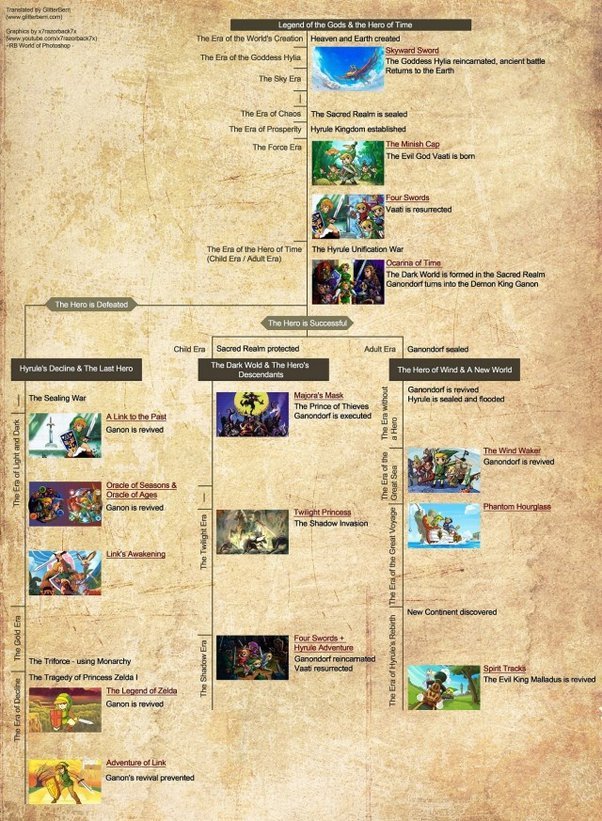
Timeline Order: The Hyrule History Lesson
If you are more of a story person, then you can play the games based on their place in the official Zelda timeline. This timeline is a bit tricky because the games split into different paths after Ocarina of Time. But don’t worry too much about all of that, just see what time the story is set in and play that way. Here’s a simpler way to look at it:
The Skyward Era
- The Legend of Zelda: Skyward Sword: This is the first game in the timeline. It tells the origin of Link, Zelda, and the Master Sword.
The Era of the Minish
- The Legend of Zelda: The Minish Cap: This game is about the Picori, which are tiny creatures. It explains the origin of Link’s hat and is a fun adventure.
The Four Swords Era
- The Legend of Zelda: Four Swords (Multiplayer): This is primarily a multiplayer game that focuses on gameplay, but it fits within the timeline here.
- The Legend of Zelda: Four Swords Adventures: A multiplayer adventure based on the Four Swords concept.
The Ocarina of Time Split
This is where the timeline splits into three different branches after the events of Ocarina of Time.
The Child Timeline: Link is sent back in time to prevent Ganondorf’s rise to power.
- The Legend of Zelda: Majora’s Mask: This game takes place directly after Ocarina of Time.
- The Legend of Zelda: Twilight Princess: Set many years after Majora’s Mask, Link must defeat the power of the Twilight.
- The Legend of Zelda: Four Swords Adventures: This game falls after Twilight Princess in the Child Timeline.
The Adult Timeline: Link defeats Ganondorf, but he is sent away before he can be stopped, and Hyrule is flooded.
- The Legend of Zelda: The Wind Waker: Link sails the Great Sea to stop Ganondorf once again.
- The Legend of Zelda: Phantom Hourglass: A sequel to The Wind Waker.
- The Legend of Zelda: Spirit Tracks: Takes place many years after Phantom Hourglass and focuses on the descendants of the previous characters.
The Downfall Timeline: Link is defeated at the end of the Ocarina of Time, and this timeline explores the events that happen in the alternate outcome where Link fails.
- The Legend of Zelda: A Link to the Past: A classic adventure where you journey into the dark world.
- The Legend of Zelda: Oracle of Seasons/Oracle of Ages: Two interconnected games where Link travels to different lands to protect nature.
- The Legend of Zelda (NES): The first game of the series and set in this timeline after the other games in the downfall timeline.
- Zelda II: The Adventure of Link: A direct sequel to the first Legend of Zelda.
- The Legend of Zelda: A Link Between Worlds: Set in the same world as A Link to the Past, but many years later.
- The Legend of Zelda: Tri Force Heroes: The events of this game occur in the downfall timeline, but it does not add too much to the story.
The Breath of the Wild Era
The timeline placement of these two games is a bit vague, but they exist at the end of the timeline, far in the future. Some have suggested that these two games take place after all of the split timelines.
- The Legend of Zelda: Breath of the Wild: This game takes place in a far future Hyrule after it was destroyed in the past.
- The Legend of Zelda: Tears of the Kingdom: This is the direct sequel to Breath of the Wild.
Playing in timeline order is for those who love lore and want to see how the events of each game fit together. This is a more complex path, so if you are just starting out, you might find it easier to just enjoy them without worrying about the timeline first.
Gameplay Style: Finding Your Flavor
Another way to approach the games is by their gameplay style. Some Zelda games have a top-down view, while others are in full 3D. Some focus more on puzzle-solving, while others are more action-oriented. Here’s a way to group them based on how they play:
Top-Down Zelda Games
These games have a view from above, where you look down at Link as he moves around the world.
- The Legend of Zelda (NES)
- Zelda II: The Adventure of Link (NES) (although it does have side-scrolling as well.)
- The Legend of Zelda: A Link to the Past (SNES)
- The Legend of Zelda: The Minish Cap (GBA)
- The Legend of Zelda: A Link Between Worlds (3DS)
- The Legend of Zelda: Oracle of Seasons/Oracle of Ages (GBC)
- The Legend of Zelda: Four Swords (GBA)
3D Zelda Games
These games take place in a fully 3D world where you control the camera and move around in all directions.
- The Legend of Zelda: Ocarina of Time (N64)
- The Legend of Zelda: Majora’s Mask (N64)
- The Legend of Zelda: The Wind Waker (GCN)
- The Legend of Zelda: Twilight Princess (GCN/Wii)
- The Legend of Zelda: Skyward Sword (Wii)
- The Legend of Zelda: Breath of the Wild (Switch/Wii U)
- The Legend of Zelda: Tears of the Kingdom (Switch)
Handheld Zelda Games
These games are designed to be played on portable systems and have unique designs because of this.
- The Legend of Zelda: Link’s Awakening (GB/Switch)
- The Legend of Zelda: Phantom Hourglass (DS)
- The Legend of Zelda: Spirit Tracks (DS)
- The Legend of Zelda: Tri Force Heroes (3DS)
Choosing to play by gameplay style is great if you have a specific preference for top-down or 3D games. This lets you pick games that you’re more likely to enjoy right from the start.
Starting Points: Where to Jump In
If all of this feels a bit overwhelming, don’t worry! Here are a few recommended starting points for new players.
Beginner-Friendly Games
These are some of the easiest games to get into because they are designed for new players and are straightforward to learn.
- The Legend of Zelda: Ocarina of Time: It’s a fantastic introduction to 3D Zelda games and introduces you to the standard Zelda formula.
- The Legend of Zelda: A Link to the Past: This game is a classic top-down adventure that’s easy to pick up and play.
- The Legend of Zelda: Breath of the Wild: Its open-world design can seem daunting, but it’s actually very forgiving and allows you to learn at your own pace.
Games for Lore Lovers
If you want to learn all about the story and the world of Hyrule from the beginning, then you will want to start here.
- The Legend of Zelda: Skyward Sword: This is the first game in the timeline, so it’s the place to start for lore junkies.
Games for Retro Fans
If you want to experience the old classic games then these are the place to start:
- The Legend of Zelda (NES): This game is hard, but it’s a classic and an important part of video game history.
- The Legend of Zelda: A Link to the Past (SNES): A step up in both complexity and gameplay from the first game.
A Quick Guide Table
Here is a table that summarizes everything discussed in this article.
| Play Style | Description | Recommended Games |
|---|---|---|
| Release Order | Play in the order that the games were released. | Start with The Legend of Zelda (NES) and play through to The Legend of Zelda: Tears of the Kingdom. |
| Timeline Order | Play the games based on the official Zelda timeline. | Start with The Legend of Zelda: Skyward Sword and then follow the appropriate timelines based on the events in Ocarina of Time. |
| Gameplay Style | Play based on the type of gameplay you want (Top-down, 3D, Handheld) | Pick the style of gameplay you want and choose the game based on the style. |
| Beginner Friendly | Games that are easy for new players to start with. | The Legend of Zelda: Ocarina of Time, The Legend of Zelda: A Link to the Past, or The Legend of Zelda: Breath of the Wild |
| Lore Focused | Focus on the story of the series. | Start with The Legend of Zelda: Skyward Sword and then play through the timeline. |
| Retro Classics | If you love old-school video games. | The Legend of Zelda (NES) or The Legend of Zelda: A Link to the Past. |
In the end, remember that the most important thing is to have fun. Don’t worry too much about playing in the perfect order. Just pick a game that looks interesting to you and enjoy your time in Hyrule!
Where to Start: Zelda
Final Thoughts
The best order depends on your preference; however, playing by release date offers a good experience to see the series’ evolution. You might also choose a timeline-focused approach to follow the narrative.
For beginners, start with Ocarina of Time or Link to the Past before moving to more complex games. Ultimately, what order to play zelda games is a very personal choice. Find the order that best fits your play style.

