
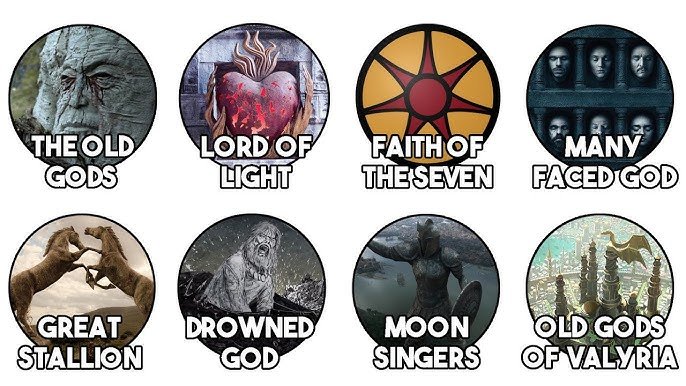
The major gods in Game of Thrones are the Old Gods of the Forest, the Faith of the Seven, and the Drowned God, with the Lord of Light (R’hllor) also playing a significant role.
The world of Westeros features diverse beliefs, but who are the gods in Game of Thrones that people actually pray to? The continent doesn’t have a single dominant religion.
Instead, people follow various deities, shaping the culture and politics of the land. The ancient Old Gods still hold sway in the North.
Meanwhile, the Faith of the Seven has many followers in the south and the Drowned God is revered by Ironborn. These diverse beliefs create a fascinating and complex religious landscape.

Who are the Gods in Game of Thrones?
Okay, let’s dive into the world of Westeros and Essos, where gods aren’t just stories – they’re a big part of everyone’s lives! Unlike our world, where many people might not believe in gods, in Game of Thrones, they’re very real to the characters. These aren’t always friendly gods, either. Some are kind, some are scary, and some are just… mysterious. So, who are these powerful beings that people pray to, fear, or even follow into battle? Let’s take a closer look at the main belief systems and the gods they represent.
The Old Gods of the Forest
In the North of Westeros, many people, especially the families descended from the First Men, worship the Old Gods. These aren’t gods with names or clear forms like you might picture. Instead, they’re connected to nature itself. Think of the wind rustling through the trees, the snow falling silently, and the deep, dark heart of the forest. These are where the Old Gods live.
The Heart Trees
A big part of worshiping the Old Gods is the heart tree, a weirwood tree with a face carved into its trunk. These faces are believed to be ancient, and people come to the heart trees to pray. They might sit or kneel before the tree, whispering their troubles, worries, and hopes. It’s like talking to nature itself, trusting that the Old Gods are listening. They don’t have priests or churches, just these special trees in sacred groves.
Nature’s Power
Followers of the Old Gods believe that the gods are all around them in the natural world. They respect the strength of the mountains, the flow of the rivers, and the wild creatures in the forests. This respect for nature is an important part of their beliefs.
Unlike many other religions in the series, the Old Gods do not offer clear promises or direct intervention. Instead, their followers rely on their own understanding of the natural order and the wisdom of their ancestors. It’s a more subtle, quiet kind of faith.
Key Characteristics
- No named deities.
- Worship of nature and natural elements.
- Heart trees are sacred places of prayer.
- No priests or central organization.
- Focus on ancient traditions.
The Faith of the Seven
In most of Westeros, especially in the South, the main religion is the Faith of the Seven. This religion is very different from the Old Gods. The Faith of the Seven has a group of seven gods instead of just one (or none with a name) in the case of the old Gods. These gods are all different parts of one being, kind of like a family. They are the Father, the Mother, the Warrior, the Maiden, the Smith, the Crone, and the Stranger.
The Seven Aspects of God
- The Father: Represents justice and judgment. People ask the Father for fairness and guidance. He’s often seen as an older man with a long beard.
- The Mother: Represents mercy, love, and childbirth. People pray to the Mother for comfort and family blessings. She is often shown as a gentle woman holding a child.
- The Warrior: Represents courage and strength in battle. Soldiers often pray to the Warrior for victory. He’s depicted as a strong knight in armor.
- The Maiden: Represents innocence, beauty, and love. Young women and those seeking love often pray to the Maiden. She’s typically portrayed as a beautiful young woman.
- The Smith: Represents craftsmanship and labor. People who build things and work with their hands often pray to the Smith. He’s depicted as a strong man with an anvil and hammer.
- The Crone: Represents wisdom, guidance, and the passage of time. Older folks and those seeking wisdom pray to the Crone. She is usually shown as an old woman holding a lamp.
- The Stranger: Represents death and the unknown. People are afraid of the Stranger and pray that he doesn’t come for them. He’s the one people fear the most.
Churches and Septons
Unlike the worship of the Old Gods, the Faith of the Seven has many churches, called septs, and their religious leaders are called septons and septas. They perform ceremonies, lead prayers, and help people understand the teachings of the Faith of the Seven. The Faith has a very strong structure and a lot of influence in the kingdoms.
Religious Symbols
The holy symbol of the Faith of the Seven is a seven-pointed star. You see it on banners, buildings, and clothes, showing that someone follows the Faith. This symbol represents the seven aspects of their god. Religious texts and holy books also exist.
Key Characteristics
- Seven aspects of one God.
- Organized religion with septs and clergy.
- Seven-pointed star as a symbol.
- Has religious texts and teachings.
- Strongly influences politics and society.
The Lord of Light (R’hllor)
Across the Narrow Sea, in Essos, many people worship the Lord of Light, also known as R’hllor. This is a fiery and powerful god who is constantly fighting against the darkness. Followers believe that he is the true god and that the other gods are false. This religion is very intense and powerful with some pretty impressive magic.
Fire and Light
Fire is a huge part of this religion. They believe that fire is a representation of R’hllor’s power. Followers often use fire in their prayers, rituals, and ceremonies. They also believe in seeing visions in the flames. They believe that through fire, they can see the will of the Lord of Light.
Priests and Priestesses
The religious leaders of R’hllor are priests and priestesses, often referred to as red priests or red women. They have the ability to use magic and have a lot of power within their religion. They can perform miracles, revive the dead, and predict the future, among other abilities. This makes them very influential.
The Promised Prince
A big part of R’hllor’s faith is the belief in a “promised prince” who will be reborn to fight the darkness. This is a messianic figure who they believe will be key in the great battle between good and evil. Many have been identified as this figure during the series.
Key Characteristics
- God of fire and light.
- Belief in an eternal battle between light and darkness.
- Red priests and priestesses wield magical power.
- Emphasis on fire as a sacred element.
- Belief in a “promised prince”.
The Drowned God
On the Iron Islands, people have a very unique and strange religion. They worship the Drowned God, who they believe lives beneath the sea. This religion is closely tied to their seafaring life and their tradition of raiding and pillaging. They believe in being strong and taking what they want. Death by drowning is seen as a sacred passage to their god.
“What is Dead May Never Die”
This is a common saying among followers of the Drowned God. They believe that death by drowning is not the end, but a new beginning in the underwater kingdom of their god. They honor death in the sea and see it as a return to the Drowned God. But also, it means that while you may have a setback or a defeat, you will come back stronger.
The Drowning Ritual
A key ritual in this faith is the drowning ritual. Someone is drowned and then revived. It’s a sort of rebirth that signifies devotion to the Drowned God. This ritual often involves priests or priestesses and is performed on new followers or those who wish to reaffirm their faith.
Sea and Strength
The Drowned God’s followers believe in the power of the sea. They often raid and use their boats to travel around. It’s not just a religion, but it’s a way of life for the Ironborn. They value strength, skill in battle, and courage at sea.
Key Characteristics
- God of the sea and storms.
- The sea is a sacred place.
- “What is dead may never die” is a central tenet.
- Drowning rituals are a key part of worship.
- Strong ties to Ironborn culture and seafaring life.
Other Beliefs and Unnamed Gods
Beyond these main religions, there are other beliefs and gods that are spoken about or mentioned in Game of Thrones. Some people worship gods that are specific to their small villages or regions, or even personal gods they have created or followed themselves. Some are connected to specific places or natural phenomena.
The Many-Faced God
In Braavos, there is a mysterious religion centered on the Many-Faced God. Followers believe that the Many-Faced God is the god of death, but that all other gods are simply different aspects of this one god. The Faceless Men, a group of assassins, follow this religion and believe they are doing the work of death by taking life. This religion also has the concept of serving by helping to give a peaceful death to those who ask for it.
Various Local Deities
There are other smaller, less defined beliefs throughout the world that are shown or talked about. These may include gods of specific locations, gods who are seen in the stars, or gods that are worshiped by particular cultures. Game of Thrones includes a wide range of different beliefs, just like in the real world.
So, as you can see, the world of Game of Thrones isn’t just about kings, queens, and battles. The gods play a very important part in people’s lives, giving them hope, fear, and shaping how they live. These gods influence everything from how people see the world to how they fight wars, and they add a lot of depth to the story.
Understanding who the gods are in Game of Thrones is a great way to understand the motivations and actions of the characters, and the cultures that they belong to. These religions have a huge effect on the stories that play out. From the quiet prayer beneath the heart tree, to the fiery visions of R’hllor, each belief brings something different to the complex and engaging world of Westeros and Essos.
Every Game of Thrones Religion Explained in 14 Minutes
Final Thoughts
The Faith of the Seven dominates in southern Westeros, with its aspects representing different virtues. The Drowned God is worshipped by the Ironborn, a brutal deity demanding sacrifice. The Old Gods, worshipped in the north, are nameless forces of nature.
Across the Narrow Sea, R’hllor, the Lord of Light, gains popularity. These varied beliefs shape cultures, politics, and actions throughout the series. Ultimately, who are the gods in game of thrones, is a complex question without simple answer. They are powerful influences.

