
The answer to ‘who is the murderer of the Westing game’ is that there is no actual murder; Sam Westing faked his death.
The Westing game is a twisted tale, isn’t it? It pulls you in with the promise of a whodunit, making you question every character. So many secrets and red herrings make you truly wonder who is the murderer of the Westing game.
It’s a clever setup that keeps you guessing until the very end. You scrutinize every action and word, trying to find the villain lurking in the shadows. But the truth, as is often the case, is more complex.

Who is the Murderer of The Westing Game?
The question of “who is the murderer of The Westing Game?” is at the heart of this thrilling mystery by Ellen Raskin. The book throws us into the complex world of Sunset Towers, where sixteen unique individuals are gathered for a very strange reason: to participate in a game designed by the eccentric millionaire, Samuel Westing. But here’s the twist – Westing has been found dead, and one of these sixteen people is believed to be his killer. But things aren’t always as they seem. Instead of a straightforward whodunit, we get a cleverly crafted puzzle, full of red herrings and surprising revelations. Let’s dive deeper into this captivating mystery and explore the possible culprits and the true solution.
The Initial Suspects
When Samuel Westing is found dead, the sixteen potential heirs are immediately under suspicion. Raskin does a brilliant job of making each character appear capable of the crime, giving us plenty of reasons to doubt them. Let’s meet some of the prime suspects:
The Westing Heirs
- Grace Windsor Wexler: A social climber, she is eager for money and status, making her a potential suspect. Her desire for a better life might push her to do anything.
- Jake Wexler: Grace’s husband, a podiatrist, appears to be a simple man, but he also has his ambitions and hidden desires. His financial worries could be a motive.
- Angela Wexler: Their seemingly perfect daughter, engaged to a wealthy doctor, secretly feels trapped. Could her desire to escape lead to murder?
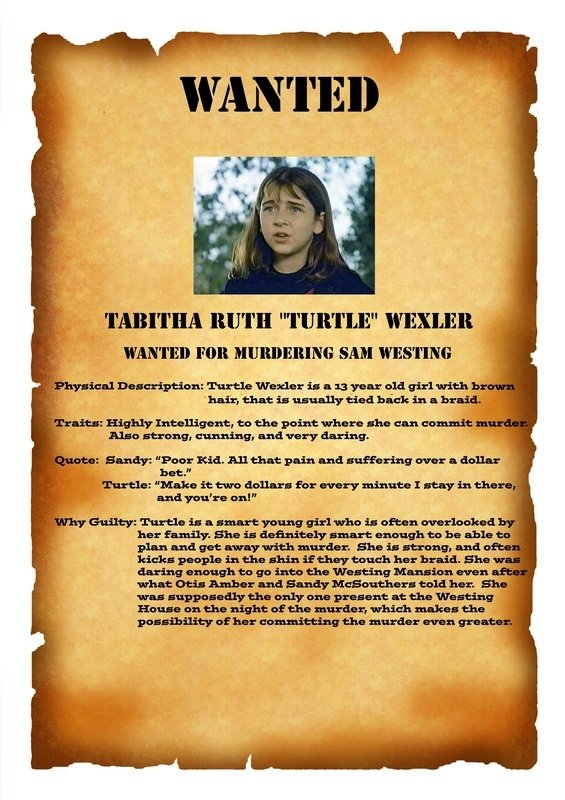
- Turtle Wexler: The younger, more unconventional daughter, is often overlooked but possesses a sharp mind and street smarts. She is perhaps more observant than anyone suspects.
- Flora Baumbach: A kind seamstress, she seems harmless at first, but her past connection to the Westing family adds a layer of complexity. Could there be something lurking beneath her gentle exterior?
- Mr. James Shin Hoo: He owns a restaurant with a lot of stress and frustration, and his business isn’t doing so well. His anger and financial woes paint him as a potential suspect.
- Sun Lin Hoo: She’s Mr. Hoo’s wife, always wanting to go back home and rarely speaking English. Her unhappiness and her husband’s stress could make her do something out of frustration.
- Doug Hoo: Mr. Hoo’s athletic son. His love for running makes him more of an active presence, but what else does he have going on?
- Theo Theodorakis: A thoughtful and intelligent young man. His love for games makes him a great partner for Turtle, but could he have a dark side?
- Chris Theodorakis: Theo’s brother, who has a neurological disorder. His wheelchair limits him, but maybe he could be involved in a different way.
- Denton Deere: Angela’s fiancé and a doctor. His professional demeanor and scientific mind could hide an ability to be calculating.
- Berthe Erica Crow: A troubled cleaning lady with a hidden past, her strong feelings of guilt could be hiding a secret.
- Otis Amber: A delivery boy for the grocery store, but he also works with Crow. He appears simple, but he’s always nearby. Is he an informant or something more?
- Judge J.J. Ford: She is the first black female judge. She has a connection to the Westing family. Her cool, calm exterior could hide a dark secret.
- Sidney Sikes: A medical examiner who reports Westing’s death. His presence is brief, but it’s crucial to the story.
- Samuel Westing: Wait a minute, how can a dead man be a suspect? That’s the question the book will ask the reader. Could Westing have a role in his own death?
The Clues and the Game
Samuel Westing’s will is the key to this whole puzzle. It sets up a game, where the heirs are divided into pairs, and each pair receives a set of clues that appear to be just random words. The game isn’t really about finding a murderer; it’s about something more significant. These clues aren’t about finding a killer directly but finding the true identity of Westing. The pairings of the players make it hard to know who the real killer is.
Analyzing the Clues
Each set of clues is made up of seemingly random words and phrases, but it’s through analysis and teamwork that some of the heirs make progress. Here’s why the clues are essential:
- Red Herrings: The clues often point towards the wrong people, creating red herrings that lead the heirs on wild goose chases. They think one thing, but the truth turns out to be something else entirely.
- Misdirection: Raskin masterfully misdirects the readers by pointing to obvious suspects, making the real answer even more surprising.
- Hidden Meanings: Some of the clues aren’t just words. They carry double meanings or require the heirs to think outside the box.
- Teamwork: The game requires teamwork. It forces the heirs to cooperate, revealing both their true characters and the depth of their intellect.
The game turns into a hunt to figure out who Westing really was. The clues aren’t just words; they are pieces of a puzzle meant to show them that the answer is not what they first assumed.
Exploring Possible Motives
Everyone has a motive, some of which are stronger than others. Examining their motives is a way to understand why any of them could be a killer.
Motives for the Murder
Let’s dig deeper into why each character might have wanted Westing dead:
- Money: The most obvious motive is the prospect of inheriting Samuel Westing’s vast fortune. Almost everyone in the book has some kind of financial trouble, so this gives everyone a reason to want Westing’s money.
- Revenge: Some of the characters have connections to Samuel Westing’s past, including Judge Ford, and have a reason to seek revenge for their past.
- Escapism: Some characters feel trapped in their lives and see the inheritance as a way to finally be free. Angela, for instance, feels like her life isn’t her own.
- Power: A few characters, like Grace, seek social power, and Westing’s wealth represents a path to that.
- Guilt: Characters like Crow carry heavy guilt that they are seeking to resolve.
The Truth About Samuel Westing
Here’s the twist: Samuel Westing wasn’t simply a victim. As the heirs get closer to the end of the game, we begin to realize that Westing had a grand plan. He was not just trying to find a killer but was also trying to accomplish something else. It is a game of identity, and Westing turns out to be someone entirely different.
Westing’s Many Faces
Samuel Westing had many identities, and each one plays a part in the story:
- Samuel Westing: The eccentric millionaire who dies at the beginning of the story is also the mastermind behind the game.
- Sandy McSouthers: The doorman, is the same person as Samuel Westing. He gets fired to create a mystery, but he’s still in charge, acting as Westing’s spy.
- Barney Northrup: The real estate agent who rented out the apartments in Sunset Towers. He is actually another one of Westing’s disguises.
- Julian R. Eastman: The final persona. Julian R. Eastman is revealed to be the fourth identity of Westing and that he has been living as a normal man all along.
The Real “Murderer”
Now, for the answer to the question we’ve all been wondering: there is no murderer! Samuel Westing orchestrated his own death. Westing had a rare disease and he made a clever plan to bring all these people together and change their lives through a game. The murder was a hoax, a setup for the game. The real mystery wasn’t “who did it?” but “who was he?”
Why No Murderer?
Here’s why there isn’t a murderer in the traditional sense:
- A Game of Identity: The game was a test, it was about helping people find the best versions of themselves.
- A Chance for Change: Westing wanted to change the lives of these individuals, giving them a new direction and new found love for one another.
- Finding the “Fourth”: The game focuses on discovering Westing’s multiple identities, particularly his final one.
The Impact on the Heirs
The game had a profound impact on all the heirs. Here are some key examples:
- Turtle Wexler: She learns the importance of family and friendship. She develops a strong relationship with Sandy McSouthers/Westing and gains financial independence.
- Angela Wexler: She breaks free from her engagement and pursues a life that’s true to herself. She gains a newfound sense of her own strength.
- Theo Theodorakis: He finds his passion for writing and also gets to experience love. He’s not just a game player; he’s a person with a creative side.
- Chris Theodorakis: He is finally able to find a normal friendship and also see nature through other’s eyes, which he could not do before.
- Judge Ford: She comes to terms with her past and accepts her connection to the Westing family.
The game wasn’t just about winning a fortune, it was about learning, changing, and finding deeper connections with others. The characters all learn and grow over the course of the story, and that’s what makes it such a good book.
The Deeper Meaning of the Game
The Westing Game isn’t just a whodunit; it’s a story about identity, redemption, and the power of human connection. It’s a reminder that sometimes, things aren’t always as they appear, and that looking deeper can bring about the greatest rewards. Westing’s last game shows us the importance of not just looking at the surface, but to look deeper, and see the real meaning in what we see around us.
The story is about the power of family, that the family you make is sometimes more important than the one you are born into. In the end, Westing, through his game, creates a new family, proving that the most valuable things in life aren’t always about money, but about the connections that we make along the way.
So, while we initially search for the murderer of The Westing Game, what we find instead is a lesson in life, love, and the complexities of human nature, all wrapped up in a truly clever and unforgettable story. It challenges readers to not just solve a mystery but to think about what truly matters. It’s a book that stays with you long after you’ve turned the final page, and it encourages us all to look beyond what seems obvious.
The Westing Game teaches that truth often lies hidden beneath the surface, and the real treasures in life are the connections we make and the changes we inspire in others. In this story the biggest “treasure” is the connection between all the heirs and the way they all help each other improve as people.
The answer to “Who is the murderer of The Westing Game?” is both surprising and also deeply satisfying, it’s that there isn’t one. It highlights that the story’s main focus is on the journey of personal growth and human connection. It’s a book that we can all learn from.
Book Review: The Westing Game
Final Thoughts
The Westing game reveals a shocking truth: Sam Westing is not murdered. He faked his death and orchestrated the entire game. Ultimately, who is the murderer of the Westing game? No one is the murderer because a murder did not happen. The game was a final, clever act of manipulation by Westing.
This elaborate plot showcases his eccentric personality.

