
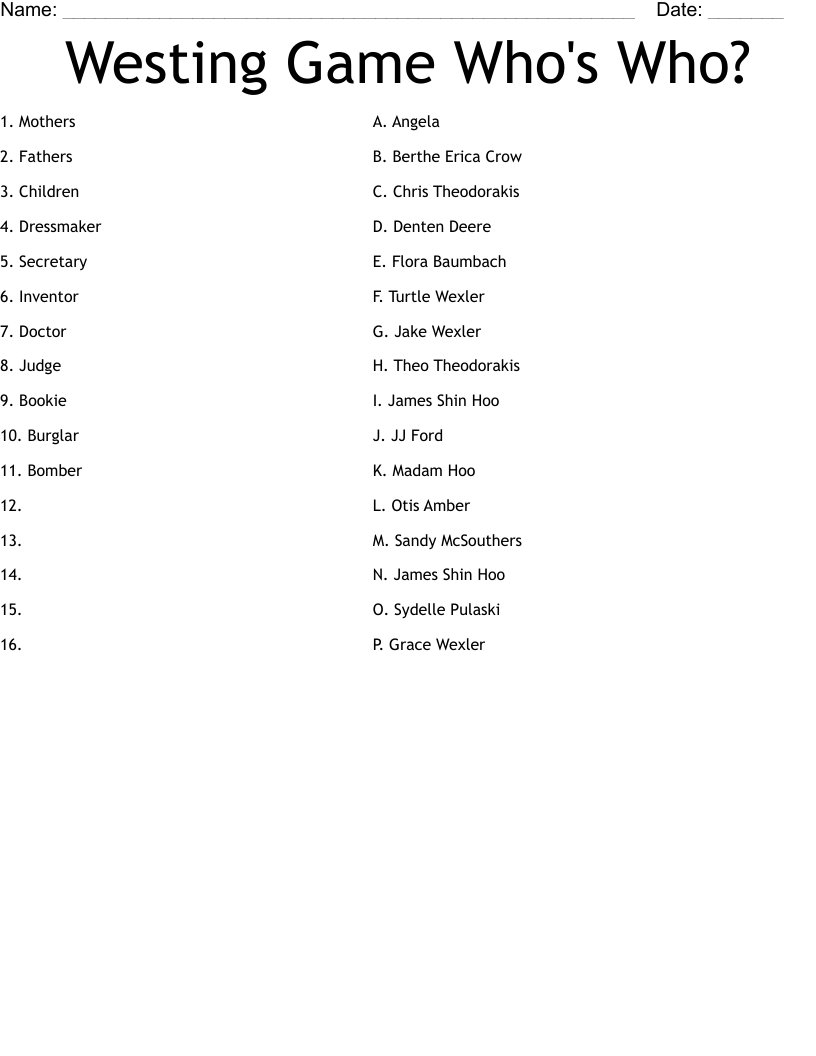
The burglar in The Westing Game was Madame Hoo.
The complex puzzle of The Westing Game keeps readers guessing. One question often asked is, “who was the burglar in the westing game?” It is not a simple answer as there are multiple layers to each characters motives.
The book cleverly misdirects, making numerous individuals seem like potential culprits. However, the truth comes out during the final gathering of all the players.
Madame Hoo’s motive stemmed from her desire to return home. She committed her crime to finance her journey. This surprise revelation brings an interesting end to the long and confusing mystery.

Who Was the Burglar in The Westing Game?
The question of “who was the burglar in The Westing Game” is a central mystery that keeps readers guessing throughout Ellen Raskin’s fantastic novel. It’s not just a simple “whodunit”; it’s a complex puzzle involving multiple characters, hidden motives, and a whole lot of red herrings. We’re not talking about a smash-and-grab kind of crime; this burglary is more about secrets, lies, and a very clever game orchestrated by the deceased Samuel W. Westing. Let’s dive deep into the clues and suspects to finally uncover the truth.
The Initial Suspicions: A Cloud of Doubt
At the start, the novel throws a net of suspicion over pretty much everyone. All the residents of Sunset Towers are named as potential heirs to Westing’s fortune, and all are considered suspects in his supposed murder, and the theft of valuable items. The police investigate the case of Samuel W. Westing, but the reader soon understands that the actual mystery is a game. Some characters, though, initially appear more suspicious than others.
The “Obvious” Suspects
Jake Wexler: As a podiatrist, Jake might have access to things he shouldn’t. He also has a slightly abrasive personality, which doesn’t make him seem trustworthy early on. He also mentions he “is not the burglar” in response to Mr Hoo’s accusation, which makes us think, maybe he is the burglar. He is seen as someone who is easily frustrated and not good at following the rules.
Grace Windsor Wexler: As Jake’s wife, Grace is also considered a suspect, however, she is more concerned with social status and appearances. In many instances in the story, Grace shows how selfish she can be. At first, we might wonder if Grace was trying to make it look like somebody else was the burglar so that they would not suspect her.
James Shin Hoo: The owner of a failing restaurant, he’s clearly struggling financially and appears to have a grudge against Westing. He also has a history of creating items like paper insoles, which makes him seem like he would not be a kind of person who would be a burglar. He always appears angry and frustrated.
Flora Baumbach: She seems too gentle to be a burglar at first but she’s also grieving the loss of her daughter, which could lead her to act out of character. Maybe she is not as gentle as she seems.
These are only some of the suspects in the mystery. All residents of Sunset Towers are potential suspects, with different reasons for being involved with the case. The truth is far more complicated than simply picking out the seemingly “bad” people.
The Clues Begin to Emerge: Hidden Messages and Codes
As the game progresses, it becomes clear that the true mystery of “The Westing Game” is not about finding the burglar, but about solving the puzzle Westing has left behind. The clues are not straightforward; they are fragmented and disguised. Characters are paired together, and they get clues to figure out who murdered Samuel W. Westing and also, who was the burglar.
The Will’s Intentional Ambiguity
Westing’s will is a masterclass in misdirection. It does not clearly state who the murderer is or who was the burglar. It makes it appear like anyone can be the burglar. He states that one of the sixteen heirs is also the murderer. The will is deliberately confusing, making all the heirs suspicious of each other. The language is full of wordplay and hidden meanings, designed to force the heirs to think critically. He also includes a clause for everyone that he has a “bad habit” of hiding the truth.
The Importance of the Paired Teams
The pairings of heirs are not random. Each duo has their own strengths and weaknesses. These pairings make it possible for the characters to have different perspectives of the clues and different strengths which would lead to the solution faster. For example, the pairing of Turtle and Flora is important to Turtle, as it gives her a place where she can learn to be a kind human and learn to care for others.
Turtle Wexler and Flora Baumbach: Turtle’s sharp intellect and Flora’s kindness form a strong team.
Sandy McSouthers and Judge Ford: Sandy’s observant nature and Ford’s legal knowledge offer a unique perspective.
Theo Theodorakis and Doug Hoo: Their curiosity and athleticism complement each other.
The Words of the Clues
Each pair receives a set of words that they must use to figure out the mystery. These words are not random. They are selected with intention to mislead and confuse the heirs. The words can often be rearranged into sentences or phrases that lead to further clues. The characters learn that they can’t just interpret the words literally, they need to think outside the box.
The Red Herrings: Misleading the Readers and the Heirs
Raskin does a masterful job of throwing us off the scent with a number of red herrings. These false clues make us suspect characters who are not really involved in the burglary. This is a huge part of the fun of the book, as you’re constantly questioning who you think is guilty.
The Bombings and the Distraction
Several bombings occur in the book, mostly in the coffee shop. These events make it seem that one of the heirs is trying to harm the other heirs or trying to cause distraction from their crime. They serve as a distraction and make the heirs more suspicious of each other.
The Timeline: The bombings take place at specific times, and each event changes the atmosphere and makes the heirs tense.
The Motive: The true motive is not harm but to scare and force the game to escalate. These events make people less logical and increase the possibility of mistakes.
The Faked Death of Samuel W. Westing
This was the biggest red herring of the story. It was Westing’s way of manipulating the heirs and making sure they were thinking. The whole premise of the game centers around finding Westing’s killer and the burglar, and the entire time, he is alive, this throws everyone off the trail.
The Disguise: Westing takes on different disguises throughout the book, using his knowledge of acting and disguises to throw everyone off the trail.
The Purpose: The game was not actually about solving a murder mystery, but about changing the lives of all the characters, helping them change into better versions of themselves.
The Truth Revealed: The Actual Burglar and Their Motive
The answer is revealed in the end, and it’s not as simple as picking the most obvious suspect. The burglar is actually a collective of characters working under one main mastermind.
The Mastermind: Sam Westing
The real person behind the burglary was Sam Westing himself. The theft was planned by him and coordinated by his four personalities: Sam Westing, Sandy McSouthers, Barney Northrup, and Julian R. Eastman. Westing’s ultimate goal was not to find a thief or a murderer, but to bring these specific sixteen people together, to help them become better versions of themselves, and to give them all parts of his company. He wanted to give the company to someone worthy, not just someone from the bloodline.
The “Burglar”: A Complex Operation
The actual “burglar” wasn’t one person, but rather a series of actions. The supposed stolen items were a mixture of valuable things that Westing didn’t care about that much. The items that he actually cared about were the things that he wanted to distribute amongst the sixteen heirs in the will, these were things like his land, and the factory.
The Intention: The intention was never to truly steal the items. The real goal was to add another layer to the game and force the heirs to look for clues. He wanted to make the heirs work together, and to use their brains and strengths.
The “Stolen” Items: These were items selected for their symbolic value as much as for their monetary value.
Why This Reveal is Significant
The reveal that Westing was behind everything is significant. It completely changes our understanding of the entire game. It shows how clever Westing was, and how much he enjoyed playing games. This is not just about a crime; it’s a game about life, self-discovery, and personal growth.
The Importance of Perspective
The story emphasizes how perspective can shift and change the way we look at something. What seems like a simple burglary is something deeper. What seemed like random events were actually part of a larger plan. The readers also come to learn that sometimes, what seems obvious on the outside, is not what it actually seems like from the inside.
Themes of Growth and Change
The reveal is not just a plot twist. It highlights the theme of growth and change. The game transforms each heir, helping them become more confident, kinder, and more aware of the world around them. It is a story of growth and change for not only the characters but for the readers too. It also touches on the themes of justice, fairness, and family.
The Lasting Impact of the Westing Game
The Westing game is not simply a puzzle to solve, but a catalyst for change and personal growth. The characters are not the same by the end of the game. The impact of Westing’s game remains long after the mystery has been solved, and these characters have to live with the impact of the game for the rest of their lives.
A Lesson in Strategy and Deception
The game teaches the reader about strategy and deception. It shows how easily we can be misled, and how important it is to look beyond the surface. Just like the characters in the story, the reader also has to pay close attention to details and be cautious about the conclusions that they come to. It is not as obvious as just pointing at the person who seems the most guilty.
The Importance of Teamwork
The game also highlights the importance of teamwork and collaboration. The heirs realize that they cannot solve the puzzle on their own. They learn to trust each other, and rely on their strengths, and learn to work around their weaknesses.
In the end, the question of “who was the burglar in the Westing Game” leads us down a complex path of misdirection, hidden identities, and ultimately, self-discovery. It wasn’t just about finding a thief, but about understanding the complexities of human nature and the power of a well-crafted game. It’s a mystery that continues to fascinate readers of all ages, reminding us that sometimes, the truth is far more surprising than we could ever imagine.
The Westing Game in 60 Seconds
Final Thoughts
The true burglar in The Westing Game was Berthe Erica Crow. She stole the items to fulfill her part of Sam Westing’s twisted game. This revelation came as a surprise to many characters and readers alike.
Crow, burdened by her past, felt compelled to participate in the game. The motive for stealing was not malicious but driven by manipulation. This answer answers the question, who was the burglar in the westing game.

