
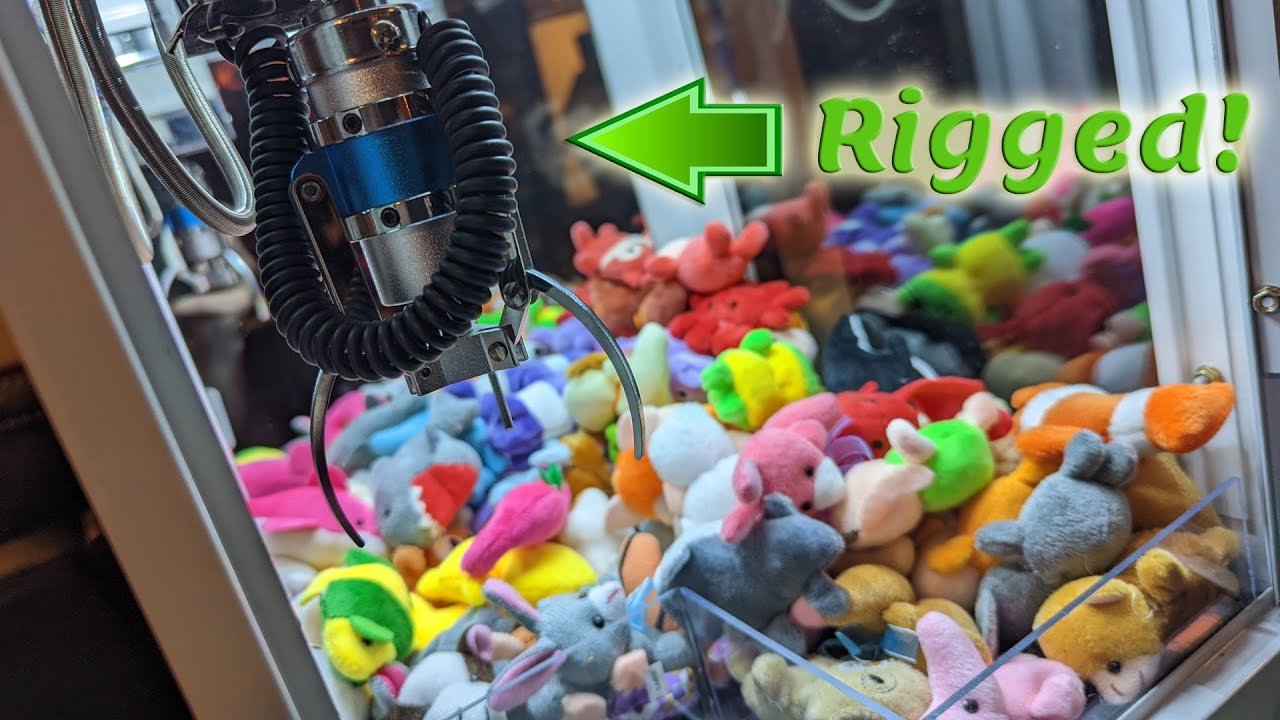
It’s a common belief that claw games are rigged, and while some machines might have settings that make winning harder, many operate within legal guidelines with adjustable grip strength and payout rates.
Have you ever felt the frustration of watching a claw weakly grasp a plush toy, only to drop it moments later? The allure of claw machines is undeniable, yet so many players question their fairness, often wondering, are claw games rigged? It’s a thought that crosses almost everyone’s mind after a few unsuccessful attempts.
This idea leads many people to speculate about the hidden mechanisms behind these popular arcade games. Are they truly games of skill, or are we all just being subtly manipulated?

Are Claw Games Rigged? Unveiling the Truth Behind the Arcade Classic
We’ve all been there, haven’t we? Staring intently at a plush toy, our fingers hovering over the joystick, hoping this time, this time, we’ll finally win that prize. The claw descends, grips, and… well, often it drops the prize right before the chute. This common experience has many people asking the same question: Are claw games rigged? The answer, like most things, isn’t a simple yes or no. It’s more like a complicated “maybe, but probably not in the way you think.” Let’s dive deep into the mechanics, the myths, and the reality of claw machines.
The Mechanics of the Claw
Before we can talk about rigging, we need to understand how claw games actually work. These machines aren’t just about random luck; they involve a blend of mechanical engineering and a bit of psychology. Think of them as sophisticated vending machines with a fun, interactive element.
The Claw Itself
The claw is a pivotal part of the entire game. It’s typically made of three metal prongs, which are meant to grip the prize. But here’s the key: the strength of the grip isn’t always consistent. Most claw machines use an adjustable grip strength, which is decided by the operator. That means the claw might feel strong on one attempt but weak on the next. This variation is not about the claw being “out to get you” but a calculated choice by the game’s owner.
The Software Behind the Scenes
Claw machines have a computer controlling them, not just gears and levers. These computer systems allow operators to adjust several settings. They can change things like how often a strong grip happens, making it less like winning every other turn and more random. This setting is called the “payout rate.”
Payout Rate Explained
The payout rate is a percentage that determines how often a player should win a prize. For instance, a machine with a payout rate of 10% will, on average, allow a win about once every ten tries. This doesn’t mean it’s going to be win on your tenth attempt every single time. Instead, it’s an average, and that’s where the difficulty seems to increase. These payout rates keep the games profitable for the businesses that own them. Some places may even have multiple settings, so that at certain times of the day, the difficulty or payout rate might change. This is not exactly rigging, but it is game management.
The Myth of the “Random” Claw
Often, people believe that the claw is completely random and that you could win at any moment if you are lucky enough. While there is an element of chance, it’s not as random as it appears. The operator controls the probability of a win through that machine’s computer settings. So while luck is definitely involved, so are the game’s internal settings.
So, Are They “Rigged?” The Gray Area
Now, let’s get into the heart of the matter: Is this “rigged?” The term “rigged” often suggests something illegal or unfair. Claw games are generally not rigged in that sense, where the machine is designed to outright steal money from people. The operation is more along the lines of being “carefully controlled.”
Legality and Regulations
In most places, claw machines fall under the category of skill-based games rather than pure gambling. That doesn’t mean there aren’t rules about them. Regulations vary, but typically they are allowed as long as they aren’t advertised as games of chance. They also should be kept at a certain payout rate, and some areas even need regular maintenance and inspection.
The Difference Between Control and Rigging
Control and rigging are not the same. Game operators control the settings of the game to ensure profitability, and that is what they are supposed to do. The difficulty is adjusted to ensure that the prizes are not all given out at once. Rigging, on the other hand, implies deceit, making the game unwinnable regardless of skill. What most people experience with claw games is often not rigging, but the result of controlled payout rates. Most games are kept at a difficulty level where they payout enough to remain popular and still be profitable.
Factors Influencing Your Chances of Winning
While the machine’s settings influence your chances, there are also many other factors that affect the possibility of a successful grab. These include the type of toys in the game, how many toys are in the game, and even the way you play.
Prize Placement and Type
The way prizes are arranged makes a huge difference. If items are stacked tightly together, it is more difficult for the claw to get a good grip on the plush. Also, some toys are harder to grab than others. Items with slick surfaces or uneven shapes can be very challenging. For example, a stuffed animal with many points may be difficult, compared to the classic ball-like ones.
The Weight of the Prizes
Claw games are not just about grip strength. They are also about weight and balance. If a prize is too heavy, the claw will likely drop it, even if it gets a good grip. This is often a reason why you see items dropped even after it looks like you successfully grabbed them.
Machine Condition and Maintenance
A machine that isn’t properly maintained can also make it harder to win. If the claw’s prongs are bent or worn, it might not grip as well. A poorly maintained machine can be harder to win not due to its settings, but simply because it is in bad condition. For these kinds of machines, it may be better to just move on to another game.
Tips and Tricks (or are they?)
Many people have shared “secret” methods for winning claw games. Let’s look at some of the most common “strategies” and see how well they actually work.
The “Jiggle” Method
This involves trying to make the claw move and shake the toy, while it is in the claw, hoping it will get positioned better to grab. This method is not very dependable. If the claw’s grip is weak, all the jiggling in the world will not help. This tactic is probably more wishful thinking, than real tactic.
Going for a “Low Hanging Fruit”
Another suggestion is to target items that are near the opening or on top of the pile. The idea is that they will be easier to grab because they are not surrounded by other items. While this can improve the possibility of a grab, it still doesn’t guarantee that you will win. And again, if the claw strength is weak, the item will not be grabbed effectively.
Playing at Off-Peak Hours
Some claim that machines are set to be easier during slower times, but that has no evidence. While some arcade operators might adjust settings to attract more players when things are quiet, it is not a widely known practice. More often than not, the settings will be the same no matter the time of day.
The “Two Claw” Method
Certain machines have two buttons which control two different claws. The idea is to try and get both claws to work together to pick up one single object. This has a very low chance of success, as it’s very difficult to get both claws in perfect position. More often than not, you will end up wasting your money.
What Actually Works? (Hint: It’s Mostly Luck)
The reality is that there isn’t any way to guarantee a win every time you play. The game is designed to be a bit tricky to beat. The most effective strategies involve patience, understanding the basic mechanics, and perhaps a little bit of luck.
The Psychology of Claw Games
Beyond the mechanics, there is also a bit of psychology at play. These games are designed to be engaging and keep you coming back. Even when you know the odds are not on your side.
The Near-Miss Effect
The “near-miss” is a clever tactic. When the claw almost grabs the prize, it makes you feel like you are very close to winning. This motivates you to keep trying, even if the odds are still against you. It is an intentional tactic, and part of the game design to keep you playing.
The Lure of the Prize
The prizes themselves are a big attraction. The sight of cute or popular toys is intended to make people feel that the effort is worth it. This is not much different than the reason people play arcade games, slot machines, and other prize based games.
The Feeling of “Beating the Machine”
When you win a prize, it gives you a feeling of accomplishment. This feeling is something that people chase, and it is a major part of the overall appeal. It is a feeling of personal victory, no matter how small the prize might be.
Ethical Considerations
It’s important to consider the ethical aspects of claw games. While they may not be “rigged,” are they always fair?
Transparency
One of the issues people have with claw games is that the mechanics are not always transparent to players. Most people don’t know about payout rates or adjustable grip strength. Better communication could help players feel that they are more informed about what they are playing.
Responsible Gaming
Like any other kind of game, it’s important to play claw games responsibly. Set a budget and stick to it. Don’t chase losses by spending more than you originally intended. Remember that these games are for fun, and shouldn’t cause financial stress.
Real Life Examples
Lets take a look at some real-life examples and scenarios regarding claw games and if they are rigged.
Arcade Anecdotes
Think of the times you have seen people play these games. They spend money with no luck, while someone else comes and wins on their very first attempt. This is not proof of the game being rigged. It is just a common aspect of random probability. The game settings are usually designed to give just enough wins, to keep the game attractive. But most people will not win.
The Viral Videos
There are countless videos online of claw games being “exposed” for being rigged. Usually it just shows that games are controlled by payout rates and adjustable claws, not actual rigging. Many people will jump to the conclusion that a machine is rigged, based only on one or two attempts. They do not understand that the game is not designed to make sure everyone wins.
So, are claw games rigged? The answer is nuanced. They are designed with controlled payout rates and variable claw strength, but these are legal and controlled aspects of the game. While that might make it sound unfair, it is just a common practice among many prize-based games. The purpose is to ensure that the businesses that own these machines can remain profitable, and they are not designed to simply steal money from players.
Are Claw Game Machines Rigged?
Final Thoughts
Claw game mechanics often involve adjustable settings, influencing win rates. Skill plays a small part, but machine calibration significantly impacts outcomes. Some locations set the grip strength very low, making success difficult.
Therefore, are claw games rigged? While not always outright scams, they definitely favor the house. Operators control the probability of winning, leading to a frustrating experience. Players should approach these games for fun, not guaranteed prizes.

