
A standard football game consists of 90 minutes of playing time, divided into two 45-minute halves, with a halftime break in between.
Ever found yourself wondering exactly how long you’re glued to the screen, watching those tense matches unfold? It’s a question that often pops up for casual fans and dedicated supporters alike, how many minutes are played in a football game? The answer is actually quite straightforward, although it might feel like an eternity when your team is down by one goal!
The total playtime doesn’t include extra time, stoppages, or the half-time period. Those add extra elements to the experience, making each match a unique, time-bending event.

How Many Minutes Are Played in a Football Game?
Alright, let’s dive deep into the world of football and figure out exactly how much time the players spend on the field during a game. It might seem straightforward, but there are actually some interesting details that go into calculating the total playing time. You might be surprised that it’s not just about four quarters of a set length. We’re going to cover everything from the standard playing time to what happens with extra periods and even talk about the different levels of play, since that can change things up a bit. So, grab your metaphorical helmet and let’s get started!
The Standard Football Game Length
At the professional level, specifically in the NFL (National Football League), a standard football game is divided into four quarters. Each quarter is 15 minutes long, making a total of 60 minutes of scheduled playing time. Now, that’s important to remember: “scheduled”. There’s more to the game clock than just the four 15-minute quarters, but that’s the basic starting point. So, if you were to sit and watch a game, you would see the clock counting down from 15:00, four times throughout the game.
Breaks and Halftime
Football games aren’t just one solid hour of non-stop action, and that’s good for the players! There are essential breaks built into the game for players to rest, strategize, and, let’s be honest, catch their breath. After the first and third quarters, there is a short break, known as a “quarter break”. These intermissions are generally brief, only a couple of minutes long and allow teams to regroup and get ready for the next quarter.
The biggest break happens between the second and third quarters. This is called halftime. Halftime in a professional NFL game is usually 12 to 15 minutes. That might seem like a long time, but it gives the players a significant break and allows for a bit of halftime entertainment, too. At other levels of football, the halftime break may be shorter, but the concept of a halftime break is always there. In addition, timeouts, penalties and injuries can also pause the game clock.
College Football Game Length
College football games also use the concept of four quarters, but they have some small, yet notable differences from NFL games. For instance, the total playing time for a college football game is the same as the NFL: 60 minutes.
However, the college rules for stopping the clock are different. You’ll find that a lot of the stoppages that would end the game clock in the NFL will keep the clock running in college. This can make the length of a college football game quite variable. You might find that one game is much faster and shorter than another in college play.
Different Timing Rules
A key difference lies in how the clock is handled. For instance, in the NFL, the clock stops after an incomplete pass. However, in college football, the clock continues running, unless it’s very close to the end of a half or the ball goes out of bounds. There are other nuances that can affect game time, but these rule differences significantly impact the overall flow and pace of the college game. This results in games that can often feel shorter, even though they have the same amount of scheduled time.
High School Football Game Length
High school football makes another slight alteration in playing time. Rather than the 15-minute quarters used in the NFL and college, the standard high school football game uses 12-minute quarters. This still amounts to four quarters, but now the total amount of scheduled playing time is reduced to 48 minutes.
Reasons for Shorter Quarters
There are a few good reasons for having shorter quarters in high school games. First, these young players might not be physically developed enough to handle the longer quarters. The coaches also want to ensure that the players are safe and not overly fatigued. Second, high school football doesn’t have the same resources as colleges or the pros. Shorter quarters mean fewer commercial breaks, meaning shorter games overall. This makes it easier to schedule games and have a manageable overall schedule.
What Happens When the Game is Tied?
It’s important to understand the difference between a regular game and a game that enters what’s called ‘overtime’. When a game ends in a tie after regulation time, the overtime rules come into play.
Overtime in the NFL
In the NFL, overtime is complex and has undergone changes in recent years. The current rules are designed to end the game as quickly as possible and give both teams a chance to score. In the NFL, if the first team in overtime scores a touchdown, they win. If the first team to possess the ball gets a field goal, then the other team will also get the chance to possess the ball and tie or win the game. If both teams score field goals and/or neither score a touchdown, then the game continues with sudden death (the next score wins). There are also situations where the first team does not score on its first drive, and the game will then continue. Overtime in the NFL can sometimes result in a long extra period. In the regular season, a game can end in a tie if neither team scores in the additional period.
Overtime in College Football
College overtime is quite different. Instead of a sudden death situation, each team gets the chance to start at the 25-yard line. They then have a chance to score. If they do, then the other team gets a chance to score. If a team fails to score, or the other team makes a score of higher value (for instance, a touchdown vs. a field goal), that team wins. In college, overtime continues until a team scores more than the other in a given round.
Overtime in High School Football
High school overtime rules are also different from both the NFL and college. Usually, in high school, teams get a possession to score from the 10-yard line. If a team scores on their possession, then the other team gets a chance to score, and so on. Overtime is very similar to the college rules. This type of overtime continues until one team scores, but the rules might vary slightly depending on the state or league.
The Game Clock vs. Real Time
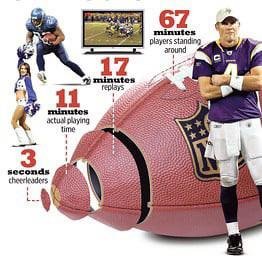
It’s crucial to remember that the 60 or 48 minutes of scheduled game time is not the same as the total time you’ll be watching the game. There’s a difference between the ‘game clock’ and how long you’ll actually be in front of the TV watching. Many things can stop the game clock:
Incomplete Passes: In the NFL, the clock stops after incomplete passes until the ball is snapped again.
Out-of-Bounds Plays: If a player goes out of bounds, the clock stops until the ball is put back into play.
Penalties: If a penalty happens, the clock is stopped while the officials determine the penalty and move the ball.
Timeouts: Teams can call timeouts to stop the clock strategically, giving them a chance to catch their breath, make a game-plan, or make a specific player change.
Injuries: If a player gets hurt, the game stops while medical personnel attend to the player.
Change of Possession: In certain situations, the game clock will stop after a change of possession.
All of these breaks make the actual time a football game takes longer than the listed playing time. While the scheduled game time is 60 or 48 minutes depending on the level of play, it’s not uncommon for an NFL game to take three or more hours from start to finish. College games can also be quite lengthy because of the difference in clock rules, and high school games can run for two or more hours.
Other Factors That Can Affect Game Time
Beyond all of the typical game stoppages, other events can make a football game longer than expected. Here are some factors that can influence game duration:
Commercial Breaks: Football is a very popular sport, so there are often a large number of commercial breaks throughout the game.
Challenges: If a coach believes a call was incorrect, they can throw a challenge flag and have the officials review the call. This process takes some time, further extending the total game time.
Special Events: Sometimes there are special ceremonies or events that are part of a football game, like a presentation at halftime, or a retirement ceremony. These events add to the time spent at the game or watching it on TV.
Variations Around the World
It’s worth noting that rules can vary in different football leagues around the world. Although most leagues adopt the rules from NFL or NCAA, differences do exist:
Canadian Football League (CFL): The CFL features a 12-minute quarter format similar to high school football, with four quarters for a total of 48 minutes of scheduled play.
International Football: In international leagues, variations in rules, like time management and overtime procedures, exist from league to league.
Understanding Game Clock Strategy
Understanding how the game clock works is very important for both coaches and fans. It’s often just as important as the plays that are run on the field. Coaches often use the clock as a weapon to run out time and control the pace of play. In addition, teams with a lead in the fourth quarter will frequently use the clock to their advantage to keep possession of the ball and prevent the other team from scoring.
For fans, understanding how the clock works can make the viewing experience that much more enjoyable. The clock itself is just as much a part of the game as the players, the game plan, and even the football itself.
So, while the listed game time for football is straightforward, many other elements impact how long a game takes from start to finish. This is why football fans often set aside large blocks of time to enjoy watching their favorite teams and games.
The time played on the field is the scheduled game time, which is a set number of minutes depending on the level of play. The actual time you spend watching the game, however, is significantly longer due to many factors which impact the real-time duration of a football game.
Ultimately, whether it’s a high school game, a college game, or a professional match, the duration of a football game is a combination of scheduled time and the many stoppages that can occur throughout a single contest. The clock is an important tool in football, and understanding its nuances adds depth to appreciating the game.
A Beginner's Guide to American Football | NFL UK
Final Thoughts
Therefore, a standard football game features two 45-minute halves. These halves are separated by a 15-minute halftime break. Referees might add stoppage time at the end of each half.
This added time compensates for injuries and other game interruptions. How many minutes are played in a football game, exactly? It is typically 90 minutes of actual play, excluding stoppage time.

