
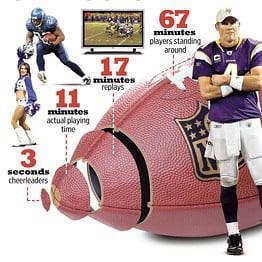
The total playing time in an NFL game is 60 minutes, divided into four 15-minute quarters.
Ever wondered exactly how much time is spent on the field during a professional football match? You often hear about thrilling plays and nail-biting finishes but what about the actual game clock? Many people ask, “how many minutes in nfl game” and it’s a fair question considering all the stoppages.
The clock might be running, or it might be paused, creating a unique ebb and flow. It is this complex time management that gives the game much of its flavor. The 60 minutes of playing time provides the basis for all of that action.

How Many Minutes in an NFL Game? A Deep Dive
Okay, football fans! We all love the excitement of a good NFL game. The big plays, the cheering crowds, the nail-biting finishes – it’s all part of what makes football so much fun. But have you ever stopped to think about just how long a game actually lasts? It’s more than just 60 minutes on the clock, that’s for sure! Let’s break down everything that goes into the total time of an NFL game, from the official rules to those little moments in between plays.
The Official Game Clock: 60 Minutes
First things first, an NFL game is officially timed for 60 minutes. That’s the amount of time the clock runs for the actual gameplay. This 60 minutes is divided into four equal quarters, each lasting 15 minutes. Think of it like four mini-games within one big game. Each quarter has its own unique flow and intensity.
Breaking Down the Quarters
Let’s look at how those quarters break down:
- First Quarter: 15 minutes of game clock.
- Second Quarter: 15 minutes of game clock.
- Third Quarter: 15 minutes of game clock.
- Fourth Quarter: 15 minutes of game clock.
See? Simple enough, right? But that’s not the full story! This 60 minutes is just the clock time. There’s much more that contributes to the total length of a game. There are things like time outs, halftime, and commercial breaks that add lots of extra time.
Why NFL Games Go Beyond 60 Minutes
So, if the game is only 60 minutes of clock time, why do NFL games usually take around three hours to finish? It’s because of all the stoppages in play. The clock isn’t always running, and that’s where the extra time comes in. Here are some of the main reasons why:
Timeouts
Each team gets three timeouts per half. These are when the clock stops, so coaches can talk with their players and plan their next moves. A timeout could be a quick break, but it still adds to the total time.
Halftime Break
Between the second and third quarters, there’s a longer break called halftime. This is a 12-15 minute break in NFL, time for teams to rest, regroup, and make any necessary adjustments. It’s also when fans get a chance to stretch and get ready for the second half of the game.
Commercial Breaks
This is a big part of why games last so long. Commercial breaks happen between quarters, after touchdowns, after extra points, after field goals, after penalties, and during timeouts. They’re necessary for broadcast television, and that time really adds up. Think of it this way, while you might be using the restroom, having some snacks or talking with your friends, the game is still not running. This is one of the things that make NFL games so long and keep those of us watching engaged and entertained while we have a moment of a break.
Penalties
When a penalty occurs during the play, the clock stops. The referees will explain the penalty, and the teams line up again to continue play. This takes some time, and often causes replays, adding more to the total time. Some penalties also result in moving the ball forward (or backward), and it always means extra time off the clock.
Injuries
If a player gets hurt, the game clock stops while they receive medical attention on the field. The clock remains stopped until the injured player is off the field and the game can resume. The time this takes can vary depending on how serious the injury is.
Instant Replay and Reviews
Referees sometimes need to look at a play again, using instant replay to make sure they make the right call. They might be checking to see if a player was out of bounds, if a catch was made, or for a penalty that might have been missed. The process of reviewing a play takes extra time off the clock.
Incomplete Passes and Out-of-Bounds Plays
Whenever there’s an incomplete pass or a player goes out of bounds, the game clock stops. This allows the players to reset and get ready for the next play. These stops may only last a few seconds, but they happen frequently throughout the game, and they add up.
The Two-Minute Warning
At the end of the second and fourth quarters, there’s an automatic two-minute warning. This is a break in the play to let teams know how much time they have left in the quarter. The clock stops after the two-minute warning and starts again when the play resumes.
How the Clock Works: A Deeper Look
The NFL clock isn’t always running. It’s not like a regular clock where the minutes just keep ticking away. It stops and starts quite often. Let’s look a little more closely at when the clock starts and stops during a game:
When the Clock Starts
- After a kickoff
- After a completed pass or a player is tackled in bounds.
- When the ball is snapped following a change of possession.
When the Clock Stops
- After an incomplete pass.
- When a player runs out of bounds.
- When a penalty occurs.
- During timeouts.
- After a score (touchdown, field goal, or extra point).
- During an injury timeout.
- During an official review.
- At the two-minute warning.
So, you can see there are lots of reasons why the clock might stop, and this is why the actual length of an NFL game is quite long and can feel like more than just the 60 minutes on the game clock.
The Average Length of an NFL Game
Given all of those stoppages, the average NFL game lasts about 3 hours. It’s important to understand that this time is only an average. Some games will take less time, while others can take longer, especially if there are a lot of close calls, injuries, or reviews, or especially when there are overtime periods.
Factors Affecting Game Length
Several factors can affect how long a game ends up taking, including:
- Number of scoring plays: More touchdowns and field goals mean more breaks for extra points and kickoffs.
- Number of penalties: More penalties mean more stops, referee discussions, and replays, taking up more of the game’s time.
- Close games: Tight, exciting games can have more timeouts and reviews in the fourth quarter, making them longer.
- Injuries: Serious injuries that require more attention and time on the field will add more time to the game clock.
Overtime
If a game is tied at the end of the fourth quarter, it goes into overtime. The rules for overtime have changed over time, but now, if each team gets a chance to possess the ball, they get a chance to score in overtime to win the game. Overtime can last up to 15 minutes. If a touchdown is scored on the first possession then the game ends, but if any other score occurs or no score is made, then the other team will get the chance to score. This can add another 15-20 minutes on average to the game length if needed.
Understanding the Time Element in Football
Understanding the time in a football game is a big part of understanding the game itself. It’s not just about the clock, it’s about strategy. Coaches and players carefully manage the clock, they use timeouts and other strategies to make the most of every minute.
How Coaches Use Time
Coaches use time to their advantage. They will decide to call timeouts to stop the clock, change players, and discuss the plays. They also need to be aware of the game clock at all times. For example, if a team is behind late in the game, they may use timeouts to stop the clock to try to score points, so that their opponents will not run out the clock.
How Players Use Time
Players also need to be aware of the time. Quarterbacks might take more time to huddle with the team before the next snap to make the most of time remaining, while running backs may stay in bounds instead of running out of bounds to keep the clock going. Clock management is a big part of a team’s strategy.
So, while the official game clock is 60 minutes, the actual time spent watching a football game is much longer. Between timeouts, halftime, commercial breaks, and all the other stops in play, a typical NFL game will usually fill about three hours of your day. Now, the next time you are watching a game, you’ll know why it takes so long to complete one!
A Beginner's Guide to American Football | NFL UK
Final Thoughts
So, a standard NFL game consists of 60 minutes of play. This game time is divided into four 15-minute quarters. There are also stoppages for timeouts and other situations that make the actual time spent watching longer.
Determining ‘how many minutes in nfl game’ is quite straightforward, it is 60 minutes. Keep in mind that the overall broadcast may run much longer than this due to commercials and halftime.

