
A strategy is strictly dominated if another strategy always yields a better outcome for a player, regardless of what other players do.
Ever wondered about those situations where one option is just always inferior? In game theory, we have a term for this: strictly dominated. So, what does strictly dominated mean in game theory? It’s a concept that helps us analyze strategic interactions, showing when a player has a clearly suboptimal choice.
Essentially, if a strategy is strictly dominated, a different strategy always gives that player a higher payoff, no matter what choices other players make. This dominance makes the inferior strategy, quite logically, something to avoid.

What Does Strictly Dominated Mean in Game Theory?
Alright, let’s dive into the fascinating world of game theory! It might sound like something from a super-secret spy movie, but it’s actually a way of thinking about how people make choices when those choices affect others. One of the key concepts in game theory is “strictly dominated.” Don’t let the fancy words scare you – it’s simpler than it sounds. Basically, a strategy is strictly dominated if there’s another strategy that always gives a better result, no matter what the other players do.
Understanding the Basics: Strategies and Payoffs
Before we can really understand strictly dominated strategies, let’s make sure we’re all on the same page with some basic ideas. In game theory, a strategy is simply a plan of action that a player chooses. For example, in a game of rock-paper-scissors, a player’s strategy could be “always choose rock.” A payoff, on the other hand, is the reward or outcome a player receives after making their choices. Payoffs can be anything – money, points, or even just the satisfaction of winning.
What is a Game?
A “game,” in the game theory sense, isn’t necessarily a fun, recreational activity. It’s any situation where people (or companies, countries, etc.) make choices that affect each other’s outcomes. Think about a chess match, business competition, or even deciding who gets the last slice of pizza – these are all “games” in the eyes of a game theorist. In such a game, everyone is trying to maximize their own payoff, and these payoffs are always interdependent on the choices of other players.
Representing a Game: Payoff Matrices
Games are often shown using what’s called a payoff matrix. This is just a table that shows all possible choices for each player and the resulting payoffs. Let’s take a look at a simple example:
Imagine two friends, Alice and Bob, are playing a game. They each have two choices: either “Cooperate” or “Defect.” Here’s how their payoffs might look:
| Bob | ||
|---|---|---|
| Cooperate | Defect | |
| Alice | Cooperate (3, 3) | (0, 5) |
| Defect (5, 0) | (1, 1) | |
In this matrix, the first number in each pair is Alice’s payoff, and the second number is Bob’s payoff. For example, if Alice chooses “Cooperate” and Bob chooses “Defect,” Alice gets a payoff of 0, and Bob gets a payoff of 5. We also call this a normal form game representation.
Defining Strict Domination: Always Worse
Now that we have these basics down, we can properly define a strictly dominated strategy. A strategy is strictly dominated if another strategy provides a better payoff for the player, no matter what the other players choose to do. In simple terms, if you have a strictly dominated strategy, you’re always better off choosing something else. It’s like having a button you should simply never press. Let’s go back to our game with Alice and Bob.
Analyzing Alice’s Strategies
Look carefully at Alice’s options in the payoff matrix. Let’s analyze what happens if she chooses “Cooperate”. If Bob also chooses “Cooperate”, she gets 3. But if Bob chooses “Defect”, she gets 0. Now, let’s consider what happens if she chooses “Defect”. If Bob chooses “Cooperate”, she gets 5. And if Bob chooses “Defect”, she gets 1. No matter what Bob does, Alice’s payoff is always higher when she chooses “Defect” than it is when she chooses “Cooperate”. We say “Defect” strictly dominates “Cooperate”.
Why is it “Strictly”?
The word “strictly” is important. It means that the dominating strategy must give a strictly better outcome for a player in every possible situation. If there is even one instance where the dominated strategy is not worse than the other, then it is not a strictly dominated strategy. Let’s consider what is not strict domination. A strategy is weakly dominated if it is no better in one case and better in every other case. A weakly dominated strategy can be rationalizable, unlike strictly dominated strategy which is never rationalizable. Let’s take a look at an example of a weak domination to differentiate between the two.
| Bob | ||
|---|---|---|
| Left | Right | |
| Alice | Top (2, 2) | (1, 1) |
| Bottom (2, 2) | (0, 0) | |
In this game, “Bottom” is weakly dominated by “Top”. If Bob chooses “Left”, then both strategies for Alice gives a payoff of 2, but if Bob chooses “Right” then “Top” gives a payoff of 1 to Alice, while “Bottom” gives a payoff of 0. So “Top” is better in one case and no different in other case. Because of this no difference, we call it weak domination. We can eliminate “Bottom” in this case and it does not change any prediction.
The Power of Elimination: Finding the Best Strategies
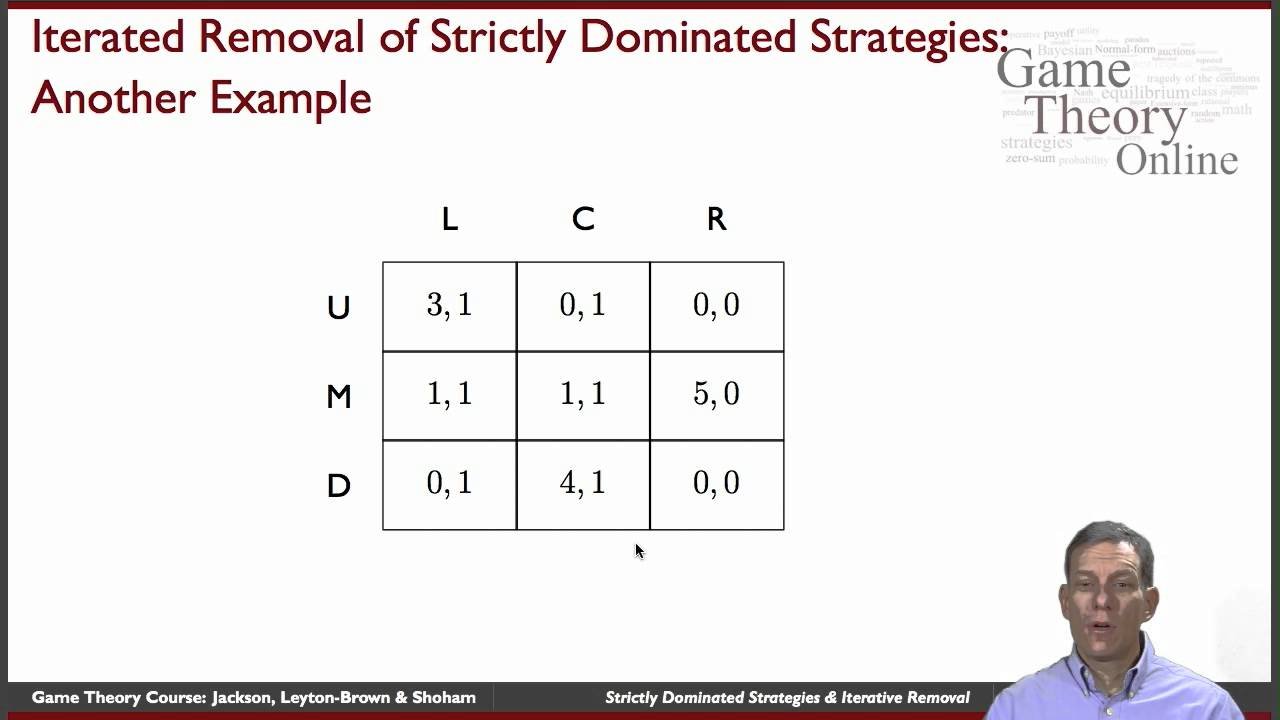
Now, why is knowing about strictly dominated strategies so helpful? Well, it lets us simplify games by eliminating choices that no player would ever rationally make. This is known as iterated elimination of strictly dominated strategies. Let’s examine this idea in details.
Iterated Elimination of Strictly Dominated Strategies (IESDS)
The idea is simple: if a strategy is strictly dominated, no rational player would ever choose it. So, we can remove that strategy from the game. This might reveal new strictly dominated strategies that we can then remove, and so on. We can perform this elimination until we arrive to an outcome or no further strategies can be eliminated.
Let’s look at a more complex game to see this process in action:
| Bob | |||
|---|---|---|---|
| X | Y | Z | |
| Alice | A (3, 4) | (5, 2) | (1, 6) |
| B (2, 3) | (4, 5) | (3, 3) | |
| C (1, 5) | (2, 4) | (0, 7) | |
In this game, Alice has strategies A, B, and C, while Bob has X, Y, and Z.
- Step 1: First, let’s analyze Alice. By carefully examining the payoff matrix, we can see that strategy C is strictly dominated by strategy B. If Bob picks X, A gives 3, B gives 2, and C gives 1. If Bob picks Y, A gives 5, B gives 4, and C gives 2. If Bob picks Z, A gives 1, B gives 3, and C gives 0. So, no matter what Bob picks, B is always strictly better than C. We can eliminate strategy C for Alice.
- Step 2: Now we have a reduced game.
Bob X Y Z Alice A (3, 4) (5, 2) (1, 6) B (2, 3) (4, 5) (3, 3) - Step 3: Let’s consider Bob’s choices. Comparing X, Y, and Z, we can see that Z is strictly dominated by Y, since 4 < 5, 2 < 5 and 6 < 3.
Bob X Y Alice A (3, 4) (5, 2) B (2, 3) (4, 5) - Step 4: Now, we have a reduced game again. Let’s consider Alice again. By comparing A and B, we see A is strictly dominated by B. If Bob picks X, A gives 3 and B gives 2. If Bob picks Y, A gives 5 and B gives 4. We eliminate A
Bob X Y Alice B (2, 3) (4, 5) - Step 5: And now we can see that Bob will pick Y. This leaves us at (B, Y) as outcome, which was arrived at by iterated elimination of strictly dominated strategies.
By eliminating strictly dominated strategies step-by-step, we have simplified the game to the point where we can predict the outcome or the equilibrium.
Real-World Examples
Strictly dominated strategies aren’t just theoretical curiosities; they appear in many real-world situations. Let’s consider a few examples:
Business Competition
Imagine two competing companies deciding whether to invest heavily in advertising or not. If one company invests a lot in ads, then the other company’s revenue will be severely affected if they do not invest in advertisements. However, both company’s advertisements will also be affected by other company’s advertisements, if both of them invest heavily. However, it is easy to see that not investing in advertisements is a strictly dominated strategy for both players.
- If the other company does not advertise, a company makes more money advertising than not advertising
- If the other company advertises, a company makes more money advertising than not advertising
Therefore, a rational company would always advertise in this case.
Environmental Issues
Consider a scenario where several countries share a common resource, like a fishing ground. If each country fishes as much as possible (a “defect” strategy), the resource will quickly become depleted, hurting everyone. However, if all other players cooperate, it is always best for a country to defect. Therefore, cooperation is a strictly dominated strategy. This example shows how game theory can help understand challenges in international cooperation and resource management.
Auctions
In a common value auction, where the value of a good is the same for everyone, bidding above one’s private estimate is a strictly dominated strategy. This is because by bidding more, you risk winning at a price higher than the actual value, which will lead to a loss. So, rational bidders will always bid below their private estimate and not bid above their true value.
Limitations of Strict Domination
While the concept of strictly dominated strategies is powerful, it’s important to acknowledge its limitations. Not all games have strictly dominated strategies. In a game of rock-paper-scissors, for example, no single strategy is always worse than the others. The best strategy is to pick randomly. Therefore, IESDS can’t be applied to the game of rock-paper-scissors. Additionally, in a game, if no strategy is strictly dominated, IESDS can’t help to determine an outcome. Therefore, other techniques, like Nash equilibrium, have to be used to analyze a game.
Furthermore, the assumption of rationality is very crucial in this concept. The process of elimination only makes sense if all the players are perfectly rational. In real life, players can make mistakes or behave irrationally, due to bounded rationality. Therefore, elimination of strictly dominated strategies, though a very useful concept, is not a magic wand that can give us an outcome in every game, and we must consider that.
Finally, let’s discuss a concept related to strictly dominated strategies that is important to understand and differentiate. A dominant strategy is a strategy that is always the best choice for a player, regardless of what other players choose. On the other hand, a strictly dominated strategy is a strategy that is always a worse choice, irrespective of other players’ actions. In simple terms, a dominant strategy is always the optimal pick, while a strictly dominated strategy is something a player should always avoid. Note, there may not exist any dominant strategy in a game, but if there is one, it is always a best-response strategy.
In summary, understanding strictly dominated strategies is very important for understanding the foundation of game theory. These strategies can often be identified using a payoff matrix. By understanding it, we can predict better rational strategies for players in different kinds of games, from economic competition to everyday decisions. However, we should be aware of its limitations, and use other techniques if required.
Game Theory 101 (#3): Iterated Elimination of Strictly Dominated Strategies
Final Thoughts
In game theory, a strictly dominated strategy yields a worse outcome for a player than another available strategy, regardless of what other players choose. The dominating strategy always gives a better payoff. Therefore, a rational player will never pick a strictly dominated strategy.
What does strictly dominated mean in game theory? It means a particular strategy is inferior and illogical to use. Players always prefer to pursue the dominating strategy over the dominated one, leading to predictable outcomes.

