
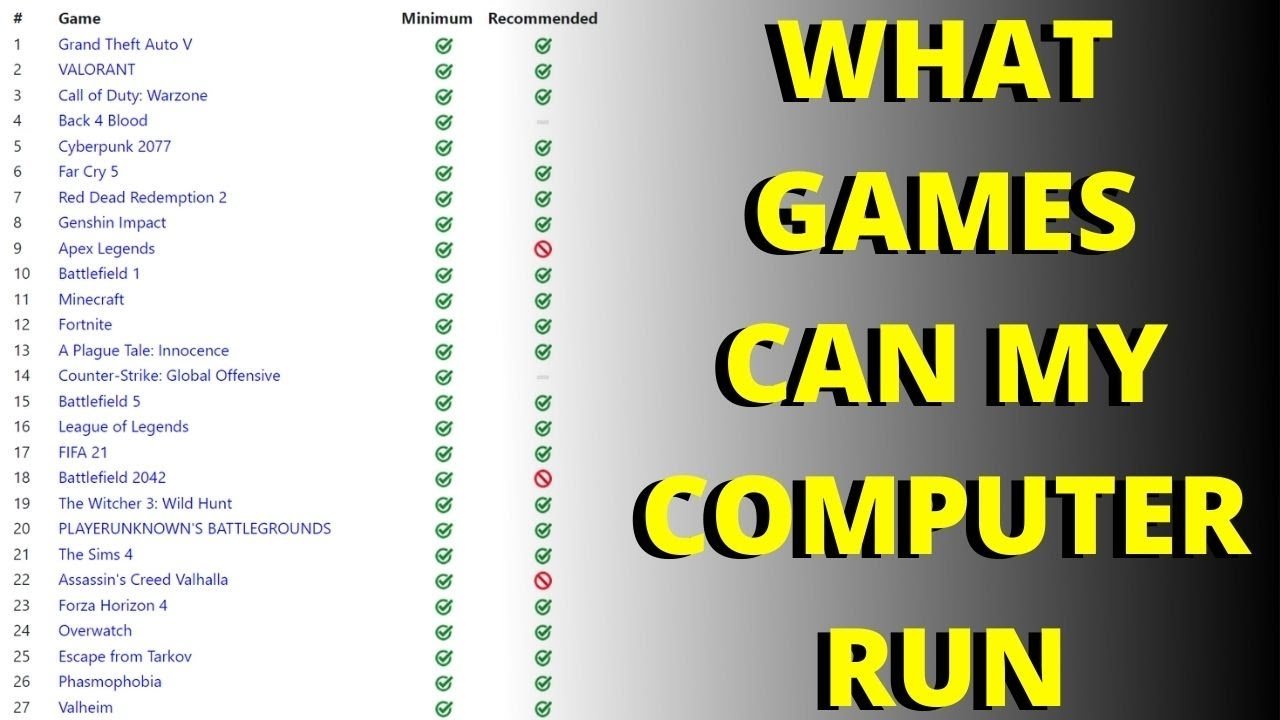
Unfortunately, without knowing your laptop’s specific hardware, I cannot say precisely what games will your laptop run. However, I can guide you on how to find out by checking your laptop’s specs and matching them against game requirements.
Ever wondered, “what games will my laptop run?” It’s a common question for many gamers. Figuring out if your machine can handle that new release is key to a smooth gaming experience. No one wants to buy a game only to find it is unplayable.
Don’t worry, we can break down how to find out which titles will work on your laptop. Knowing the specs is half the battle, so we will explain how to locate that vital information. Then, you can compare your hardware to the requirements of games you’re interested in.

What Games Will My Laptop Run?
So, you’ve got a laptop and you’re itching to play some games! That’s awesome! But before you go downloading the latest AAA title, it’s good to know what your trusty machine can actually handle. Not all laptops are created equal when it comes to gaming. Some are powerhouses, while others are better suited for homework and browsing the web. Figuring out where your laptop fits in the gaming spectrum is the first important step. This article will help you understand what makes a laptop good for gaming and give you the tools to figure out what games you can play.
Understanding Your Laptop’s Specs
The secret to knowing what games your laptop can handle lies in its specifications. Think of these specs as your laptop’s gaming “muscles.” The more powerful the muscles, the more demanding the games it can run smoothly. Let’s break down the most important parts:
The Central Processing Unit (CPU)
The CPU is like the brain of your laptop. It does all the thinking, processing all the information in a game. For gaming, you need a CPU that can handle a lot of instructions quickly. Look for CPUs from Intel (like Core i5, i7, or i9) or AMD (like Ryzen 5, 7, or 9). Higher numbers usually mean better performance. For example, an Intel Core i7 will generally perform better than an Intel Core i5, and a Ryzen 7 will generally perform better than a Ryzen 5. If you have a lower end processor such as an intel celeron or pentium, it might only run older and less demanding games. Don’t worry if you don’t understand all of the nuances of processors, the next section will cover the “minimum” and “recommended” specifications of games.
The Graphics Processing Unit (GPU)
The GPU is the superstar when it comes to gaming visuals. It’s responsible for rendering all the images you see on the screen. A good GPU is a must for smooth gameplay and high-quality graphics. For gaming, look for dedicated GPUs from NVIDIA (like GeForce GTX or RTX series) or AMD (like Radeon RX series). Again, the higher the number generally the better the gaming experience. For many laptops, they have integrated graphics. An integrated graphics card shares resources with the CPU and will not offer the same performance as a dedicated graphics card. For example, Intel UHD Graphics and AMD Vega Graphics are examples of integrated graphics, and they will typically only play older and less graphically intense games.
Random Access Memory (RAM)
RAM is like your laptop’s short-term memory. It helps your laptop juggle multiple tasks at the same time. For gaming, you need enough RAM to handle the game itself, as well as any background programs you may be running. 8GB of RAM is typically the minimum for many modern games, but 16GB or more is recommended for a smoother experience. If you run out of RAM, your game might become slow or crash. More RAM is usually better for gaming.
Storage (Hard Drive or Solid State Drive)
Your storage is where your games are installed. While storage speed doesn’t directly impact gameplay performance (once the game is loaded), it does impact loading times. Solid State Drives (SSDs) are much faster than traditional Hard Disk Drives (HDDs). Games installed on an SSD will generally load much faster. A faster loading speed will allow you to start playing your game sooner! The most important part is the capacity. The bigger your storage, the more games you can install on your laptop. For most people, at least 250GB of storage is needed if you are planning to play multiple games.
Finding Game Requirements
Every game has a set of requirements that will tell you if your computer can play the game. These requirements list the minimum specifications needed for a game to run, along with what specifications are recommended to run the game better. This will include details on the needed CPU, GPU, RAM, storage, and even what version of operating system you need. These specifications can be found on websites like the Steam, Epic Games Store, and the game publisher’s websites. Lets learn how to interpret these requirements.
Minimum System Requirements
The minimum system requirements tell you the lowest specifications your computer needs to run the game at all. Games will probably run at low graphical settings, with lower frame rates. This may mean you may experience lag and other issues. The game may run, but may not be a very enjoyable experience. It’s usually a good idea to make sure you meet or exceed the minimum requirements if you can.
Recommended System Requirements
The recommended system requirements tell you the hardware specifications needed to run the game at a better visual fidelity. Typically, the recommended system requirements are for when you want the game to look as intended by the game developers and for you to experience the game with smooth gameplay and high frame rates. If you meet the recommended specifications you will generally have a much better experience.
Comparing Your Laptop Specs to Game Requirements
Once you know your laptop specs and the requirements for a game, it’s time to compare! Here’s how you can do it:
- Find Your Laptop Specs: Look for your laptop’s original box, check your laptop’s settings, or search for your model number online to find its specifications. In Windows, you can often find basic specs in “System Information”.
- Find Game Requirements: Search online for the game’s system requirements (e.g., “[Game Title] System Requirements”). You will probably find the minimum requirements and recommended requirements.
- Compare: Compare your laptop specs to both the minimum and recommended requirements.
- If your laptop meets or exceeds the recommended requirements, the game should run great!
- If your laptop meets the minimum requirements, the game should run, but possibly at lower settings.
- If your laptop doesn’t meet the minimum requirements, the game might not run at all, or it might run very poorly.
Examples of Different Game Types
Let’s look at different types of games and what you can expect them to run on.
Simple 2D Games
These games are generally less demanding. Games like Stardew Valley, Terraria, or old retro games usually run well even on basic laptops with integrated graphics. They tend to be very processor and gpu friendly. Generally if a laptop is able to run, and browse the web, it can handle these 2d type games.
Indie 3D Games
Indie games are often designed to run well on a wide range of computers, but if they use 3D graphics they can be more taxing than 2D games. Games like Minecraft, Hollow Knight, and Among Us can usually run on basic laptops with integrated graphics, but may run better with a dedicated graphics card, especially if you are planning on having high graphical settings.
AAA Games
AAA Games are the big-budget, graphically intense games like Cyberpunk 2077, Assassin’s Creed, or Red Dead Redemption 2. These games are generally very demanding, often needing a powerful CPU, dedicated graphics card, a large amount of RAM, and a fast storage. A laptop with only integrated graphics and less than 8GB of RAM may struggle, while a laptop with a dedicated graphics card and 16GB or more of RAM may have an enjoyable experience.
Online Multiplayer Games
Online multiplayer games can fall into any of the above categories. However, they also have network considerations. You’ll want to make sure your internet connection is fast and stable for a smooth gaming experience. Some of the more demanding multiplayer games include Fortnite, Call of Duty, and Battlefield.
Using Online Tools to Help
There are websites that can check your computer specs and tell you if a game will run on your system. These can be very helpful! They scan your computer specs and compare them to game requirements. Some popular ones include:
- Can You RUN It: This website checks your system specifications against a large library of games.
- Game Debate: This website has in-depth information on games and hardware.
These websites can usually be a great starting point and will make the process of finding suitable games very easy for you.
Adjusting Game Settings for Performance
Even if your laptop can run a game, it might not run at the best settings. You can often improve performance by adjusting the game’s graphic settings, often found in the settings or options menus in-game. Some of these adjustments include:
- Lowering the graphics quality: Reduce settings like texture quality, shadow quality, and effects quality to help with performance.
- Reducing the resolution: Decreasing the resolution may improve performance, but might make the game appear less sharp.
- Turning off special effects: Disable or reduce motion blur, depth of field, and other special effects that can put extra strain on your GPU.
- Playing in windowed mode: Sometimes playing the game in windowed mode will improve performance.
Experiment with these settings to find the right balance between graphical quality and smooth gameplay. You may need to sacrifice graphics quality for performance if your laptop does not meet recommended system requirements.
Understanding the Impact of Laptops
Laptops are not always the best for gaming due to the fact that they are generally less powerful than their desktop counterparts. Laptops are built to be portable, which means their components are often smaller and less powerful. This can affect your gaming experience. Furthermore, laptops can often overheat, especially when playing graphically demanding games. It is recommended to ensure proper cooling and ventilation to ensure that you don’t overheat your system, which can lead to a worse gaming experience.
If you prioritize gaming performance above all else, you will generally get a better experience with a desktop computer. Desktop computers can have more powerful components and have better cooling solutions.
Tips for Better Gaming on a Laptop
Here are a few things you can do to make the most of gaming on your laptop:
- Keep your drivers up to date: Make sure you have the latest drivers for your GPU, as these are often optimized for the newest games.
- Close background programs: Close any unnecessary programs to free up system resources for your game.
- Keep your laptop cool: Use a laptop cooling pad if necessary to prevent overheating.
- Use the right power settings: Make sure your laptop is plugged into power, and select the “performance” power plan for the best performance.
Finding out what games your laptop can run doesn’t have to be confusing! By understanding your laptop’s specs, researching game requirements, and making a few adjustments, you can have a fun time playing your favorite games. Remember, it’s all about finding the right balance between performance and visual quality. So go ahead, explore your gaming options, and have some fun!
Play Games On ANY Laptop, Mac Or PC! – Nvidia GeForce NOW Review
Final Thoughts
The games your laptop can run depend heavily on its specs. Integrated graphics mean you should focus on older or less demanding titles. Dedicated graphics cards greatly expand your options to newer, visually rich games.
To determine what games will my laptop run, check the game’s minimum and recommended system requirements. Compare these with your laptop’s processor, RAM, and graphics card. Websites like “Can You Run It” simplify this process.
Remember, your laptop’s specific components and their performance level directly influence which games work smoothly. Choose games that fit comfortably within its capabilities to have enjoyable gameplay.

