
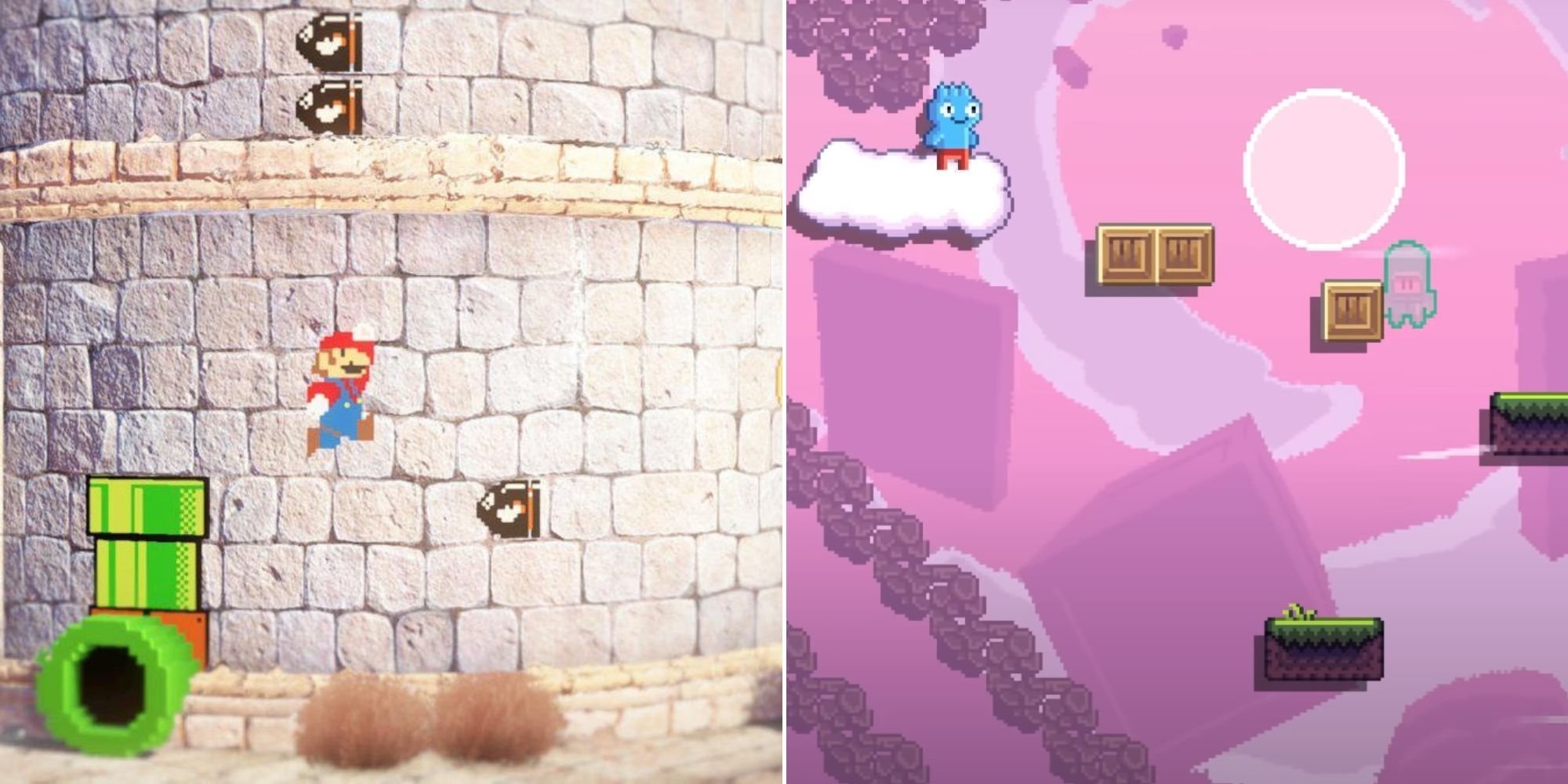
The primary reason 3D games replaced 2D ones lies in their ability to offer a more immersive and visually realistic experience for players.
The gaming landscape evolved dramatically, a change most of us have witnessed. We’ve gone from simple sprites moving across a flat screen to vast, explorable worlds rendered in three dimensions. Why have 3d games replaced 2d ones? This is a question many gamers ponder.
It’s not just about graphics, though. The shift allowed for more complex gameplay mechanics and narratives. 3D environments offer depth and a sense of freedom that was impossible in the two-dimensional realm.

Why Have 3D Games Replaced 2D Ones?
Let’s dive into why 3D games have become the kings of the gaming world, leaving 2D games often feeling like a trip down memory lane. It’s not that 2D games are bad; they still hold a special place in many gamers’ hearts. But, there are some pretty strong reasons why 3D took the crown. This transition is about much more than just pretty graphics; it’s about how we experience games and the stories they tell.
The Allure of Immersion: Stepping Into the Game
One of the biggest reasons for 3D’s rise to fame is the feeling of immersion. What does that mean? It means that when you play a 3D game, you feel like you’re actually in the game world. You can walk around, look up at the sky, and peek behind corners. It’s like you’re there with the characters, exploring the world they inhabit. 2D games, on the other hand, typically show you the world from a fixed side-view or top-down perspective. This limits how much you feel like you are actually part of the action.
Feeling Present: The Power of Perspective
Imagine playing a game where you control a little knight. In a 2D game, you see him moving left or right, jumping, and maybe swinging his sword from the side. But in a 3D game, you can move the camera and see him from behind, from the front, or even close-up to see the details of his armor. This change in perspective makes the game feel much more real and engaging. You’re no longer watching a flat picture of a knight; you’re actually guiding a character through a world. This increased immersion creates a stronger connection between the player and the game.
More Than Just Pretty Pictures: The Depth of Gameplay
The advantage of 3D graphics extends beyond just aesthetics. It actually changes the gameplay possibilities. Think about a game with a big, open world. In 2D, this would be tough to create effectively. You might only see a small portion of the world at a time. However, with 3D, you can explore vast landscapes, climb mountains, and swim through rivers, all without artificial boundaries or screen transitions. This freedom is a major draw for players, as it adds a level of interaction and exploration that was simply not possible in 2D gaming.
The Technological Leap: Rendering Realities
The move to 3D wasn’t just about wanting prettier games; it was also driven by advancements in technology. As computers became more powerful, game developers were able to render complex three-dimensional environments. This ability to create realistic shapes, lighting, and textures helped bring game worlds to life. 2D games are limited by their flat, two-dimensional space, making it harder to achieve the same level of visual detail and realism.
Polygon Power: Building Worlds Block by Block
3D game worlds are built using polygons—small, flat shapes that are joined together to form objects and environments. The more polygons a game has, the more detailed and realistic it can look. Early 3D games might have looked a little blocky because they had fewer polygons. Over time, computer hardware became more efficient at processing these polygons, leading to the incredibly detailed visuals we see in today’s 3D games. This increased processing power allowed designers to create complex animations, lighting effects, and intricate environments that 2D games simply couldn’t match.
Beyond Flat Sprites: The Shift in Character Design
Character design also evolved with 3D gaming. In 2D games, characters are usually made up of sprites, which are flat, two-dimensional images. 3D allows characters to become fully realized models that can rotate, bend, and express a wider range of emotions. This adds another dimension to character interaction and storytelling, making the game characters feel like real people within the game’s fictional world.
Gameplay Opportunities: Expanding the Game Space
The change to 3D gaming didn’t just improve the visuals; it also opened up new possibilities for gameplay. 2D games are often limited in how they can be designed. Because everything is viewed from a side-on or top-down perspective, movement and interaction are often constrained to a single plane. With 3D, the gameplay is unrestricted. You can have games with verticality, complex puzzles involving space, and the ability to interact with the environment in new and varied ways. For instance, imagine sneaking through a 3D level; you can hide behind objects, look around corners, and take advantage of the depth of the environment to outsmart your opponents. This is harder to do in a flat, 2D space.
The Rise of Open Worlds: Freedom to Explore
One of the biggest impacts 3D gaming had was the introduction of open-world games. These games allow you to roam freely in a large, seamless environment. In a 2D game, open worlds are possible, but they’re often structured differently because of the perspective. In 3D, you can truly explore vast landscapes, discover hidden places, and interact with the world in ways that 2D games just can’t facilitate. Games like “Grand Theft Auto,” “The Legend of Zelda: Breath of the Wild,” and “Skyrim” wouldn’t be possible in their current format without the ability to render and interact with a full 3D world. This freedom is a key reason why many players gravitate toward 3D experiences.
More Sophisticated Combat and Mechanics
Combat in 3D games can also be much more complex than in 2D games. 3D allows for different ranges of attack, positional advantages, and more elaborate animations, and even strategy-based gameplay . For example, in a 3D fighting game, you might have to dodge projectiles in the background and from above and below. In a first-person shooter, you must account for depth when aiming at targets that are far away. These elements are much harder to pull off in a typical 2D game format because of the limited perspective. This also extends to puzzles. 3D games can utilize perspective tricks, spatial reasoning, and many other ideas that just don’t translate well to the 2D game environment.
The Business Side: Popular Demand and Market Trends
It’s also worth noting that the shift to 3D was driven partly by market demand. As 3D games became more technologically possible, they also became what most people wanted to play. The excitement around experiencing realistic worlds and innovative gameplay mechanics led publishers to invest more heavily in 3D game development. As more popular 3D games were released, they set a trend that influenced the rest of the industry. This created a kind of loop: better technology made better games, and better games created more demand.
The Impact on Development: Costs and Resources
The shift to 3D gaming did also have an impact on game development. 3D games typically require more resources and money to develop. Creating detailed models, complex animations, and expansive environments requires larger teams of artists, programmers, and designers. This increased cost meant that smaller developers sometimes struggled to compete with large studios. However, as technology becomes more accessible and development tools become more user-friendly, we are seeing more indie developers explore 3D. It’s all about the evolution of technology, and how the possibilities evolve.
2D Games Still Thrive: Niche Markets and Nostalgia
While 3D games are dominant, 2D games are far from gone. Many players still love 2D games for their simple gameplay, creative art styles, and nostalgic feel. 2D games often focus on tight controls, clever level design, and engaging storytelling. There is a thriving market for these types of games within the indie game world. They are also common in mobile gaming, as they are often easier to create and perform well on mobile devices. Games like “Stardew Valley,” “Hollow Knight,” and “Celeste” show that 2D games can be just as compelling and engaging as their 3D counterparts, and are often beloved for their own unique style.
A Comparison: 3D vs. 2D
Let’s make a simple comparison table to visualize some of the key differences:
| Feature | 2D Games | 3D Games |
|---|---|---|
| Perspective | Fixed side-view or top-down | Free camera, can view from any angle |
| Immersion | Limited sense of being in the world | Strong sense of being in the game world |
| Graphics | Flat sprites, limited detail | Polygonal models, more detailed textures |
| Gameplay | Movement in a 2D plane, can have unique game mechanics | Free movement in 3D, more interactive environments |
| World Design | Often linear or small | Can be open-world, large and seamless |
| Combat | Simple movement, 2D animations | Complex movement, strategic depth, varying attacks |
| Development | Simpler, often lower cost | More complex, often higher cost |
| Market | Still popular, especially in indie and mobile gaming | Dominant, widely popular |
As we can see from the table, while 2D games have their own strengths, 3D games have offered a different range of possibilities in many aspects, leading to their current dominance.
In short, the shift from 2D to 3D gaming was a result of several factors, including technological advances, the desire for more immersive gameplay, and market demand. While 2D games continue to have a loyal fanbase, the innovation in 3D games has shaped modern gaming into what we experience today.
Gamedev Explains: Why mix 2D & 3D?
Final Thoughts
3D games offer greater immersion and a sense of presence that 2D games often lack. The added dimension allows for more complex environments and gameplay mechanics. This significantly contributed to the shift we’ve witnessed.
Players generally find the realism of 3D more engaging, driving demand. The advancements in technology made 3D development more accessible over time. Now we can really see why have 3d games replaced 2d ones. The visual impact is a must for contemporary gaming experiences.

