
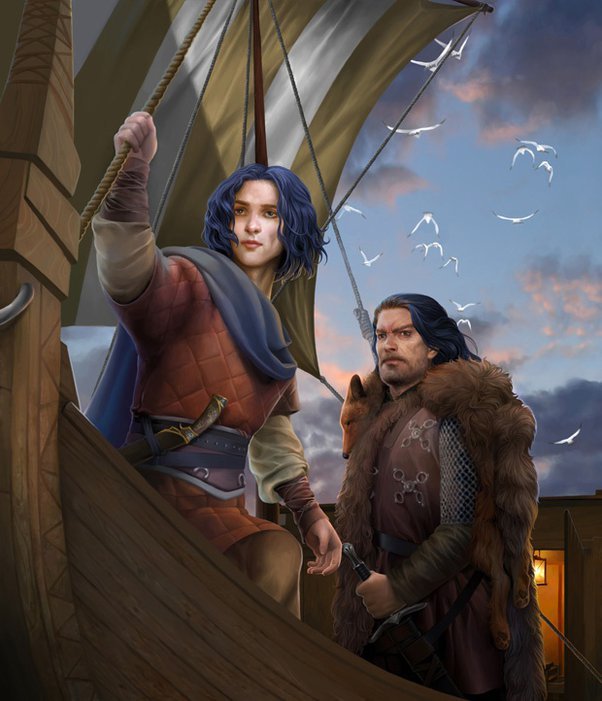
Young Griff’s storyline was omitted because the show’s writers chose to simplify the plot, removing some characters and subplots from George R.R. Martin’s books.
Why is young griff not in game of thrones? It’s a question that puzzles many fans of the book series A Song of Ice and Fire. The character, a significant player in the later novels, has no representation within the HBO adaptation.
Showrunners made many choices to fit the story into a limited number of episodes. Characters were cut, storylines combined and others changed completely. Young Griff is one such character who sadly didn’t make it to the screen.

Why is Young Griff Not in Game of Thrones?
So, you’ve watched all of Game of Thrones, and maybe you’ve even read the books by George R.R. Martin. You might be wondering, “Hey, wait a minute! Where’s this Young Griff character everyone talks about?” Well, you’re not alone. Young Griff, also known as Aegon Targaryen (but maybe not the Aegon Targaryen), is a big deal in the A Song of Ice and Fire book series, but he’s completely missing from the HBO show. Let’s dive into why he was left out, and what that means for the story.
The Sheer Complexity of the Plot
One of the biggest reasons Young Griff didn’t make it onto the screen is just how packed the Game of Thrones storyline already was. Think about it: we had the Starks, the Lannisters, the Targaryens, the Greyjoys, and so many more families vying for power. Introducing another major player, especially one with a confusing backstory like Young Griff, could have made things too complicated for the TV show’s pacing and structure. Remember the initial shock when we learned about R+L=J (Rhaegar and Lyanna are Jon’s parents)? Now imagine adding another potential Targaryen heir into the mix! The writers and producers had to make choices about which characters and storylines to focus on, and unfortunately for Young Griff fans, his was deemed not essential for the television adaptation.
The Challenge of Adapting a Complex Character
Young Griff’s story is not straightforward. In the books, he is introduced as a young man being groomed to take the throne, with a whole history and backstory carefully constructed. He is raised by Jon Connington, a former Hand of the King, who believes in his legitimacy. But, is he really who he claims to be? This ambiguity is a central part of his character arc in the novels. To translate this to television and capture the nuances of a character shrouded in mystery and uncertain identity would have been a monumental task. It would demand significant screen time, careful acting, and precise exposition. The showrunners might have felt it was a risky investment of time that might confuse casual viewers who did not have the background knowledge from reading the books. They might have worried about losing the show’s audience with this addition, when they had other established character arcs to address.
Time Constraints and Pacing Issues
TV shows have limited screen time. Unlike books where you can dedicate entire chapters to different character’s stories, television needs to fit everything into a specific number of episodes per season. Game of Thrones had a lot of ground to cover, from the White Walkers to the fight for the Iron Throne. Adding another major character like Young Griff would have meant cutting other material or extending the show longer than the producers planned. The show already struggled with pacing in later seasons, and adding Young Griff would likely have further complicated that. The show’s producers, David Benioff and D.B. Weiss, wanted to tell a clear and concise narrative and, ultimately, decided Young Griff’s story was not essential to their telling of the main plot.
The Show’s Deviation From Book Plotlines
The television show started by adapting George R.R. Martin’s first few books quite faithfully, but it gradually started to deviate from the source material as the books progressed and the television show outpaced the novels. The show ended while the book series remains incomplete. By the time the show reached the point in the storyline where Young Griff should have been introduced, the show had already made so many significant changes, and the showrunners chose to tell the story in their own way. This meant omitting characters and plotlines that, while important in the books, didn’t necessarily fit with their specific goals for the adaptation. The showrunners’ focus was on the narrative as it had been established, and it is evident they made the decision to cut character elements that they deemed unnecessary for a television format.
The Narrative Focus on Existing Characters
Instead of introducing Young Griff, the show focused more on the already established character arcs, especially those of Daenerys Targaryen and Jon Snow. These characters had been built up since the beginning of the series, and their journeys were already complex and engaging enough. They had a clear path towards the Iron Throne. The writers made the decision to condense the narrative and focus their efforts on these core storylines. Introducing a whole new Targaryen claimant at a late stage could have undermined the established paths of Daenerys and Jon. The show runners opted for a streamlined story that allowed them to reach their planned conclusion for established characters more easily.
Jon Snow’s Targaryen Lineage
The show invested heavily in the reveal of Jon Snow’s Targaryen lineage and his claim to the throne. This took up substantial screen time, and the emotional impact of this storyline was something that resonated deeply with many viewers. If Young Griff had been added to the story, he would have competed with Jon for the ‘rightful heir’ claim. This could have muddied the emotional impact and simplified the story by adding another character to this specific narrative path. In the context of television adaptation, the decision to streamline character paths, is not unusual and usually leads to a better viewing experience for audiences.
Concerns Over Redundancy
Introducing Young Griff could have created redundancy in the narrative. Both he and Daenerys are positioned as potential Targaryen claimants to the throne, and it’s likely that the showrunners felt that having two similar characters would make the plot too repetitive. Instead, they made a conscious choice to have Daenerys take on the role of a more complex and nuanced queen, someone who viewers initially rooted for but who ultimately fell victim to the corrupting nature of power. The showrunners had a clear vision for the path of Daenerys’s character, and it would not have been simple to incorporate Young Griff’s narrative path without making significant changes to the story that they wanted to tell.
Simplifying the Plot for a Broader Audience
Television storytelling often aims for clarity and accessibility, especially for a show like Game of Thrones that had a global audience. Adding a complex character like Young Griff, who challenges the lineage and legacy of the most significant characters in the story, could have alienated casual viewers. While book fans appreciate the complexity of characters and sub-plots, television often demands more straightforward character arcs. The decision to not introduce Young Griff was likely a calculated move to keep the central story as focused and easy to follow as possible, ensuring the show appealed to a broad audience.
The “Fake Aegon” Theory
A significant part of Young Griff’s storyline in the books is the question of whether he is really Aegon Targaryen, the son of Rhaegar who was supposedly killed as a baby. Some readers and fans believe he is a pretender, perhaps a Blackfyre descendant, and not a true Targaryen. This theory adds even more complexity to his character and storyline. The show probably felt that this level of ambiguity and the debate surrounding his identity would not translate well to television. They did not have enough time in their final seasons to address this intricate aspect, so they opted to leave it out completely. This aspect of Young Griff’s identity is not only complex, but requires viewers to be heavily invested in the historical lore of the universe, and this kind of character detail might not translate effectively on-screen for casual television viewers. The producers opted to focus on the core and widely known narrative strands that would have greater appeal to a broader audience.
The Impact of Omitting Young Griff on the Show
The omission of Young Griff definitely had an impact on the show’s overall plot and the conclusion of certain storylines. It led to some book readers feeling like the show’s narrative was incomplete and that a major piece of the puzzle was missing. By excluding Young Griff, the show simplified the succession struggle for the Iron Throne and chose to tell a story that primarily focused on the established character paths of the major players. This decision, while streamlining the narrative, removed some of the deeper political intrigue and moral questions that Young Griff’s story presented in the books. It allowed the show to reach a conclusion faster, but also created a feeling of something essential being missing for hardcore readers. It made sense for the producers to focus on known characters for the show, but it is still something that long-term readers find hard to reconcile.
In Summary
So, why isn’t Young Griff in Game of Thrones? It boils down to a mix of practical reasons like time constraints, pacing, and the desire for a more streamlined narrative, as well as creative decisions about which characters and storylines were most crucial for the television adaptation. While his absence is certainly a disappointment for book fans, the show made a choice to prioritize the stories of its existing main characters and to tell a particular version of the overarching story. The complex nature of his character and the narrative, and the potential for redundancy, likely made him a less than ideal fit for the television medium.
3 Reasons Young Griff IS Aegon Targaryen | Winds of Winter Theories
Final Thoughts
Young Griff’s absence from the show stems from adaptation choices. The showrunners opted to simplify the plot, excluding this complex storyline. This decision significantly altered the book’s narrative arc.
Why is Young Griff not in Game of Thrones? It is primarily because the writers chose to omit many characters. His plotline, while important in the books, posed a challenge to fit into a compressed season. The change also affected other characters’ destinies.

