
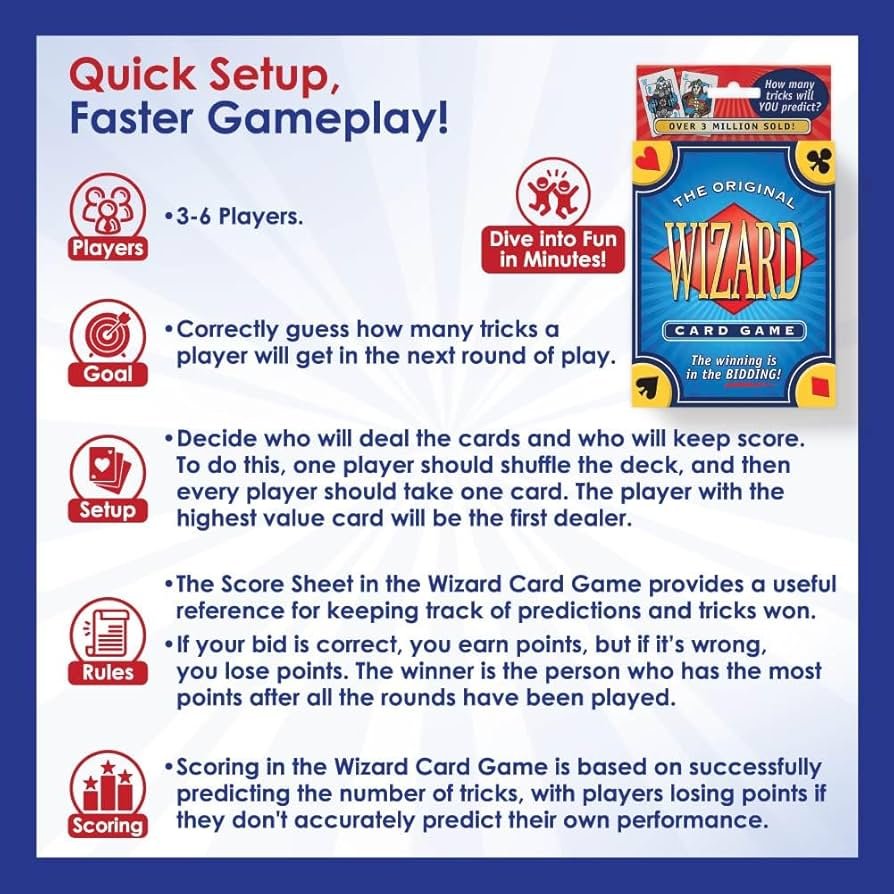
Playing Wizard involves bidding on the number of tricks you think you’ll win each round, followed by playing cards to try and meet your bid; points are awarded for correct bids and tricks taken.
Ever wondered about the intriguing world of Wizard? It’s a trick-taking game with a twist, where predicting the future becomes part of the challenge. Many find themselves asking, “how to play wizard card game?”.
This game combines strategy with a bit of luck. It tests your ability to read your opponents and to plan ahead. This guide will provide a clear path to understand how the game works, so you can start playing quickly and enjoy it.

How to Play Wizard Card Game
Okay, let’s dive into the exciting world of Wizard, a trick-taking card game that’s more than just luck! It’s a game where you need a good strategy and a bit of guessing to win. If you like games like Hearts or Euchre, you’ll probably have a blast with Wizard. This guide will break down the rules so you can start playing right away and show off your card-playing skills.
Understanding the Basics of Wizard
Before we get into the nitty-gritty, let’s cover some fundamental concepts that are key to playing Wizard. Understanding these will make learning the rules much easier.
The Deck
Wizard uses a standard 52-card deck, just like the one you might use for poker or other card games. However, Wizard also uses a special deck, usually with cards labeled “Wizard” and “Jester”. Sometimes the same deck is used, but they add jokers or remove a card and relabel a card as a “wizard” or “jester.” So, be sure to know which way your group prefers to play. The number of these special cards depends on the rules and number of players. Usually they would include 4 wizards and 4 jesters in a deck. If you don’t have a special Wizard deck, you can use a regular deck, with Aces (high cards) acting as Wizards and 2s (low cards) acting as Jesters.
Regardless of what cards are used as wizard or jester, here’s what they do:
- Wizards are the most powerful cards and always win the trick. Think of them as the superheroes of the game! If more than one wizard is played in the same round, the first wizard card played in that round wins the trick.
- Jesters are the opposite of Wizards; they always lose the trick, no matter what other cards are played. These are like the jokers of the game, but they can actually be helpful in certain situations.
The other standard cards have a rank and a suit. The suits include hearts, diamonds, clubs, and spades, like a normal deck of cards, and they’re ranked from 2 (lowest) to Ace (highest).
The Goal of the Game
The goal of Wizard is to correctly predict how many tricks you think you’ll win each round. Each round, you make a “bid” or estimate of how many tricks you think you’ll take. You score points when your bid matches the actual number of tricks you won, so precision is key.
Number of Players
Wizard is most fun with 3-6 players. It can work with two players, but there are some adjustments to be made which will be discussed later. With more players, the game gets even more interesting, and you need to pay close attention to the cards being played.
Setting Up the Game
Before you start playing, you need to get the game ready. This involves shuffling the deck and dealing out cards.
Dealing the Cards
The dealer changes each round. The player to the left of the previous dealer normally becomes the new dealer, continuing this way throughout the game. This creates a nice rotation for who gets to deal each round. The number of cards dealt varies each round. In the first round, each player gets one card, in the second round, each player gets two cards, and so on until the last round where each player has the most cards they can have. The final round depends on the number of players, so some games may last longer than others. The number of rounds and the number of cards dealt in each round follows a special formula.
- With 3-4 players, the game has 15-20 rounds.
- With 5 players, the game has 10 rounds.
- With 6 players, the game has 8 rounds.
As an example, if you have 4 players, in round one, each player will get 1 card. Round two, each player gets 2 cards, and so on until round 15, where each player gets 15 cards. After that round, the game will be over.
After dealing the cards in a particular round, the dealer then places the remaining cards in the center and turns over the top card. The suit of the top card becomes the “trump” suit for that round. If a player does not have the lead suit, and trumps are played, then that player wins the round.
For example, if the top card is the three of hearts, then hearts are the trump suit for that round. If the top card is a Wizard or a Jester, then there is no trump suit for that round.
Bidding
After you’ve received your cards, it’s time to bid. Bidding is where you predict the number of tricks you think you’ll win. Starting with the player to the left of the dealer, each player states how many tricks they’ll try to win this round. In Wizard, there is a key rule about bidding: the bids can’t add up to the total number of tricks available in each round. For example, if there are three players in a round where they each get 3 cards, then the total number of possible tricks in that round is 3. If one person bids 1 trick, then the other 2 players can’t bid 1 each, because that would add up to three. To help with bidding, it is best to go in order around the table as the bids are stated.
Here is a simple example:
If you have been dealt 3 cards, and the trump suit is hearts, and you have the Queen of hearts, the 2 of diamonds, and 7 of spades, then you would most likely bid only 1 trick, because you only have one card with a trump suit. If, on the other hand, you have three heart cards such as the King, Queen, and 10, then you might bid 3 tricks because you are very likely to win those rounds with those trump cards.
If a player has a wizard card, they might be more likely to bid one trick. If a player has a jester, they are less likely to bid any tricks.
Keep in mind that you need to look at the cards you have, the cards the other players are bidding, and the trump suit to make a smart and reasonable bid. Bidding can often be the most difficult aspect of playing the game, and it improves with more practice. It’s also important to note that bidding isn’t an exact science. Sometimes the cards will play out in surprising ways, and you won’t always win the number of tricks you bid. You might bid zero tricks and still accidentally win a trick!
Playing a Round of Wizard
Once the bids are in, the game begins. Each player will have to play one card each time, and each player will continue to take a turn until no more cards are left. This is called “playing the hand.”
Leading the Trick
The player to the left of the dealer leads the first trick. This means they play any card from their hand that they want to play. This first card determines the “lead suit” for that trick. For example, if the leading player plays the 10 of clubs, the lead suit is clubs.
Following Suit
Each player after the leading player must then play a card. If a player has a card of the lead suit, they must play it. If they do not have a card of the lead suit, they may play any other card, including a trump card. A player may also play a Wizard or a Jester if they do not have the lead suit.
Winning a Trick
Once everyone has played a card, it’s time to determine who won the trick.
- If one or more Wizards are played, the first Wizard played wins the trick.
- If no Wizards are played, but a trump suit is in play, then the player with the highest trump card wins the trick.
- If no trump cards or wizards are played, then the player who played the highest card of the lead suit wins the trick.
- If one or more Jesters are played, then the last player to play the jester loses the trick.
The player who wins the trick takes all the cards and places them in a pile in front of them. The winner of the trick then leads the next trick.
This process repeats until all players have played all the cards in their hand. Now the round ends and it is time to calculate your score.
Scoring in Wizard
Keeping score is a key part of Wizard, so here’s how it all works:
Matching Your Bid
If you successfully won the exact number of tricks you bid, you earn 20 points plus 10 points for each trick you bid. For example, if you bid 2 tricks and won exactly 2 tricks, you would get 40 points. (20 points + 2 tricks x 10 points/trick = 40 points)
If you do not win the exact number of tricks you bid, then you will lose 10 points for every trick that you are off. For example, if you bid 2 tricks and only won 1 trick, then you would lose 10 points. (20 – (2-1) x 10 = -10 points). If you bid 2 and won 3, you would also lose 10 points (20- (3-2) x 10 = -10).
If you bid 0 and win no tricks you get 20 points for each round you bid 0. For example, if you bid 0 tricks and win 0 tricks, you would get 20 points. If you bid 0 tricks and win 1 trick, you would lose 10 points. There is a high risk, high reward when bidding 0 tricks.
Keeping Track of the Score
It’s a good idea to keep score on paper or use a score tracker app or website if you want to be more high tech. After each round, total up everyone’s points. The player with the most points at the end of the game wins.
Here’s a simple table to help keep track:
| Round | Player Name | Bid | Tricks Won | Score |
|---|---|---|---|---|
| 1 | Amy | 1 | 1 | 30 |
| 1 | Ben | 0 | 0 | 20 |
| 1 | Carl | 1 | 0 | -10 |
| 2 | Amy | 2 | 1 | -10 |
| 2 | Ben | 2 | 3 | -10 |
| 2 | Carl | 1 | 1 | 30 |
Tips and Tricks for Winning at Wizard
Wizard isn’t just about the cards you’re dealt; it’s about how you play them and also being able to be adaptable to your opponent’s playstyle. Here are some tips to help you gain an edge:
Pay Attention to the Bids
Knowing how many tricks the other players bid can help you decide what to play and when. For example, if you know someone needs only one more trick to fulfill their bid, and you know you won’t win the round, you may want to take the trick to avoid giving the other player the points.
Keep Track of Cards
Try to remember the high-value cards that have been played and what suits have been depleted or used up. If all of the heart cards have been played and you have the Queen of hearts, then it is almost certain that you will win the trick when you lead with that card.
Use the Jesters Wisely
While Jesters usually lose, they can also be useful. For instance, if you are sure you’re going to win a trick, you might want to play the Jester to get rid of the annoying low card or to make another player win the trick when you don’t want to.
Don’t Be Afraid to Bid Zero
Bidding zero can be a powerful strategy if you have mostly low cards and Jesters. The reward is high, and sometimes it’s easier to avoid winning tricks than it is to try to win them. But beware, the risk is high too, because if you bid 0 and end up winning one, you’ll be penalized with negative points.
Modifications for Two Players
Playing Wizard with two players involves some adjustments to make the game more interesting. You’ll still deal cards and bid but you will also use a “dummy” hand.
- The Dummy Hand: After dealing, you set aside a “dummy” hand. It will consist of the normal number of cards for any given round. During gameplay the “dummy” hand plays their cards for the lead suit or trumps but does not bid, and does not collect tricks. These cards are always played face-up.
- Gameplay: One player bids, while the other player must play the “dummy” hand for that round and also plays their own cards to win.
Wizard is a fantastic game for all ages. It combines strategy, luck, and a bit of psychology, making each round unique and fun. This guide should help you get started, so why not grab some friends, deal the cards, and give it a go?
How To Play The Original Wizard Card Game
Final Thoughts
To play, predict how many tricks you’ll win each round. Trump suit changes per round adding an interesting variable. Bidding accurately scores big points, making it a must to think strategically. Players then follow suits, the highest card wins the trick.
The player who has predicted right scores a bonus. This score goes up or down based on bid and wins. In conclusion, how to play wizard card game involves skillful bidding, clever play and adaptation. This makes each round a unique, engaging challenge.

